
If you’ve ever looked into the mechanical trades, you’ve probably heard people use steamfitters and pipefitters almost like they’re the same thing. You’ve probably wondered about the difference between a steamfitter and a pipefitter. Honestly, at first glance, they do seem similar. But if you look closer — and you really should if you’re thinking about this as a career — the difference between steamfitter vs pipefitter becomes clearer.
So let’s slow things down and walk through what each job actually involves, what a typical day looks like, how much they earn, and what it takes to get into each trade.
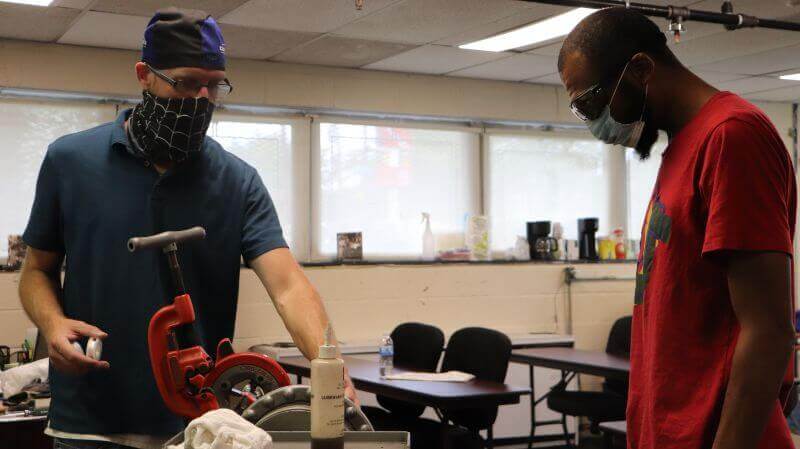
A lot of people ask, almost casually, “What is a steamfitter?” And the most straightforward answer is: a skilled tradesperson who installs, maintains, and repairs high-pressure piping systems — especially systems carrying steam, superheated water, chemicals, fuel, or other high-temperature / high-pressure substances.
But that’s the simple version.
In real life, steamfitters often work in places like:
Steam systems are dangerous — there’s no sugarcoating that — so steamfitters learn a very technical, exact style of mechanical work. Because of this complexity, the steamfitter job description typically includes interpreting blueprints, performing heavy-duty welding, performing advanced pipe fabrication, and adhering to highly detailed installation standards.
These vary by industry, but the work often includes:
Alongside all of this, the job requires deep awareness of safety, because hazards in steamfitting — from extreme heat to pressure bursts — demand alertness every single day.

Now, answering the natural follow-up: what is a pipefitter?
A pipefitter works with piping systems too, but the systems they handle may carry water, gas, compressed air, or other mechanical fluids at moderate or high pressure. Sometimes they work in industrial settings, or commercial, or even residential too. It really depends on the job site.
Where steamfitters are more locked into industrial environments, pipefitters might be found in:
Due to this variety, the pipefitter job description is broader than people expect. Pipefitters can work on chilled-water systems, gas lines, fuel systems, hydronic heating systems, and occasionally steam systems — but only to the extent their licensing allows.
Typical responsibilities include:
They also need familiarity with the unique differences between commercial piping trades and industrial piping — different tools, different regulations, and different materials.

This is where the conversation gets interesting. You’ll see the phrase steamfitter vs pipefitter appear again and again online, and people tend to oversimplify it. But truly understanding the difference between steamfitter and pipefitter means you have to look at several layers:
Steamfitters work on:
Pipefitters work on:
So although there’s overlap, a steamfitter’s world tends to involve more risk, more pressure, and often more technical regulations.
A steamfitter will almost always be in an industrial plant or massive commercial energy facility. Meanwhile, a pipefitter might jump between industrial sites and residential jobs — installing a hydronic loop one week and helping build a hospital’s mechanical floor the next.
Both use welding tools, cutters, benders, and threading equipment, but steamfitters handle specialized high-pressure tools, advanced testing devices, and thicker materials built to withstand extreme stress.
This is where the higher technical complexity of steam systems shows up.
Both trades require hands-on technical training, but steamfitters must study high-pressure hazards, specialized code compliance, and advanced thermodynamics. Pipefitters focus more on a range of fluid systems, installation codes, and cross-trade coordination.
Steamfitters manage extreme pressure systems, so the risk profile is significantly higher. Pipefitters also handle hazardous materials but with wider variation depending on the job site. So yes, both roles are physically demanding — but steamfitting leans more toward the “every minute counts” type of environment.
That’s why many people start as pipefitters and later move into steamfitting — a natural career path, pipefitter to steamfitter progression.
People don’t always ask out loud, but they always think it: “Who gets paid more?”
The simple answer is: both earn great money, but steamfitters often edge higher because of risk, skill, and industrial specialization.
A steamfitter’s salary tends to sit at the upper end of the mechanical trades. High-pressure systems demand precision and more advanced licensing, which boosts earning potential.
Meanwhile, the pipefitter salary range can vary widely depending on whether the work is industrial, commercial, or residential. Industrial pipefitters usually earn as much as steamfitters, sometimes slightly less, but residential-focused pipefitters may earn noticeably less.
In short, salary comparison steamfitter vs pipefitter shows steamfitters making a bit more on average, but location and union involvement matter too.
Here’s where things get more concrete for people looking to enter the trade.
A steamfitter apprenticeship typically lasts 4–5 years and includes:
Many people go through a trade school for steamfitter before applying to a union program.
A pipefitter apprenticeship also lasts 4–5 years and covers:
Some begin in a trade school for pipefitter program to strengthen their foundation first.
Both trades usually require:
And depending on the region, separate pipefitter certification or steamfitter certification may be required to work on specific systems.
Both trades need hands-on intelligence more than anything. But they each have a slightly different mix of skills.
Even though the two paths share tools and techniques, the mechanical habits each role develops day-to-day are very different.
It depends on the environment you enjoy, the pressure (literal and figurative!) you can handle, and the industry you want to grow in. If the idea of working around massive boilers, turbines, energy plants, and high-pressure systems excites you, steamfitting might be your path. If you like varied environments — commercial buildings, residential work, industrial systems — pipefitting might feel more balanced.
By understanding the real distinction in the steamfitter vs pipefitter conversation — from training, to risk, to salary, to work environment — you’ll make a far more confident choice. And whichever direction you choose, the mechanical trades aren’t going anywhere. They’re expanding, shifting, and becoming even more essential as industrial and commercial systems get more complex.
If you’re heading toward an apprenticeship, a trade school, or you’re simply exploring the industrial piping trades, trust yourself enough to learn the details first—the right fit matters. The right environment matters. And the trade you choose will shape a long, stable career.
Read More-