
Midlife career change is becoming the strategic move of choice for professionals in 2026 who are tired of the “Zoom gloom.” So, you’ve been working your way up the corporate ladder for ten or twenty years, but it feels more and more like a treadmill.
Fortunately, the “Standard Script” for success has officially changed by 2026. Whether you’re sitting in front of your computer, wondering whether there’s a job that will make you happier and pay you more without needing another Master’s degree, a midlife career change into the skilled trades might be the finest thing you’ve ever done.
When you change jobs at 30 or 40, you’re not merely starting over; instead, you’re making a purposeful shift. You have soft skills like project management and crisis resolution that an 18-year-old hasn’t learned yet. In addition, your maturity acts as a catalyst for faster career growth.
Let’s talk about the “why” before we go into the “how.” A lot of people are afraid that they are “too old” to undertake an apprenticeship.
However, the average age of a construction worker is currently 42. Employers are really looking for mature apprentices because you show up on time and know how to interact with customers.
In 2026, businesses will have a huge talent gap. As the older generation retires, they need someone who can both work and lead. Furthermore, being able to read a room is just as vital as being able to read a plan. This makes a midlife career change a bit easier and allows one to go into management faster.
In most trade programs or schools, people get paid apprenticeships when they finish. This is different from a university, where you have to pay to attend a lecture hall.
From the first day on the job, you get paid. While you might have to take a brief pay cut during your first year (beginning at roughly 50% of a journeyman’s compensation), by the final year, many tradespeople are making more money than their old desk-bound coworkers.
You want to land somewhere profitable if you’re going to take the leap. These are the big names for 2026: trade jobs that pay well without a degree.
This is the best of the skilled trades. You are in charge of the complicated mechanisms that make our vertical cities work.
It has more to do with mechanical logic and fixing electrical problems than with brute force. Moreover, it takes a certain amount of patience and attention to detail that comes with age.
Forget about wiring homes; the real money is in data centres, hospitals, and electric vehicle infrastructure. A midlife career change to electrical work in your 40s is good for your mind and keeps up with new technology.
Installing solar grids and wind turbine parts is a huge development area in 2026. Similarly, green infrastructure requires a high level of technical precision.
Using robots and PLCs (Programmable Logic Controllers) in factories.
If you want to advance swiftly, schools like the Philadelphia Technician Training Institute (PTTI) provide intensive vocational programs that will help adults get into the profession quickly and well. Specifically, the focus on hands-on learning ensures you don’t only read books but also learn the skill.
There is an enormous demand for Airframe and Powerplant (A&P) specialists due to the current success of the tourism industry.
Since this is a field that requires a lot of accuracy, it rewards those with high focus. If you like logistics and are very detail-oriented, you’ll do better in a controlled hangar than on a muddy building site.

It’s not simply about mending furnaces anymore. In 2026, it includes smart building automation and energy efficiency at a high level.
Every building on Earth needs to be kept at a comfortable temperature. This makes it one of the highest-paying trades that can survive a recession. In fact, demand only increases as smart-home technology evolves.
Basic welding is a fun hobby; however, specialized welding is a fast-paced job for those who want a strategic midlife career change.
Very important for infrastructure and the energy sector.
High danger, but it pays some of the best wages in the physical labor world.
You wouldn’t jump out of a plane without a parachute, would you? Likewise, this is how to keep your pivot into skilled trades safe.
Before you begin, don’t give up your day job just yet! Find out what the “Journeyman” rate is in your city. Then, visit places or offices to find out which high-paying trades are most in demand in your area.
Your resume shouldn’t merely say “Marketing Manager” when you apply for paid apprenticeships. Instead, it should put “Stakeholder Communication” and “Complex Problem Solving” front and center. Ultimately, your history of being professional is your best edge over other qualified tradespeople.
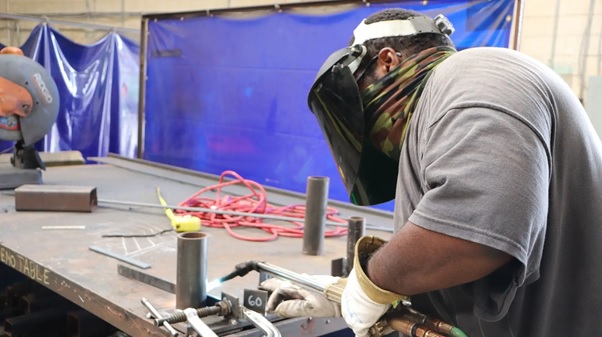
The Union Route (for example, IBEW for electricians). While this is the greatest option for people who want to get paid apprenticeships with benefits, the queue can be long.
On the other hand, in the trade school route, you get your certifications faster. With hands-on help, schools like PTTI can help you make the transition from your previous job to your new one much better. If you can’t wait two years to start a new employment, short-term trade programs are generally the best option.
To be honest, your back isn’t the same as it was when you were 20. Therefore, before you start, buy the best boots, knee protectors, and a good stretching program. As a result, you will avoid the common burnout. Most elderly persons who quit trade programs don’t do so because of the labor; they do so because they didn’t take care of their joints.
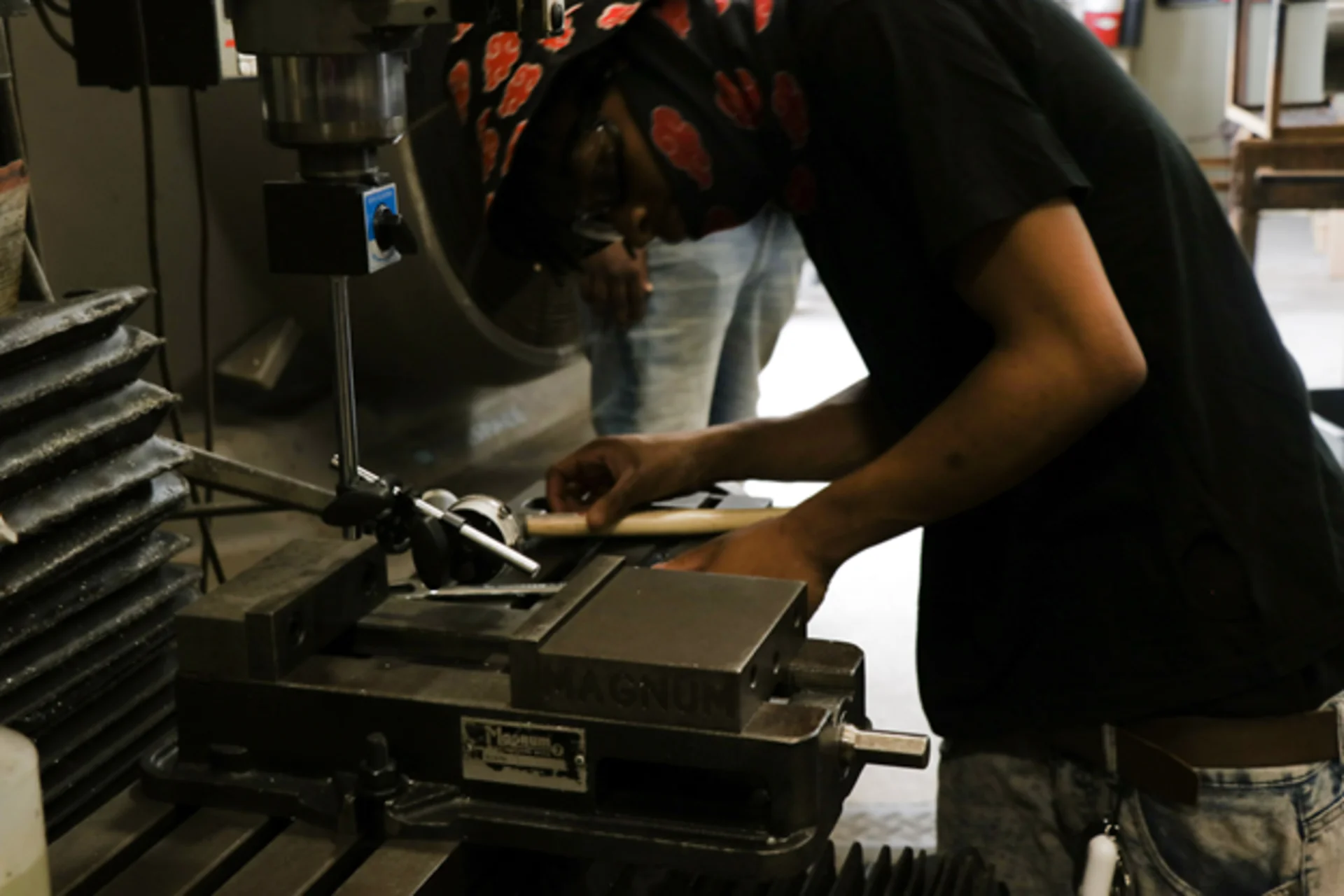
Midlife career change or changing jobs whatsoever doesn’t mean you failed; alternatively, it means you grew. People who can create, fix, and keep up the backbone of our civilization are needed in 2026.
To summarise, you’re not “starting over.” You’re using 20 years of life experience to get a better, more stable, and more successful uniform. The skilled trades give you a future where you can see the effects of your work every day. So, why stay in a cubicle for another year?
Q: Am I too old to get paid apprenticeships?
A: No way. Actually, employers like people in their 30s and 40s because they are dependable. Your maturity level helps keep job sites functioning properly.
Q: Are there actually trade jobs that pay well and don’t require a degree?
A: Yes. For instance, speciality jobs, like elevator mechanics or speciality welders, sometimes pay a lot more than the usual corporate management job and come with superior benefits.
Q: How long do trade programs normally last?
A: It depends! Some welding or HVAC qualifications take 6 to 12 months, whereas full electrical or elevator apprenticeships can take 4 to 5 years.
Q: Is the work too hard for someone in their 50s?
A: Some trades are harder than others. Nevertheless, taking care of electrical systems and planes is usually easier on the body than doing masonry or roofing work.
Read more: