
Picture yourself at eighteen years old facing that familiar pressure. Go to college. Get a degree. Build your future. Nobody explains what that future actually looks like financially. Four years later, you’re holding a diploma and owing $40,000 minimum in loans. You’re twenty-two years old. You send out resumes. Weeks pass. When someone finally calls back, they offer $32,000 to start. You move back home because you can’t afford an apartment. You attend meetings instead of building things. You shuffle papers instead of creating something tangible. Now imagine a different path. You enroll in masonry trades training in the USA.
You spend twelve to eighteen months actually learning how to build. You work with bricks, concrete blocks, and mortar. You build walls that stand for generations. You finish your program, walk directly into employment, and according to the Bureau of Labor Statistics, you’re making $56,600 annually right now—at nineteen years old.
You don’t owe anyone money. Zero debt. You have a paycheck. Real money. You can rent an apartment tomorrow, buy a truck next month, or start saving for a house by year two. The college graduate? Still paying loans. Still living at home. Still calculating how their career choices impact their financial reality.
Drive past construction sites from the 1970s, and you would witness masons mixing mortar by hand, laying bricks repetitively, and measuring with simple tools. It was hard work. The skill set remained essentially unchanged for decades.
Today’s masonry looks fundamentally different. Modern construction demands understanding building codes, structural calculations, waterproofing systems, and specialized materials. Masonry career in the USA now involves reading complex architectural plans, calculating material requirements, understanding moisture management, and adhering to seismic codes that didn’t exist thirty years ago.
Safety standards transformed the trade completely. You learn OSHA requirements, personal protective equipment standards, fall prevention systems, and emergency protocols. Construction sites operate nothing like they did previously. The complexity increased, the compensation increased, and the need for trained professionals intensified.
Technology arrived as well. Digital levels. Laser-guided equipment. Digital measuring devices. Blueprint software. Modern masons read drawings on tablets rather than rolled paper. You understand the relationship between your wall placement and structural systems. You can identify problems before they become expensive disasters.
Hands-on masonry training now includes understanding sustainable building practices, green construction materials, and energy-efficient wall systems. Some masons specialize in specialized masonry—decorative stonework, historical restoration, waterproofing applications—commanding premium compensation for focused expertise.
Masonry trades training programs teach foundational skills while adapting to industry evolution. You learn classic bricklaying technique alongside modern materials and contemporary standards. This hybrid knowledge makes you valuable immediately and prevents obsolescence as the industry advances.
Entry-level masons do fundamental bricklaying. You lay blocks, apply mortar, ensure courses stay level, and verify structural integrity. It’s repetitive initially, but repetition builds muscle memory and intuition about material behavior.
After two or three years, competent masons handle complex projects. Commercial buildings. Specialized applications. Difficult material combinations. Your attention to detail compounds into expertise. Your pay increases accordingly. The Bureau of Labor Statistics indicates that employment of masonry workers reaches 294,300 individuals, with about 20,700 job openings projected annually through 2034.
Some masons transition into supervisory roles. You oversee crews on major projects. You manage schedules, verify quality control, and ensure safety compliance. The responsibility increases. The compensation increases. Project management experience opens doors into general contracting and business ownership.
Others develop specialized expertise. Decorative masons command premium rates because few workers possess artistic skills combined with technical masonry knowledge. Restoration masons specialize in historical building repair—complex, profitable work requiring genuine craftsmanship. Waterproofing specialists focus exclusively on moisture management systems. These specializations generate substantially higher income than general masonry.
Shop ownership represents another pathway. Independent masons build reputations, develop client bases, and eventually establish contracting businesses. Many successful contractors began as entry-level masons, advanced through competence and reliability, and ultimately built companies employing dozens of workers. These entrepreneurs capture profits vastly exceeding employee-level compensation.
The flexibility within masonry career paths means you shape your own trajectory. Stay hands-on if you prefer it. Advance into management. Specialize and command premium rates. Start a business. Multiple legitimate pathways exist, and advancement depends on performance rather than credentials or connections.
Money matters, obviously. Yet people who choose masonry report satisfaction that transcends salary discussions. They describe genuine pride in seeing buildings they constructed standing for decades.
A mason completes a commercial building facade. Months later, they drive past and see it complete. Glass reflects sunlight off the brickwork they laid. That building generates office space for hundreds of workers. That brick facade will endure for fifty years, maybe longer. You built that. The accomplishment feels tangible in ways office work rarely delivers.
Job security in masonry feels fundamentally different than many careers. When economic downturns hit, buildings still need maintenance. Storms damage structures requiring repair. Urban development continues regardless of economic cycles. Your skills remain relevant through prosperity and recession alike. You can’t outsource masonry to another country. The work comes to you.
Benefits of masonry trade training include advancement without permission from corporate hierarchies. Want to become a site foreman? Develop project management skills and demonstrate reliability. Want to specialize in decorative masonry? Build a portfolio and market your artistic expertise. Want to open your own contracting business? Develop client relationships while employed, then launch independently. The pathway exists because construction industry respects competence.
Additionally, union apprenticeships in masonry offer benefits rarely discussed in career counseling offices. Health insurance during training. Pension plans that actually vest. Wage progression guarantees. Job placement assistance upon completion. These aren’t entry-level perks—they’re the actual foundation of middle-class stability that previous generations accessed regularly through skilled trades.
Physical work in masonry delivers psychological benefits that desk jobs can’t replicate. You work outdoors. You see results immediately. Your body feels engaged. You develop real strength. Boredom doesn’t plague the profession because every project presents different challenges and sites vary constantly.
Most people don’t realize construction work faces genuine labor shortages. The Bureau of Labor Statistics reports that overall employment of masonry workers is projected to grow 2 percent from 2024 to 2034, slower than average, yet approximately 20,700 job openings are projected annually. That sounds modest until you understand what it means practically.[bls]
Older experienced masons retire faster than young people enter the trade. For every young mason entering the field, multiple experienced workers exit. This creates immediate supply problems that employers can’t solve through recruitment alone.
From an employment perspective, this benefits you enormously. Employers post positions they struggle to fill. You’re not competing against dozens of applicants for rare positions. Employers compete for you. You hold negotiating leverage.
Geographic opportunities abound. Masonry work exists everywhere. Urban development requires masons. Suburban expansion requires masons. Rural construction requires masons. You can relocate toward high-wage regions or remain in lower-cost areas where masonry compensation stretches significantly further. Geographic flexibility allows strategic financial positioning that many careers don’t permit.
The construction industry employs approximately 294,300 masonry workers and projects over 20,700 annual job openings through 2034. That represents sustained genuine demand. Wages reflect this supply-demand imbalance. According to the Bureau of Labor Statistics, the median annual wage for masonry workers was $56,600 in May 2024.[bls]
You don’t need to choose between full-time programs or nothing. Multiple legitimate pathways exist.
Community colleges run evening and weekend programs specifically for working adults seeking career changes. Full-time accelerated programs compress training into twelve to eighteen months. Registered apprenticeships pair paid employment with structured classroom instruction simultaneously—meaning you earn paychecks while learning. Union-sponsored programs connect you directly with employers before graduation.
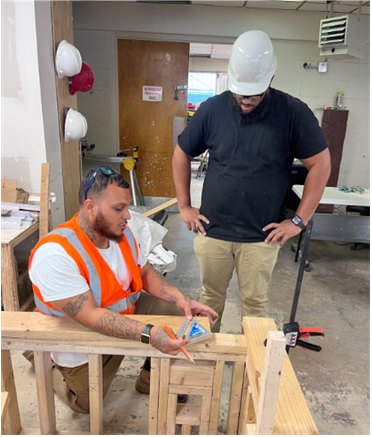
Philadelphia Technician Training Institute (PTTI) represents modern masonry training delivery. Our program structure delivers 80% hands-on curriculum with updated industry technology. That’s not sitting in classrooms watching videos. That’s actually working with bricks, mortar, concrete, and authentic construction materials.
Entry-level masons begin with fundamental tasks. You mix mortar to the correct consistency. You lay foundation blocks. You ensure courses stay level and plumb. You learn material behavior through repetition. This foundation-building phase typically lasts six months to one year.
After a year, competent masons advance. You handle more complex projects. Residential buildings. Commercial structures. Specialized applications. Your attention to detail compounds into genuine expertise. Your pay increases. Your responsibility increases. Your learning accelerates dramatically.
Master masons—people with five to ten years of focused experience—command substantially higher compensation. They handle the difficult work. Complex designs. Difficult materials. Unusual site conditions. Their expertise allows them to solve problems efficiently. Contractors direct premium-paying clients to master masons. Their hourly rates reflect this specialization.
Some masons transition into site supervisor roles. You oversee other masons. You manage schedules. You verify quality. You ensure safety compliance. The pay increases substantially. From there, advancement flows into project management positions. General supervisory roles. Eventually, general contracting and business ownership.
Others develop highly specialized expertise. Decorative stonework. Historical restoration. Waterproofing applications. These specializations command premium compensation because demand exceeds supply for specialized knowledge. As construction technology evolves, new specializations emerge creating high-wage niches for professionals with cutting-edge expertise.

Some people thrive sitting at desks. They love abstract thinking, managing information systems, attending meetings. For them, traditional college makes sense. Nothing wrong with that pathway.
Many people work differently. They think three-dimensionally. They enjoy seeing immediate results from their labor. They want buildings standing for decades as evidence of their work. They value independence and control. They’d rather solve physical problems than attend meetings.
For those people, masonry trades training isn’t a backup option for people who struggled academically. It’s the direct route toward exactly what they want. The timing has genuinely never been better. Jobs exist. Training programs accept students. Employers actively recruit. The infrastructure surrounds you.
Your masonry career in the USA doesn’t require four years of classroom instruction. It doesn’t require accumulating student debt. It doesn’t require waiting until age twenty-five to earn real income. You enter the field immediately. You build wealth from day one. You develop genuine expertise. You earn respect for competency rather than credentials.
The choice remains yours. The opportunity is genuine. The work awaits.
Read more-