
Let’s be honest, the news lately has been a little scary. Consequently, there is a new story every day about an AI bot that writes code, paints great works of art, or handles spreadsheets. It’s normal to ask yourself, “Is my future job really safe?” If you want a clear “yes,” you should stop looking at the screen and look at your hands. In a digital world, future-proof trade jobs that are hands-on are becoming the best safety net.
While software is causing problems in the tech workplace, the world of skilled trades is doing well. Why? Primarily, because you can’t “cloud-compute” a ruptured pipe at 3:00 AM, and an algorithm can’t ascend a scaffold to join structural steel in a place where the wind is strong.
In short, these jobs in skilled trades are safe from AI because they need something that robots don’t have: human intuition.
Seeing a “smart” vacuum become entangled in a rug was the most recent sight you probably remember. Similarly, picture a robot trying to discover a gas leak in a crawlspace that is 100 years old. It won’t happen for a long time. Because of this, the best AI-proof careers for stability are those that need a lot of different physical talents and the capacity to work in unforeseen situations.
For example, plumbing jobs. A plumber doesn’t just “switch parts.” Rather, they employ a “judgment angle,” which means they look at the history of the building, the water pressure, and the corrosion of the pipes all at once. That ability to think flexibly is what keeps these jobs immune to AI.
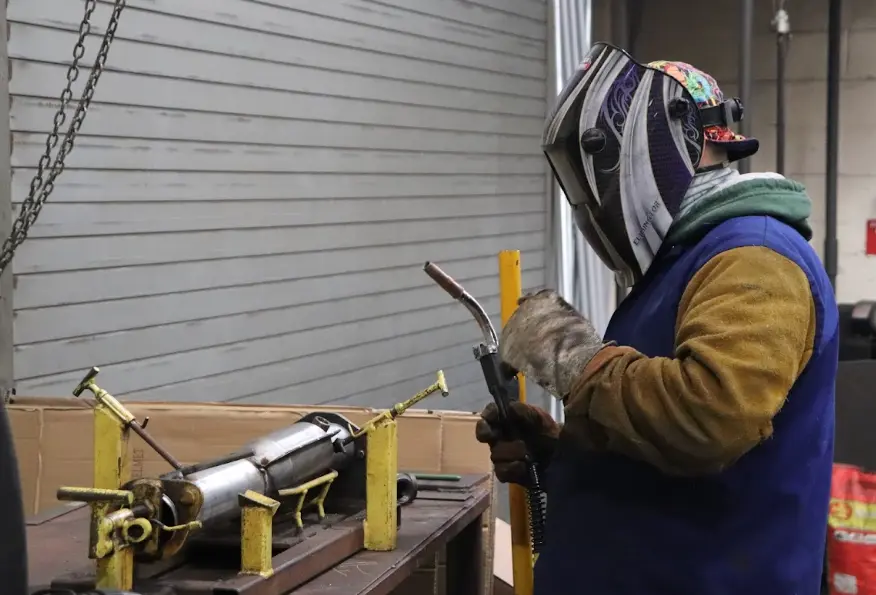
Furthermore, a welding career is the same way. Of course, a robot arm can solder a car door onto an assembly line that is completely clean. However, can it weld a strong junction on an oil rig in the ocean while hanging over the water? That needs a person to be mindful of their surroundings. Ultimately, technology is not replacing us; it is becoming our toolbox. Welders today employ high-tech sensors to make sure everything is right, which makes them faster and more useful than ever.
The trades are a great place to be if you appreciate being wanted. In fact, we are now going through a “Silver Tsunami.” By 2030, some 75 million Baby Boomers will be retiring, and as a result, they will be taking decades of technological knowledge with them. There is now a huge gap where future-proof trade jobs are sitting idle, waiting for the next generation.
Also, did you know? Between 70 and 75% of businesses say they can’t find enough applicants to fill their open positions.
Clearly, this isn’t just a “help wanted” notice; it’s a huge chance for you to have a very secure employment for life. Your paycheck won’t be shipped elsewhere because these jobs can’t be outsourced. If a bridge in your city requires repair, it needs someone who knows what they’re really doing. Therefore, you might be that person.

Let’s talk about time and money. In contrast to the “four-year degree” approach, which typically ends in a lot of debt and a “maybe” when it comes to jobs, skilled trades provide a new way: get in, get taught, and start making money.
Specifically, you can learn the skills you need in only a few months through concentrated vocational programs. For example, the Philadelphia Technician Training Institute (PTTI) has hands-on programs that respect your time and teach you the skills that companies really want. In this way, it’s a real way to get your career going without the “fluff” of a regular four-year school.
If you’re curious about the plumbing jobs that pay the most, keep these in mind:
Nowadays, experts frequently employ AR to peer over obstacles or “cobots”, robotic assistants, to facilitate monotonous welding careers and tasks.
Because of this, becoming a welder teaches you more than just how to operate a flame; it also teaches you how to manage technical systems. These are AI-proof careers because of the hybrid knowledge required to do them.
Moreover, the energy transformation is also causing a boom. We need professionals to put in and take care of these complicated systems as we progress toward greener buildings and new power infrastructures. Thus, being in a plumbing job or a welding career isn’t just about “fixing things.” It’s also about making the future of energy.

In the end, welding careers or plumbing jobs give you something that a screen can’t: a real outcome. You can say, “I made that work,” when you see a building or a bridge.
By and large, you are investing in yourself by choosing future-proof trade jobs. You’re becoming the person the world calls when things get tough. To summarize, the trades are a high-demand, high-paying, and most importantly, fully yours way to start over or start your first job.
A: Not at all! Actually, most specialists began their careers in the same place you are now. Finding the correct trade programs is the most important thing. Schools like PTTI are good at turning people who have never worked in the field before into pros through hands-on training.
A: Yes, for sure. In addition, people will always require plumbers as long as they need clean water and working water in the infrastructure. Admittedly, the work is getting more complex and pays more each year because of the advent of “smart” plumbing and green energy systems.
A: Concentrate on certain fields, such as medicinal gas systems or industrial steamfitting. These need a little more certification, but they pay a lot more because the stakes are so high.
A: AI is wonderful with data, but it’s not very good at addressing problems in “messy” places. For the time being, future-proof trade jobs will stay that way because they need human dexterity and the ability to make decisions in real time, something machines can’t do.
Read more: