
Starting a fabrication shop is easily one of the most rewarding ways to turn a technical skill into a scalable business. And, if you’re reading this, you’re probably not only thinking about making flawless beads for someone else but also more. You want to start a fabrication shop of your own, right?. It’ll be a huge leap from doing one weld to being able to handle a whole ecosystem of machines, logistics, and client administration. So, we got you!
While that “spark” of inspiration may get you in the door, business sense is what keeps the lights on. Therefore, if you’re ready to start your own business, let’s talk about how to make one that is as strong as the steel you deal with.
The trades are thriving nowadays, and specialised metalwork is at the center of it all. Recent industry studies suggest that the global welding market is projected to reach approx $40 billion by 2034, largely contributed by infrastructure upgrades and industrial expansion worldwide. There is a significant demand for competent fabricators, in the infrastructure field or the custom car parts industry. You will be a boss of your own when you start a welding business, unlike those 9-to-5 window jobs. Especially, you pick the projects and define the rules.
However, there are some changes in the industry nowadays. People don’t just want a “welder” anymore. Instead, they want expert industrial fabrication services that combine old-fashioned artistry with the modern speed of work and accuracy. If you want to win, you need to handle your business like a brand, from day one.
Trying to be everything to everyone is one of the worst things you can do. Especially if you try to go head-to-head with big companies on pricing, you might survive, but can’t thrive.
Instead, look for high-value niche projects where your unique skills may really shine.
You wouldn’t start a complicated building without a plan, would you? Similarly, your business shouldn’t be any different. Your fabrication shop business plan is like a map. Furthermore, it makes you look at the cold, hard stats: your target market, your startup costs, and the revenue you expect to make. In addition, if you need a loan for that new CNC table, it’s also the first thing a bank will ask for.
First and foremost, do not forget the basics. Fabrication or welding work takes a lot of electricity. Consequently, you need a shop with a power supply that can handle heavy industrial loads without tripping all the nearby breakers. More importantly, fume extraction is not just a nice-to-have; it is a must-have kind of thing. Ultimately, correct ventilation keeps your lungs safe and keeps you from breaking health and safety regulations.
You might want to buy every tool in the catalogue, but when starting a fabrication shop, you should just acquire the “Critical Three” to keep your debt as low as possible:
For machines that can do MIG, TIG, and Stick welding.
You can’t fabricate square things on a wooden bench. A levelled steel fixture table is the key to getting the last-minute details right.
Use a horizontal band saw or an industrial cold saw to make clean, repeatable cuts.
If you’re not so sure about the technical aspects of things before you buy something, you might want to take a refresher course. For example, PTTI offers hands-on programs that can help you learn how to handle or buy the tools you need to start a fabrication shop. By doing so, a little formal training can help you avoid making any costly blunders down the line.
You need to protect yourself before you start working on a paying project. Because welding is dangerous by nature itself— sparks flying with structures carrying heavy loads all around you. So, a strong legal protection is a must for running and owning a welding business safely.
To begin with, reach out to a professional to set up an LLC or S-Corp. This keeps your personal property safe, like your house or truck, if your business ever runs into some trouble. Additionally, you also require insurance for all your “Completed Operations”. This one is significant as it protects you in case the weld fails after the job is done and is out of your control.
Moreover, your “street cred” comes from your AWS (American Welding Society) certifications. In the eyes of high-value clients, these proper vocational certifications show that your store meets industry standards. Thus, this is a very important part of starting a fabrication shop that gets contracts from businesses or even the government.
Here comes a hard truth: in this field, you don’t get paid to weld alone; rather, you also get paid to estimate. If you give a client a low quote for a project, you’re basically paying them to let you work for them. Therefore, you will need to be quite precise with your estimates.

In big 2026, your smartphone screen will be your store’s front door. Since people will Google you before they contact you, from homeowners to project managers. If you are starting a fabrication shop nowadays, you need to have a web presence.
You should be the first name that comes up when people search for welding or fabrication shops. Put keywords like “fabrication shop” or “repair” in your website headings in a way that makes sense, to make it more digitally pronounced. These keywords tell search engines exactly what you do. If you use high-volume keywords in your content, it will also help potential customers choose your link above the others.
Since fabrication is a visual treat for those interested, invest in a good phone camera and understand the basics of lighting. For example, a gallery of “stacked-dime” TIG welds is way more appealing to clients than any text brochure. Share behind-the-scenes videos of your work over on socials to develop trust with viewers and prove that you are a professional who knows what they are doing.
It’s not a 100m sprint to run the shop; it’s a marathon. You need to find a balance between “office work” and “shop work” to stay in the game.
If you are feeling like the business side of your shop is taking up too much of your time, PTTI’s networks and communities can assist you in training future employees. While it’s always hard to find “good hands” to work on the deck, hiring someone with a strong background in industrial fabrication services can help. Enables you to reach your growth goals much faster.
The goal changes once your store is set in, as it should. Most owners want to stop working with their hands and have their money work for them. At the same time, they delve more into the managerial side of business. That’s when one should pay attention to their systems. In fact, you want a store that can keep running even when you aren’t holding the torch up the whole time.

Be ready for challenges. Tools will break, and the pricing of materials will spike like a porcupine.
Don’t just choose a price that sounds good. Figure out your “break-even” point. You need to know exactly how many billable hours it takes to cover your monthly expenses in overhead before you can make any profit. In fact, this is an important part, more like a characteristic of running a welding business that will thrive.
As your business grows, you will find yourself dealing with more complicated industrial fabrication services. This could mean working with structural steel or pressure vessels. While such projects come with more paperwork and stricter restraints on schedule and more, the pay makes it all worth it.
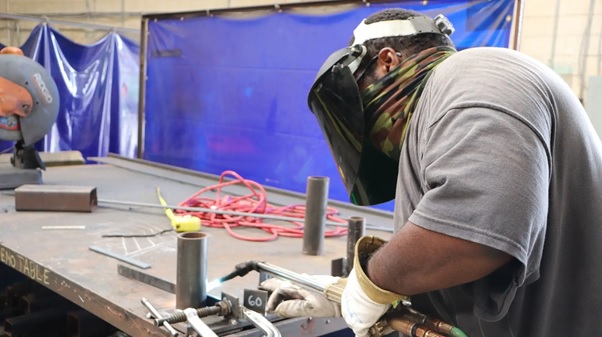
At the end of the day, starting a fabrication shop is more about persistence and grit. It needs the skill of a craftsman and the vision of a tycoon. And you can get through the early chaos and establish something that lasts long just by sticking to a good fabrication shop business plan.
Starting a welding business has never been an easy task, let alone growing it to far horizons, but there’s nothing like seeing a finished project and knowing that it’s your name on the bill. Three keys: stay true to your niche, keep up with SEO and networking, and never stop learning.
1.How much does it cost to start a fabrication shop?
A: A modest start could usually cost between $10,000 and $50,000. This includes your first couple of months of rent, machines, and basic materials. A good fabrication shop business plan will help you figure out these numbers precisely, aligned with your niche.
A: General liability is the bare minimum. However, “Completed Operations” insurance is very important for anyone who runs a welding business, as it covers your work after it has been delivered and installed.
A: Yes, but only if you know and can balance the inflow and outflow of capital. You’re not just selling your time; rather, you’re also selling the services of your expensive machines and your hard-earned knowledge of industrial fabrication services.
4.Do I need to be a certified welder to run a shop?
A: Technically speaking, you can own a business without being certified, but it is a whole lot more complicated compared to someone with a certificate. Having AWS credentials can help you gain credibility among your potential clients. And if you are looking to develop your skills to apply for a certificate, programs like PTTI are a great place to start.
Read more: