
You can overcome imposter syndrome starting today by recognising that every expert was once a nervous beginner. So, you finally got one of those entry-level construction or speciality trade jobs. The salary is better than retail. You’re ready to build a meaningful future in Philly. But even though the opportunity is great, by day three, your back hurts, your hands are blistered, and you’re watching an expert pipefitter move so fast you feel like a complete phoney.
You’re thinking they will realise they hired the wrong person. In fact, research shows that almost 70% of the population encounters imposter syndrome over their lifespans. And in a high-stakes, hands-on environment, that number often feels much higher. That feeling is why you need to overcome imposter syndrome before it saps your motivation. In fact, in the trades, your brain is often as exhausted as your body.
If you don’t handle the mental pressure of starting a skilled trades career, you risk burning out before your first 90-day review. This blog is your guide to surviving the “rookie” phase, dealing with the physical toll of manual labour, and setting the foundation for how to get promoted in the trades.
TL;DR – The Quick Plan:
But before we talk about the plan, let’s define the enemy. Imposter syndrome is the voice in your head that says you’re not as competent as other people think you are.
In the context of blue-collar career advice, when you’re in a room of people who’ve been doing the work for twenty years. You feel like a “fake” because you can’t name every wrench or the fastest way to pull wire. Getting solid blue-collar career advice early on can help you realize this feeling is temporary and completely normal for entry-level jobs.
Crucially, not dealing with these feelings leads to “over-leveraging.” It’s when you want to work twice as hard to prove you belong, and it might lead to mistakes or injuries.
The trades are all about safety and precision, whether it’s in towns like Philly or even the expanding industrial hubs in other parts of the U.S. Consequently, if you are too busy trying to look “cool,” you are not watching the live wire or the huge machinery in front of you.
To help you navigate this, let’s understand all this in three parts now!
To overcome imposter syndrome, one requires a change in perspective of “not knowing.” As a matter of fact, in the trades, a worker is respected for asking questions. A worker who behaves as if they know it all is a liability.
Being new is a superpower. It signifies you have new eyes. You can question “why do we do it this way?” In some cases, this helps veterans find inefficient usual habits.
Cease saying “I can’t do it” to your supervisor. Instead, say, “I haven’t mastered this yet.” This change in terminology drops the negative mindset and replaces it with “he/she is trying”, helping overcome imposter syndrome through a growth mindset.
To maintain your confidence in yourself, make a note of three things you accomplished or learnt every day. For example,
Don’t expect to be the foreman in month one. Entry-level jobs are a steady increment game. With that in mind, here’s how you should pace yourself to overcome imposter syndrome successfully.
During this initial period, all you have to do is be a sponge now.
Now that you understand the essentials, it’s time to deliver some value. Nonetheless, this is where you begin to overcome imposter syndrome with action.

By this point, you should be a dependable member of the team. To achieve advancement and promotion in the trades, you need to prove you can take responsibility without being watched over constantly.
You can’t overcome imposter syndrome while your body is crashing. This is going to take time and effort. Lots of young people in Philly come out of college full of energy, but have little idea about “pacing.”
Simply put, your body is your main tool. If your tools are rusted and broken, you can’t work.
Once the boots come off, the work mentality should turn off. If you spend your whole night Googling “how to be better at plumbing”, you’re not resting. At the end of the day, give yourself permission to be a person who is not at work. Ultimately, this mental reset is important for launching a skilled trades career that lasts decades.
Specifically, when you’re new, the urge to rush to look competent is high. However, rushing leads to mistakes that hurt your reputation. Take it easy. Accuracy over speed.
If you want to go from apprentice to lead, you have to be the person everybody trusts. Basically, trust is based on two things: security and reliability.
The community of alumni and employers here helps you all the way out. This helps to overcome impostor syndrome, which is simpler when you’ve already practised the hard stuff in a controlled environment.
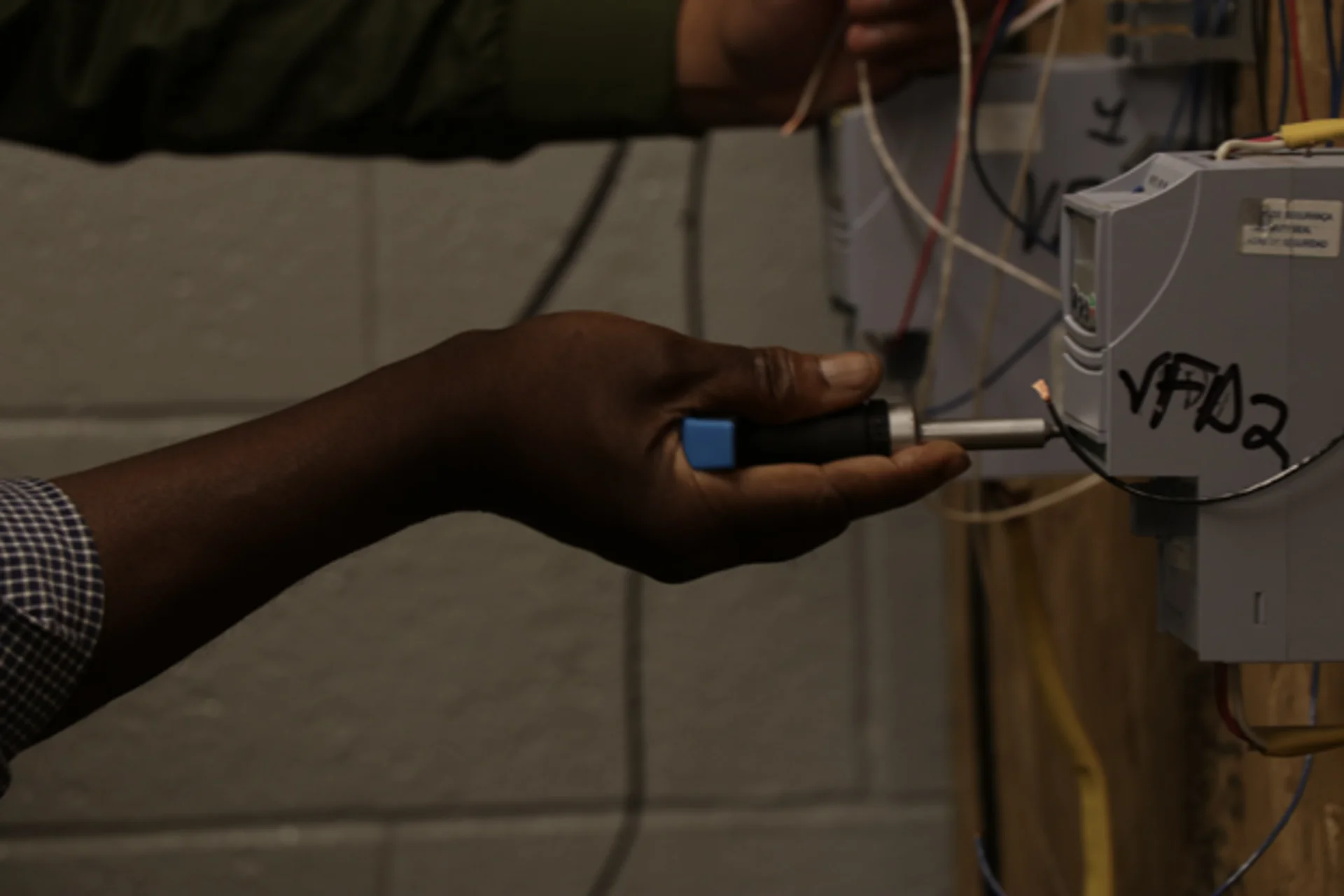
If you want to know how to get promoted in the trades, quit thinking like a “helper” and think like a “problem solver.” When you identify a problem, don’t only report it, but also provide a potential remedy. This proactiveness is rare in entry-level jobs.
| Action | Why It Matters |
| Ask 3 specific questions a day | Avoids costly mistakes. Shows engagement. Helps overcome imposter syndrome. |
| Clean and clear the workspace | Respects the site and keeps everyone safe. |
| Check your pride | Everyone starts at the bottom, and listening is the quickest way to the top. |
| Proper PPE use | A 30-year career needs good long-term health as its basis. |
Lastly, the first three months are more of an evaluation of moral character than of actual skill. To overcome imposter syndrome, you must understand that you are a work in progress. No matter whether you’re on a site in Philly or a manufacturing factory, the principles are the same: show up, listen up, and level up.

Don’t let the worry of “not knowing enough” stop you from pursuing a skilled trades career. Every expert you meet started out as a scared “newbie”.
A: Most people report feeling less like a “newbie” after six months to a year. The adjustment takes the first three months.
A: In such a case, yes. Because they have’soft skills’ like communication and punctuality that 18-year-olds can lack. Experience matters most in entry-level jobs.
A: Initially, the first two weeks are the “break-in” stage. Your body will ache. Take Epsom salt baths, stretch every morning, and don’t skip breakfast. You’ll get physically stronger, and the physical toll of manual labour will lessen.
A: Credibility is hard to come by, so try not to be the type of person who needs to hear things reiterated three times. If you want to go even further in the trades, get certified from an institute like PTTI.
Read more: