
Most people considering the trades ask one practical question first. What will the training actually teach me to do? It is a fair question. Marketing language rarely answers it. Job sites do not hire enthusiasm. They hire people who can read a print, snap a line, mix a batch correctly, and build something that holds.
This guide answers that question directly for concrete masonry training Philadelphia students can start this year. You will see the specific skills taught, why crews depend on each one, and how long the training takes. We will cover foundation layout, concrete mixing, framing, drainage, and safety. You will also see realistic earnings data, regional demand, and the exact steps to enroll.
If you learn better by doing than by reading, this trade rewards you. Keep reading to see what a real construction technician program Philadelphia employers respect actually covers.
Concrete masonry training teaches you to read blueprints, lay out foundations, mix and place concrete, build walls and floors, install drainage, and work safely. Training covers real job-site tasks from the first week. You practice each skill by hand, using industry-standard tools, until the work meets professional standards.
That is the short answer. The longer answer matters more, because the order of the training reflects the order of real construction work.
PTTI’s Concreting, Masonry, and Framing program organizes learning into six connected areas. Each one builds on the last.
| Course Area | What You Learn to Do |
| Introduction to Concreting | Concreting processes, basic tools, wall materials |
| Concreting and Construction Safety | Tool handling, injury prevention, safe work practices |
| Blueprint Reading and Shop Math | Reading layouts, elevations, scales, and dimensions |
| Wall and Floor Construction | Mixing concrete, layout, wall building, scaffolds, floors |
| Drainage, Retrofits, and Add-Ons | Drainage systems, footings, foundation repair |
| Concreting Applications in Real Life | Retaining walls, driveways, walkways, masonry finishes |
Crews do not start by pouring concrete. They start by understanding the drawing. Then they lay out the work. Only then does material go down.
Training follows that same sequence for a reason. A student who learns layout before mixing understands why the mix matters. That context builds judgment, not just technique.
Every item on that list appears in the masonry hands-on training curriculum. That alignment is deliberate.
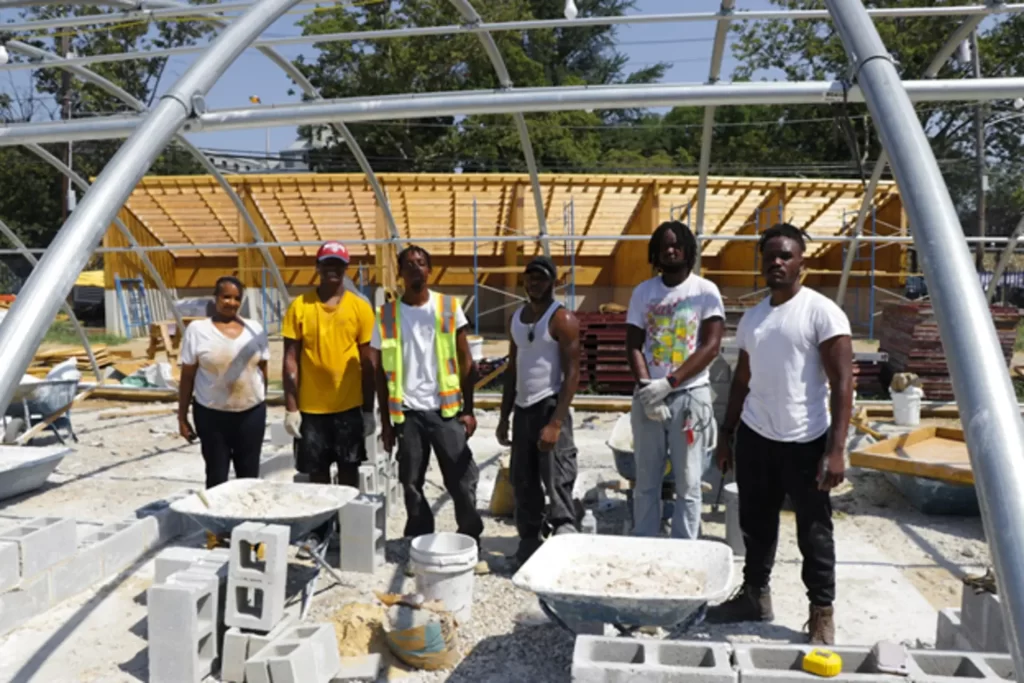
Foundation layout means transferring a blueprint onto the ground accurately. Masons measure, mark, and square the work before any concrete is placed. A layout error carries through the entire structure. That is why crews treat layout as the most important early skill on any project.
Layout is measurement plus interpretation. You read the drawing. You establish reference lines. You check that corners are square and dimensions match the print. Then you set forms.
The work looks simple from a distance. It is not. Small errors compound quickly. A quarter inch off at a corner becomes a serious problem three walls later.
Students learn shop math and key terminology before touching a layout. A foundation layout course depends on this foundation. You learn to read layouts and elevations accurately. You assess drawing scales and dimensions. You also learn computer drawings and specific views.
That combination turns a drawing into an actionable plan. Employers rely on it constantly.
Philadelphia builds on tight, irregular lots. Row-home blocks in South Philadelphia and North Philadelphia leave little margin for error. Renovation work in Mantua, Powelton Village, and Spring Garden often ties new work into existing structures.
Layout precision matters more in those conditions, not less. Crews working near Broad Street or along Woodland Avenue face the same constraint. Accurate layout protects the schedule and the budget.
Repetition turns each step into instinct. That is the point of applied practice.
Concrete mixing means combining materials to the correct proportions so the finished work reaches full strength. Masons learn how mixes behave, how to place concrete cleanly, and how conditions affect curing. Poor mixing weakens structures. Correct mixing produces work that lasts decades.
Students learn to mix concrete and work with it directly. You learn how the material handles. You learn how timing affects placement. You also learn the tools and the techniques that reduce waste.
These concrete mixing skills separate a helper from a technician. Helpers carry material. Technicians control quality.
Mixing does not exist on its own. It supports building. In this part of the program, students learn to lay out, set up, and build a wall out of concrete. You also build scaffolds to keep the work area safe and accessible.
Floor work follows. Students learn upper-floor and ground-floor construction, floor types, finishes, ventilation, and protection methods.
Philadelphia’s weather adds real pressure here. Freeze-thaw cycles punish weak concrete. Basements across Overbrook Park, Wynnefield, and Haddington show what poor placement produces over time. Training that emphasizes correct technique protects both the structure and your reputation.
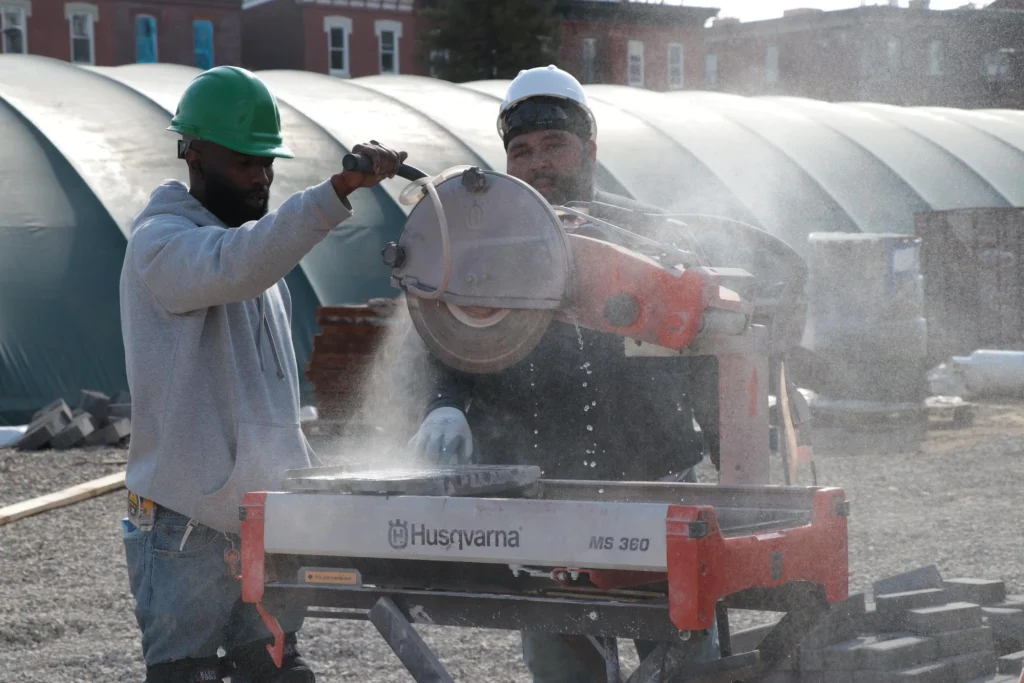
Frame setup and structural work teach students to build the systems that hold a structure together. Training covers wall and floor framing, scaffolds, drainage systems, footings, and foundation repair. These skills turn a poured foundation into a finished, functional build that meets job-site expectations.
Framing connects masonry to the rest of the build. Students learn wall construction, framing, and building foundations through real practice. Scaffold building is part of that work.
Safety is not a separate topic here. It runs through everything. Students learn tool handling and proper techniques that reduce injury risk. Real demonstrations reinforce the habits employers expect.
Water destroys foundations. That makes drainage a core masonry skill, not an afterthought.
Students learn the importance of a dry foundation and the principles of drainage. You study drainage systems, terminology, construction, and drain testing. You also learn retrofitting concepts and repair methods for failing structures, including fast footing and foundation build-up.
This knowledge has clear local value. Older housing stock across Philadelphia frequently needs retrofit and repair work. Contractors serving Yeadon, Lansdowne, Darby, and Drexel Hill handle these jobs regularly. Crews in Camden, Pennsauken, and Collingswood face similar demand across the river.
| Skill Area | Why Job Sites Need It |
| Framing and wall setup | Structural integrity and correct load paths |
| Scaffold building | Safe, legal access to elevated work |
| Drainage systems | Prevents flooding and long-term damage |
| Retrofits and repair | Restores failing foundations and footings |
Graduates who understand repair work carry an advantage. Renovation demand stays steady even when new construction slows.
Masonry is physically demanding but very learnable. Most students master the fundamentals through repetition, not natural talent. The trade rewards patience, accuracy, and consistency. With structured hands-on practice and instructor feedback, beginners with no experience regularly reach job-ready skill levels within months.
The work is physical. You lift, bend, and stand for long stretches. Precision matters under time pressure. Weather affects the job.
None of that makes masonry inaccessible. It simply means the trade rewards preparation.
You cannot learn a trowel by watching one. Skill comes from repetition with correction.
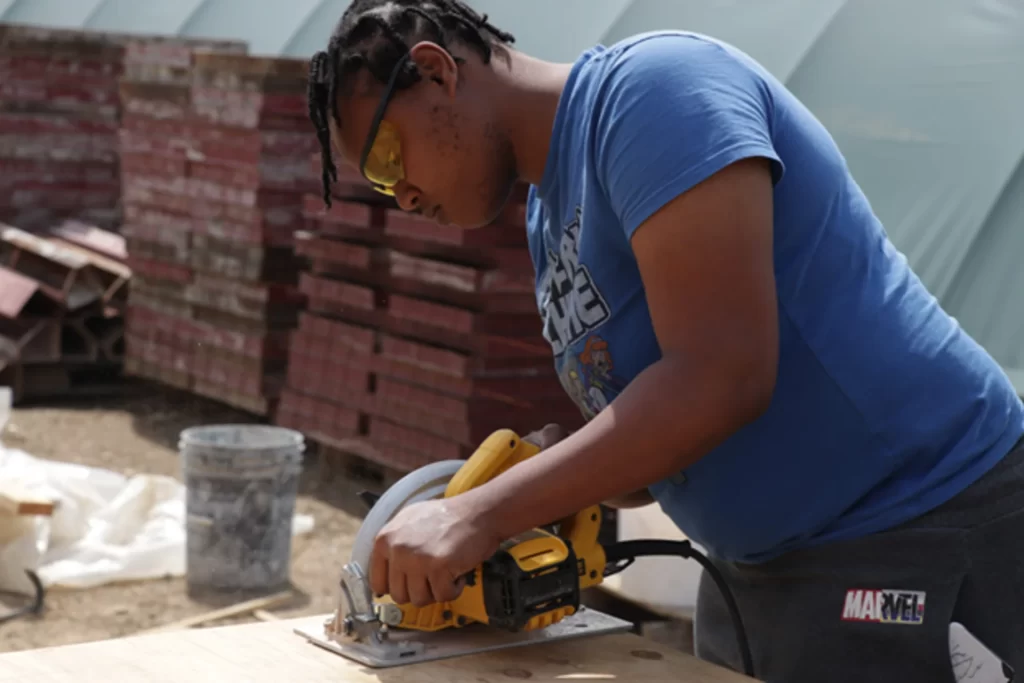
PTTI’s program uses an 80% hands-on curriculum for exactly this reason. Students spend most of their time doing the work, not reading about it. Instructors correct technique in real time. That feedback loop shortens the learning curve dramatically.
Adult learners and career changers often worry about returning to school. That concern is common and manageable. Students who have been out of school for years adjust quickly in an applied format. Many find hands-on learning easier than a traditional classroom. If you want to talk through your situation, the admissions team can walk you through the options.
Masons build and repair structures using concrete, block, brick, and stone. Daily work includes reading prints, laying out work areas, mixing and placing concrete, building walls and floors, installing drainage, and finishing surfaces. Masons work on residential, commercial, and infrastructure projects across construction and renovation.
A mason’s day follows a practical rhythm. You review the drawing and plan the sequence. You prepare the site and set up safely. You lay out the work. Then you mix, place, build, and finish.
Cleanup and protection close the day. Curing work needs protection from weather and traffic.
Masonry skills transfer across many employers and project types. Graduates find work in several settings.
Philadelphia supports all of these categories. The city’s mix of aging row homes, active commercial development, and infrastructure repair creates continuous work. Nearby communities including Ardmore, Cherry Hill, Maple Shade, Cinnaminson, and Haddonfield feed into the same regional labor market. Northeast Philadelphia and Southwest Philadelphia both see steady residential and repair activity.
PTTI supports this transition through careers and job opportunities resources and career services. Students receive resume building and interview coaching as part of professional development.
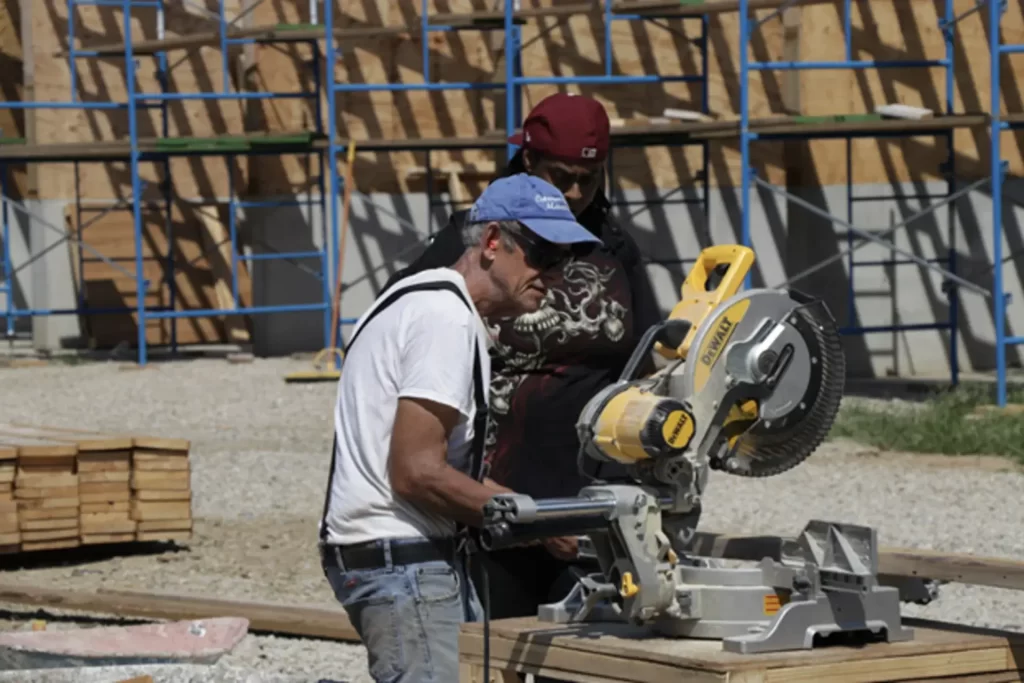
PTTI’s Concreting, Masonry, and Framing program takes 26 weeks to complete. The curriculum is 80% hands-on. Total tuition is $18,038, plus a $150 registration fee and a $12 insurance fee, for a total of $18,200. Books and supplies cost $0. Financial aid options are available to students who qualify.
Twenty-six weeks is roughly six months. That timeline works because the program concentrates on applied skill rather than unrelated coursework.
You are not spending semesters on general education requirements. You are in the lab, building. That focus is what makes a short program legitimate rather than shallow.
Schedule flexibility matters for adults balancing work and family. PTTI offers two options:
Admissions staff help prospective students choose the schedule that fits their existing commitments.
Cost transparency should be standard. You deserve the full number before you commit.
Financing may be available through grants, scholarships, federal and private loans, and institutional financing plans. The financial aid team guides students through each step, from account creation to entrance counseling and repayment planning. That support continues after graduation.
Compare that structure to a four-year degree. You reach the workforce far sooner, with a specific, employable skill set. For many students, that difference defines the return on their investment.
Masonry and construction careers offer steady demand and solid pay. The U.S. Bureau of Labor Statistics reports about 20,700 masonry worker openings each year through 2034, driven largely by replacement needs. Construction and extraction occupations had a median annual wage of $58,360 in May 2024, above the $49,500 median for all occupations.
Two figures matter most for someone entering the field.
First, replacement demand. According to the U.S. Bureau of Labor Statistics, most masonry openings come from workers retiring or moving to other roles. That demand continues regardless of growth rates.
Second, wages. Construction and extraction occupations pay above the national median for all occupations. Overall employment in this group is projected to grow faster than average through 2034.
| Metric | Figure |
| Annual masonry openings (national) | About 20,700 |
| Construction & extraction median wage | $58,360 (May 2024) |
| Median wage, all occupations | $49,500 (May 2024) |
| Annual construction & extraction openings | About 649,300 |
Individual earnings vary by employer, experience, specialty, union status, and overtime. Treat these as regional context rather than a guarantee.
Masonry is a starting point, not a ceiling. Experienced technicians move into several directions.
Each step builds on the same fundamentals taught in a concreting and framing program. Layout accuracy and material knowledge remain valuable at every level.
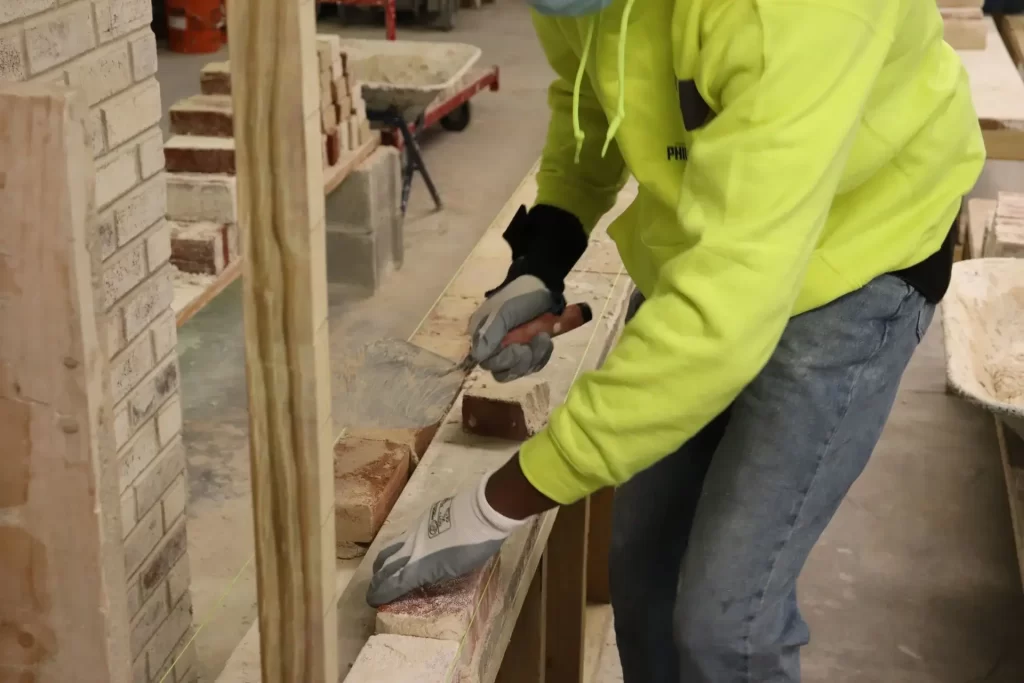
Hands-on training produces job-ready masons because the trade is physical and judgment-based. You cannot learn material behavior, tool control, or layout accuracy from a screen. Structured programs also provide instructor correction, safety training, and employer connections that self-teaching cannot replicate.
A four-year degree takes years and often creates significant debt. Earning starts later. Coursework rarely touches job-site skills.
A 26-week program reverses that equation. You train specifically for the work. You enter the field sooner. Employers get someone who can contribute immediately.
Online courses can explain concepts. They cannot give you trowel time.
Self-teaching creates gaps that show up quickly on a job site. You may learn one technique well and miss safety fundamentals entirely. Employers notice.
| Path | Hands-On Practice | Safety Training | Instructor Feedback | Career Support |
| Hands-on trade program | Extensive | Structured | Immediate | Included |
| Traditional college | Limited | Varies | Delayed | General |
| >Online-only training | >None | Theoretical | Minimal | None |
| Self-learning | Inconsistent | Ad hoc | None | None |
Generic vocational programs fall short for a different reason. They often teach broadly without depth in any single trade. A focused construction trade school Philadelphia students choose should go deep on the actual work.
Enrolling is straightforward. Contact admissions, discuss your goals and schedule, review financial aid options, and complete the application. PTTI’s campus sits at 1901 West Girard Avenue in Philadelphia. Admissions staff guide applicants through eligibility requirements, documentation, scheduling, and funding before classes begin.
Most applicants complete the process in a few conversations. Preparation makes it faster.
Smart applicants ask direct questions. Good schools welcome them.
You should also ask about outcomes. PTTI reports a 92% job placement rate for students who complete its programs, noting that placement rates vary month to month and represent an average across a sample time frame. Ask any school to explain how it calculates such figures.
Prospective students can also visit the campus to see the labs before deciding. Seeing the space answers questions that no brochure can.
You can also call the campus or reach out through the contact page with questions.
The question that opened this guide deserves a direct closing answer. Concrete masonry training teaches you to read a print, lay out a foundation, mix and place concrete correctly, build walls and floors, and handle drainage and repair work. Those are the skills Philadelphia job sites hire for every week.
You can build them in 26 weeks. You do not need prior experience or a four-year degree. You need structured practice, real equipment, and instructors who correct your technique.
Ready to see the labs and talk through your options? Book an admissions appointment to get started. You can also explore the full Concreting, Masonry, and Framing curriculum or review student resources before you decide.
You learn blueprint reading, shop math, foundation layout, concrete mixing, wall and floor construction, scaffold building, drainage systems, and foundation repair. PTTI’s program also covers safety and real-life applications like retaining walls, walkways, and driveways through hands-on practice.
Masonry is physically demanding but very learnable. Success comes from repetition and accuracy rather than natural talent. Because PTTI’s curriculum is 80% hands-on, beginners with no experience build real skill quickly through guided practice and direct instructor feedback.
A mason builds and repairs structures using concrete, block, brick, and stone. Daily tasks include reading prints, laying out work, mixing and placing concrete, building walls and floors, and installing drainage on residential, commercial, and infrastructure projects.
PTTI’s Concreting, Masonry, and Framing program takes 26 weeks to complete. Morning and evening class schedules are available, which helps working adults, career changers, and parents finish the program without leaving their current jobs.
Total tuition is $18,200, which includes $18,038 in tuition and fees plus a $150 registration fee and a $12 insurance fee. Books and supplies cost $0. Grants, scholarships, loans, and institutional financing may be available to qualifying students.