
The hardest part of leaving the military is rarely the work itself. It’s the translation. You spent years operating equipment, following technical procedures, leading a team under pressure, and holding a safety standard that left no room for error. Then you separate, and a civilian job board asks for a “degree” or “3–5 years of experience” as if none of that counted. It counts. In the skilled trades for veterns, it counts more than almost anywhere else.
Skilled trades for veterans are one of the most direct, best-paying, and fastest routes from military service to a stable civilian career. The skilled trades for veterans reward exactly what the military builds: discipline, precision, respect for procedure, physical capability, and the ability to work as part of a crew. On top of that, veterans often have education benefits that can help fund training, and employers across welding, pipefitting, manufacturing, automotive, and HVAC are actively short on skilled workers.
This guide breaks down how to turn your military experience into a skilled trade career: which of your service skills transfer, which trades fit veterans best, how GI Bill and related benefits generally work for trade school, what the DoD SkillBridge program offers before you separate, and how to start in the Philadelphia region. It’s written for transitioning service members, recent veterans, and those who separated years ago and are ready for a career that respects what they already know.
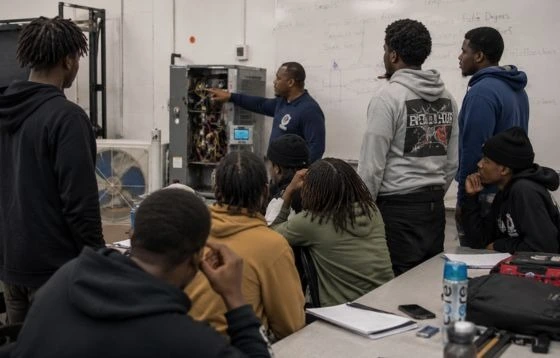
Trade employers describe their ideal hire in almost the same words a squad leader would use: shows up on time, follows the procedure, respects safety, communicates clearly, and can be trusted with expensive equipment. That’s not a coincidence. The skilled trades run on the same operating principles as a military unit.
Consider what a typical enlistment builds. Students learn to read and follow technical manuals to the letter. You maintain and troubleshoot equipment because failure has consequences. Aspirants work in heat, cold, and awkward conditions without quitting. You hold a security and reliability standard. You lead or follow depending on the mission. Strip away the uniform and that is a description of a job-ready tradesperson.
This is why skilled trades for veterans consistently produce strong outcomes. Veterans tend to complete training, pass certification tests, and stay in the field, because the discipline that makes a good service member makes a good welder, pipefitter, or technician. Employers know this, and many actively seek out veteran candidates.
Ready to put that experience to work? Explore PTTI’s hands-on trade programs and see which one matches your service background.
Yes — directly. Most military roles build technical, mechanical, and safety competencies that map onto civilian trades with minimal retraining. The specific hard skills vary by job, but the underlying habits transfer to every trade on the floor.
Here is how common military strengths line up with trade-floor expectations:
| Military Experience | How It Transfers to the Trades |
| Following technical orders and manuals | Reading blueprints, welding symbols, and job specifications |
| Equipment operation and maintenance | Machine setup, diagnostics, and preventive maintenance |
| Safety and reliability standards | OSHA compliance, PPE discipline, hazard awareness |
| Working under pressure and deadlines | Meeting production schedules and job-site timelines |
| Team coordination and leadership | Crew work, supervising apprentices, shift leadership |
| Physical stamina and precision | Position welding, overhead work, fine tolerances |
If your military occupation already involved welding, metalwork, mechanics, HVAC, electrical, or construction, you may be closer to certification than you think. If it didn’t, the transferable mindset still shortens the learning curve dramatically. A structured, hands-on program simply gives you the specific technical reps and the credential employers require.
The best trade depends on your background and what you want your days to look like, but a handful stand out for veterans because of demand, pay, and how cleanly military experience carries over.
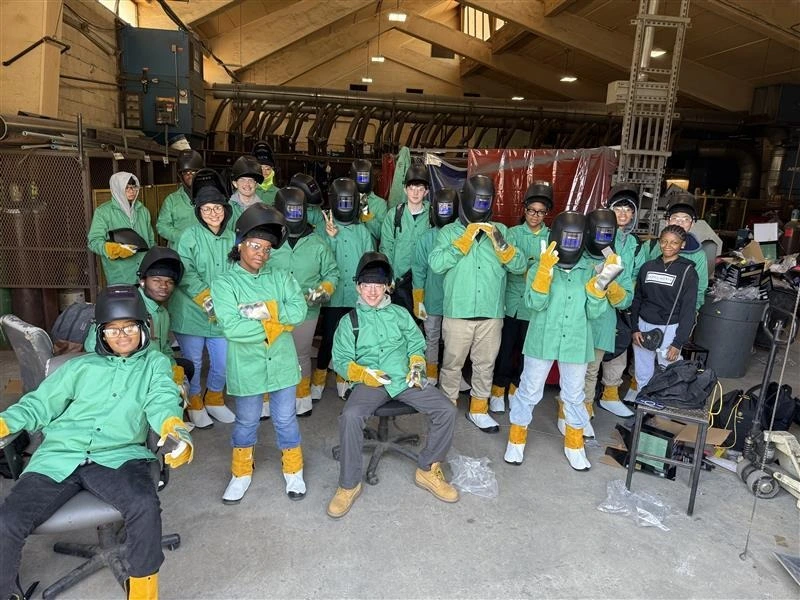
Welding is often the first trade veterans consider, and for good reason. It rewards precision, steadiness, and procedure-following, and it pays well with strong demand. Welders join and repair the metal that builds ships, bridges, buildings, and infrastructure. In the Philadelphia region specifically, active shipbuilding and ship repair create steady structural and pipe welding work — a natural landing spot for veterans, especially those from maritime or engineering roles. You can learn more on PTTI’s Welding Technology program page.
Pipefitters and steamfitters install and maintain the piping systems that move steam, water, gas, and fire-suppression fluids through commercial and industrial buildings. The work involves blueprint reading, precise measurement, and often welding — a strong match for veterans who worked in mechanical, utilities, or shipboard systems. Explore the Steam, Sprinkler & Pipe Fitting program.
Modern manufacturing is increasingly automated, blending mechanical work with robotics, controls, and diagnostics. Veterans who maintained complex systems or worked in electronics adapt quickly. See the Manufacturing & Automation program.
Today’s automotive technician is part mechanic, part diagnostician, working on increasingly computerized and electrified vehicles. Veterans from motor-transport, vehicle-maintenance, or diesel backgrounds often find this the most familiar path. See the Automotive Repair program.
Other strong fits include HVAC, and Concreting, Masonry & Framing, along with Central Processing & Sterile Services for veterans drawn to healthcare-adjacent work. The point is that a skilled trade career for veterans isn’t one path — it’s a set of them, and the right one depends on you.
Not sure which fits? Contact PTTI admissions and talk through your military background with someone who understands trade careers.
In most cases, yes. The Post-9/11 GI Bill and the Montgomery GI Bill both cover what the VA calls non-college-degree (NCD) programs — the vocational and technical training that leads to a certificate, diploma, or industry license rather than a college degree. Welding, HVAC, and similar trade programs fall squarely into this category.
Under the Post-9/11 GI Bill (Chapter 33), eligible veterans receive up to 36 months of entitlement, the VA pays the school directly, and benefits can include a monthly housing allowance and a books-and-supplies stipend. For non-college-degree programs, the VA pays the lesser of the school’s actual charges or a national annual cap (set at $29,920.95 for the August 2025–July 2026 year). Because many trade programs cost well under that cap, the GI Bill often covers tuition in full.
Beyond the GI Bill, veterans may have access to other pathways:
Important: Benefit rules, eligibility, and program approval vary by individual and change over time. Always confirm that a specific program is VA-approved using the VA’s official GI Bill Comparison Tool and verify your personal eligibility with the VA and the school’s certifying official before making any benefit decisions. PTTI’s admissions team can walk veterans through options on the veterans and financial aid page.
DoD SkillBridge lets active-duty service members train with a civilian employer during their final 180 days of service while continuing to receive military pay and benefits. It’s designed to close the gap between military experience and civilian credentials by giving you real, supervised work experience before you ever take off the uniform.
A few practical points for 2026:
SkillBridge and trade training can work together: some veterans use SkillBridge to gain civilian experience, then use GI Bill benefits to earn a certification that locks in higher pay. Even when a SkillBridge placement doesn’t convert to a direct hire, you leave with civilian experience and contacts that put you ahead of peers who separate cold.
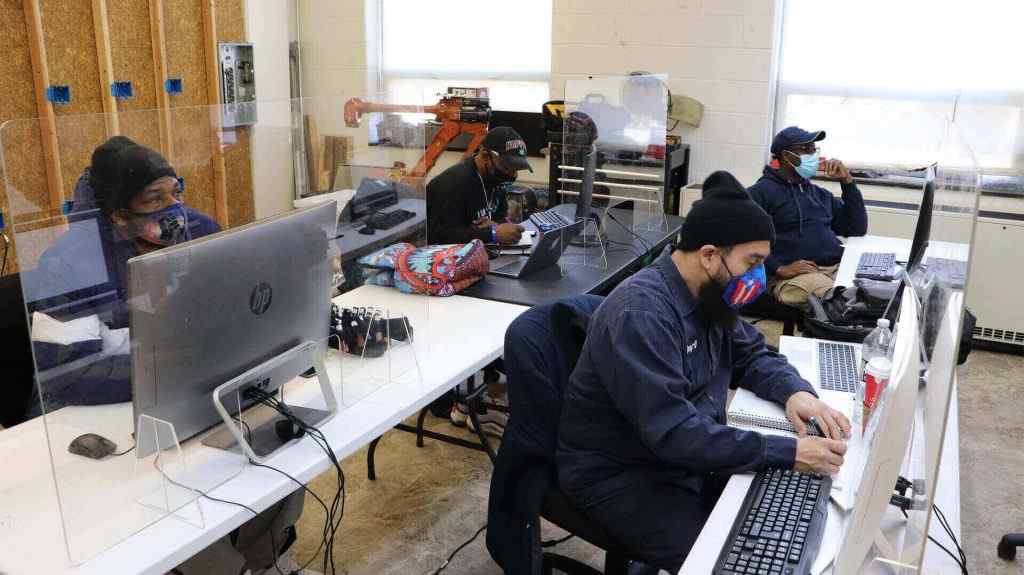
The demand picture is strong, and it’s structural rather than temporary. Take welding as the clearest example. The U.S. Bureau of Labor Statistics projects roughly 45,600 openings for welders, cutters, solderers, and brazers each year through 2034, driven largely by the need to replace an aging workforce. Industry analyses cited by lawmakers have gone further, projecting a national shortfall of about 330,000 welders by 2028 — a gap the shipbuilding and defense industrial base is especially eager to fill.
That national demand has a sharp local edge. Philadelphia’s maritime sector, aging infrastructure, commercial construction, and manufacturing base all need skilled tradespeople, and the defense supply chain has explicitly called for matching transitioning service members to these jobs.
Average welders in the Philadelphia area generally earn between $52,000 and $60,000 per year. The certified, specialized, and union welders frequently exceed $70,000. Pipefitting, manufacturing, and automotive roles offer comparable ranges depending on certification, overtime, and specialization. For a veteran, that’s a civilian income you can start earning quickly, without a four-year degree or student debt.
| Trade Path | Typical Philadelphia-Area Range | Veteran Fit |
| Welding | $52,000 – $80,000+ | Precision, procedure, maritime/engineering roles |
| Pipefitting / Steamfitting | $55,000 – $85,000+ | Mechanical, utilities, shipboard systems |
| Manufacturing & Automation | $50,000 – $75,000+ | Electronics, systems maintenance |
| Automotive Repair | $45,000 – $70,000+ | Motor transport, diesel, vehicle maintenance |
Most focused trade programs prepare veterans for entry-level work in well under a year. The trades are performance-based: once you can demonstrate the skill and pass the relevant certification test, you’re hireable. That’s a fundamentally different timeline than a traditional degree.
For veterans, the timeline is often even shorter in practice, because the discipline and mechanical foundation are already there. A structured program concentrates on the specific technical reps and the credential — certification readiness, blueprint reading, safety cards, and hands-on hours — rather than unrelated coursework. Explore the full lineup of PTTI trade programs to compare training paths.
Certifications are what turn “I can weld” into “I’m hireable for this contract.” For welders, the American Welding Society (AWS) Certified Welder credential is performance-based, widely recognized, and portable across states — you test at an accredited facility, an inspector evaluates your weld, and you carry the credential with you. Across the trades, OSHA safety certification is frequently expected, and pipefitting, automotive, and manufacturing each have their own recognized credentials.
Hiring managers in skilled trades consistently look for the same core competencies, most of which veterans already have or can build quickly:
A quality program is built specifically to develop and document these competencies, which is why hands-on training on industry-standard equipment matters so much for a smooth transition.
For veterans in Pennsylvania, New Jersey, and the surrounding counties, the Philadelphia region offers an unusually good combination of demand, industry diversity, and access to training. Shipbuilding and ship repair, infrastructure work across the tri-state area, commercial and healthcare construction, and a durable manufacturing base all create steady openings. Because certifications are portable, training in Philadelphia positions veterans to take work across the region — from North and South Philadelphia to the surrounding Pennsylvania and South Jersey communities.
Philadelphia Technician Training Institute (PTTI) trains veterans and civilians alike in Welding Technology, Steam, Sprinkler & Pipe Fitting, Manufacturing & Automation, Automotive Repair, Concreting, Masonry & Framing, HVAC, and Central Processing & Sterile Services — using real labs and industry-standard equipment. For veterans, that means turning service experience into a documented, hireable civilian skill set, with admissions support to help navigate benefits and program selection.
Take the next step. Explore veteran-friendly programs and financial aid options, request information, or schedule a campus tour to see the labs and talk with instructors who understand where you’re coming from.
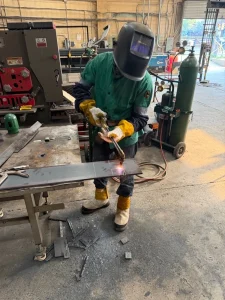
You already did the hard part. You learned to hold a standard, follow a procedure, and maintain equipment. A skilled trade career for veterans simply channels that into work that pays well, hires steadily, and can’t be outsourced or automated away. The demand is real, the benefits can fund the training, and the timeline is measured in months, not years.
The move from military experience to a skilled trade career is one of the clearest paths a transitioning service member can take. With hands-on training, the right certifications, and a region hungry for skilled workers, Philadelphia is a strong place to make that move.
Ready to start? Apply now, request information, or schedule a campus tour at PTTI and turn your service into a civilian career built to last.
In most cases, yes. The Post-9/11 GI Bill and Montgomery GI Bill cover approved non-college-degree programs, including welding and other trades, often paying tuition in full plus a housing allowance for eligible veterans. Always confirm a program’s VA approval and your eligibility through the VA’s GI Bill Comparison Tool before enrolling.
Welding, pipefitting and steamfitting, manufacturing and automation, automotive repair, and HVAC are among the strongest fits. They reward the precision, safety discipline, and procedure-following that military service builds, and all have solid demand and pay in the Philadelphia region.
Directly. Reading technical manuals, maintaining equipment, holding safety standards, working under pressure, and coordinating a team all map onto trade-floor expectations. Veterans typically move through hands-on training faster because the underlying discipline is already there.
A focused, hands-on welding program can prepare a veteran for entry-level work in well under a year. Because welding is performance-based, you become hireable once you can consistently pass a weld test to standard.
SkillBridge is a Department of Defense program that lets active-duty members train with an approved civilian employer during their final 180 days of service while keeping military pay. It requires command approval, and 2026 rules make early planning essential.
No. The trades are hireable on demonstrated skill and certification, not a college degree. A high school diploma or GED plus hands-on training and the right credential is the standard entry point.
Philadelphia Technician Training Institute (PTTI) offers hands-on training across welding, pipefitting, manufacturing, automotive, HVAC, masonry, and sterile processing, with admissions support to help veterans navigate benefits and choose a program.