
The most common myth about auto repair is that it is a job, not a career. People picture a technician doing oil changes forever, capped at a modest wage, with nowhere to go. That picture is wrong, and the data proves it.
Auto repair is one of the few fields with a clear, published ladder. Every rung has a credential attached. Every credential comes with a pay increase. You can see exactly where you stand and exactly what the next step requires. Few careers are that transparent.
This guide maps the full ladder. You will see each stage from entry technician to master tech to shop foreman. You will learn what ASE certification actually requires, which specializations pay premiums, and what earnings look like at each level. You will also see how hands-on training shortens the climb.
If you are weighing auto repair as a long-term path in Philadelphia, this is the advancement story you need before you decide.
Automotive career progression follows a published, credential-based ladder. You move from entry technician to certified technician to master technician, then into foreman or management. Each stage has clear requirements. Unlike many careers, advancement depends on proven skill, not on office politics or a four-year degree.
That structure is the point. In most fields, promotion is vague. In auto repair, the path is written down. ASE publishes exactly which tests you need. Employers know what each credential means. You always know your next move.
Many people assume auto repair caps out early. It does not. The assumption comes from seeing entry-level pay and stopping there.
Here is what actually happens. A new technician starts with basic maintenance work. Within a few years, certifications open more complex jobs. Complex jobs pay more. Add master status, and you become the person the shop calls when nobody else can solve the problem. That person is not replaceable.
From there, the ladder continues into leadership. Foreman. Service manager. Shop owner. Each step builds on the last.
Auto repair is measurable. Either the vehicle runs correctly or it does not. Either you diagnosed the fault or you did not. That clarity means your skill is visible.
Employers pay for that visibility. A technician who can solve hard diagnostic problems saves the shop money and keeps customers. This is why the automotive technician career path rewards people who keep learning.
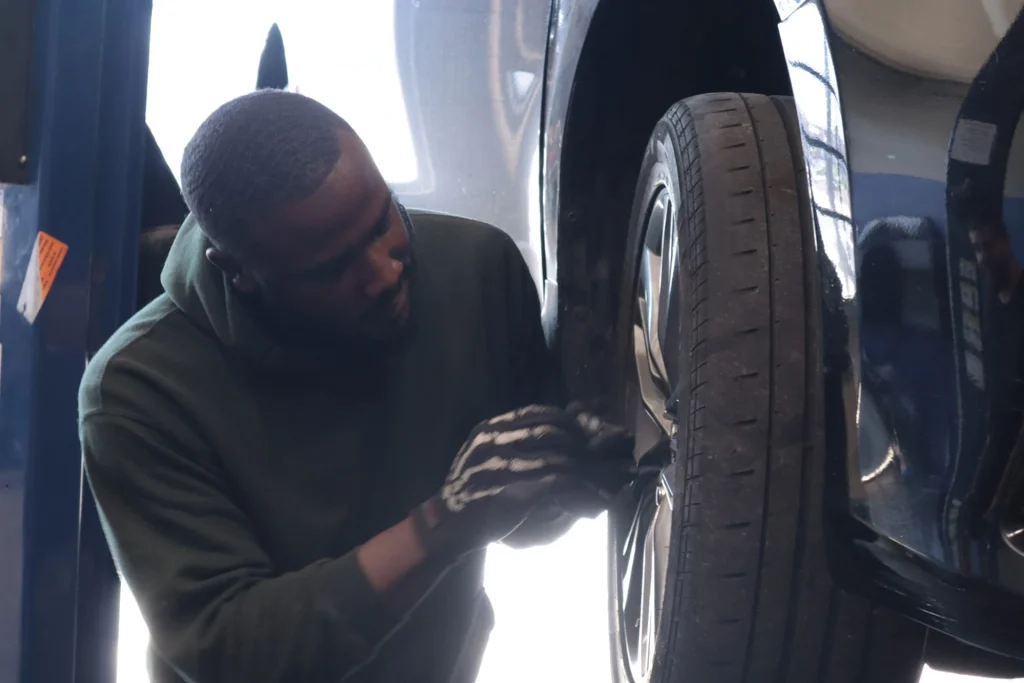
The auto mechanic career ladder has four main stages. You start as an entry-level technician doing maintenance and basic repair. You then earn ASE certifications and take on harder work. Next comes master technician status. Finally, you can move into foreman, service manager, or ownership roles.
Each stage takes time. But the sequence is predictable, and you control the pace.
You begin here after training. Your work covers oil changes, tire service, brakes, fluid checks, and basic inspections. You learn the shop’s rhythm and build speed.
This stage matters more than people think. You are building the habits that determine everything after. Accuracy, safety discipline, and communication all start now.
Graduates of hands-on programs enter this stage already comfortable with tools and procedures. That head start compresses the timeline. PTTI’s automotive repair training is built around exactly this readiness.
Now you begin passing ASE tests. Each certification proves competence in a specific system. Each one opens work that pays better.
Most technicians start with the areas they touch daily. Brakes, or electrical, or engine performance. You do not need to pass all eight at once.
The A-series covers passenger vehicles. It runs A1 through A9. Many technicians begin with A5 Brakes, because the work is familiar. Others target A6 Electrical and A8 Engine Performance early, since those cover the highest-demand diagnostic skills.
| Test | Area |
| A1 | Engine Repair |
| A2 | Automatic Transmission/Transaxle |
| A3 | Manual Drivetrain and Axles |
| A4 | Suspension and Steering |
| A5 | Brakes |
| A6 | Electrical/Electronic Systems |
| A7 | Heating and Air Conditioning |
| A8 | Engine Performance |
Pass A1 through A8, and you earn ASE Master Automobile Technician status. This is the top general credential for passenger car technicians.
Note one detail people miss. A9, the light vehicle diesel test, is not required for master status. It is optional and valuable, but separate.
Master techs get the problems nobody else solved. They mentor newer staff. Dealerships and specialty shops actively recruit them.
Here the ladder shifts from technical to leadership. A foreman still fixes vehicles, but also runs the floor. Beyond foreman sit service manager, shop owner, and instructor roles.
This is where the earning ceiling rises sharply. You can read more about how automotive technicians advance their careers at each stage.
To become a master auto technician, pass all eight ASE Automobile tests, A1 through A8, and document two years of hands-on work experience. Formal training can substitute for one year. Each certification lasts five years and requires recertification to keep master status current.
That is the whole requirement. It sounds simple, and structurally it is. The work is in the preparation.
ASE requires two years of relevant hands-on experience for most tests. But there is an important substitution rule.
Graduates of accredited automotive programs can substitute one year of formal training for one year of work experience. This matters enormously for timeline. It is one of the most concrete ways training accelerates the climb.
You can also pass tests before completing the experience. ASE assigns a “designation pending” status. The certification is awarded once your documentation is verified. Smart technicians use this to study while they accumulate hours.
ASE certifications last five years. Recertification requires retesting, not continuing education credits.
There is a catch worth knowing. Master status requires every component certification to stay current. If A1 lapses, you lose master status until you recertify, even if A2 through A8 remain active.
Some technicians reach master status quickly. Others take longer. Both are normal.
The variable is not talent. It is exposure. A technician who works on varied systems daily builds test-ready knowledge faster than one stuck on a single task. Choosing a shop that rotates you through different work speeds the ASE master tech path considerably.
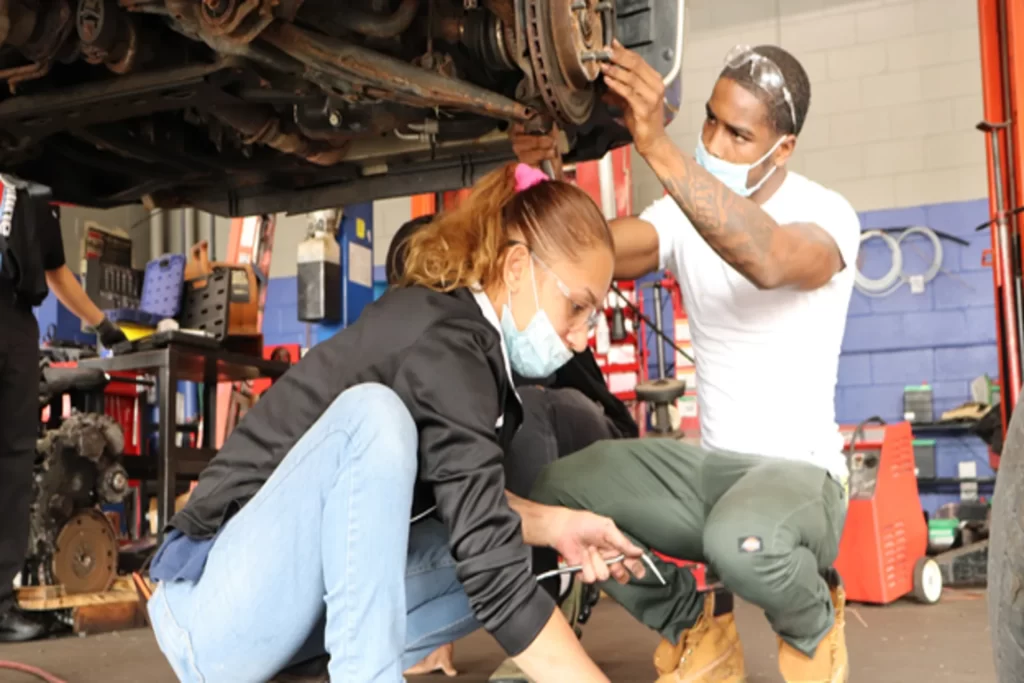
To become a shop foreman, first build strong technical credibility, ideally master technician status. Then demonstrate leadership: mentoring newer techs, handling difficult diagnoses, communicating with service advisors, and managing workflow. Most shops promote from within, so consistent performance and reliability matter as much as skill.
The transition surprises people. Being the best technician does not automatically make you a foreman. The job changes.
A foreman is a translator and a traffic controller. You still turn wrenches. But you also assign work, verify quality, and unstick problems.
Technical skill gets you considered. These skills get you chosen.
Communication comes first. A foreman explains complex problems to people who are not technicians. Teamwork comes second. You cannot run a floor if the floor does not trust you. Reliability comes third, and it may matter most.
Employers watch for these long before they promote. This is why quality programs treat professionalism as part of technical training, not separate from it. PTTI’s approach to career readiness and job support reflects that reality.
The ladder does not stop. Service managers run the business side. Shop owners run everything.
Some technicians take a different route entirely and open their own shops. Others move into training and instruction. The technical foundation supports all of these.
Auto repair pays well long term when you climb the ladder. The national median wage for automotive service technicians was $49,670 in May 2024, according to the U.S. Bureau of Labor Statistics. Entry roles pay below that. Certified, master, and foreman roles pay meaningfully above it, especially with specialization.
The median is a midpoint, not a ceiling. That distinction is everything.
Here is how earnings typically progress. Figures are regional estimates and vary by shop, employer type, and pay structure.
| Career Stage | Typical Direction of Pay |
| Entry-level technician | Below the national median |
| Certified technician | At or moderately above median |
| Master technician | Well above median |
| Shop foreman / service manager | Highest tier, plus leadership pay |
Several factors move these numbers. Dealerships often pay differently than independent shops. Flat-rate pay structures reward speed and skill directly. Many shops add per-certification bonuses, paying extra per flat-rate hour for each credential you hold.
Industry data consistently shows ASE-certified technicians out-earn uncertified peers. Estimates commonly place the gap in the range of 10 to 20 percent.
That is a strong return for a modest investment. It also compounds. Each certification you add expands the work you can take and the shops that will hire you.
This is where the ceiling lifts fastest in 2026.
Modern vehicles are computers with wheels. Advanced Driver Assistance Systems use cameras, sensors, and software. Electric and hybrid vehicles require battery, power electronics, and high-voltage safety knowledge. Very few technicians can handle all of it well.
Scarcity creates premium pay. Technicians who understand both traditional and electrified systems hold real leverage.
PTTI covers modern diagnostics as part of automotive training, and related coverage on EV battery repair skills explains why this specialization matters now.
Philadelphia supports a steady automotive job market. Nationally, roughly 70,000 openings for automotive service technicians are projected each year through 2034, largely to replace retiring workers. That replacement demand reaches every metro with a dense vehicle population, including Philadelphia and its surrounding counties.
Vehicle density drives this. More cars mean more service. Philadelphia has plenty of both.
Opportunity spreads across the region. Dealerships, independent shops, fleet operations, and service centers all hire.
Graduates find work across North, South, and West Philadelphia, along corridors like Broad Street and Woodland Avenue. Opportunity extends into Drexel Hill, Lansdowne, Darby, and Yeadon, and across the bridge into Camden, Pennsauken, Cherry Hill, and Maple Shade. Because skills transfer, training centrally in Philadelphia opens the whole regional market.
An aging workforce is leaving. Experienced technicians are retiring and taking decades of knowledge with them.
That creates a gap. It also creates unusually fast advancement for people entering now with current skills. When experienced techs leave, shops need someone ready to step up. Training positions you to be that person. PTTI’s automotive campus is built to prepare students for exactly that opening.
Hands-on training shortens automotive career progression in three concrete ways. It substitutes for part of ASE’s experience requirement. It builds diagnostic skill on real equipment before you are on the clock. And it prepares you for certification tests rather than leaving you to figure them out alone.
Speed matters here. Every month you shave off the climb is a month at higher pay.
Not all paths are equal. Here is the honest comparison.
Versus traditional college. A four-year degree takes years and often heavy debt. It also does not prepare you to diagnose a vehicle. Auto repair does not require it. Employers want demonstrated skill.
Versus online-only training. You cannot learn diagnostics through a screen. Videos teach concepts. Vehicles teach technicians. Employers know the difference immediately.
Versus self-learning. Working on your own car builds curiosity. It rarely builds certification readiness, safety discipline, or the employer connections that get you hired.
Versus generic vocational programs. A program is only as current as its equipment. If the shop trains on outdated technology, graduates arrive behind.
Look for these specifics when you evaluate any program.
This is the standard PTTI’s automotive program is designed around, and it is the standard you should hold every school to. You can see how graduates describe the experience through the PTTI alumni community.
Cost is a real concern. It should not be a wall.
Before you rule anything out, get the full number in writing and check what support applies to you. PTTI publishes financial aid information covering aid programs, and veterans should review veterans’ benefits options specifically.
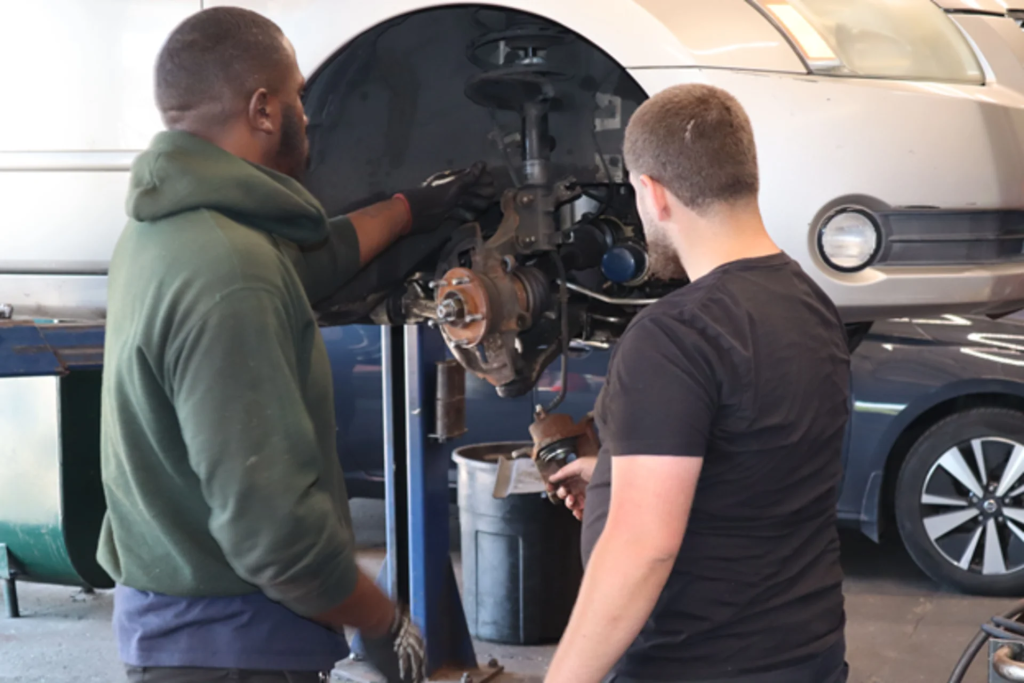
The ceiling in auto repair is high. The path to it is published, measurable, and open to anyone willing to build real skill. That is rare.
What determines how fast you climb is where you start. Training that puts you on real equipment, prepares you for ASE, and connects you to employers turns a multi-year climb into a shorter one.
See it for yourself. Schedule a campus tour and walk the automotive shop floor. Talk to instructors. Look at the equipment. Then decide.
Ready to move? Contact admissions or explore all PTTI programs to find your starting point.
How do I become a master auto technician?
Pass all eight ASE Automobile tests, A1 through A8, and document two years of hands-on experience. Accredited training can substitute for one year. PTTI’s automotive program builds the diagnostic skills those tests measure, using real equipment and certification-focused instruction.
What is the career path for a mechanic?
The path runs from entry-level technician to certified technician, then master technician, then foreman or service manager. Each stage is tied to proven skill and certification. Hands-on training at PTTI prepares you to enter that ladder job-ready rather than starting from zero.
How do I become a shop foreman?
Build technical credibility first, ideally master status, then demonstrate leadership through mentoring, quality control, and clear communication. Most shops promote from within. PTTI emphasizes the professionalism and teamwork employers look for when they choose who to promote.
Does auto repair pay long term?
Yes. The national median was $49,670 in May 2024, but certified, master, and foreman roles pay well above it. EV and diagnostic specialization adds further premiums. Training that covers modern vehicle technology, as PTTI’s does, positions you for the higher rungs.
Is auto mechanic a dead-end job?
No. Auto repair has one of the clearest advancement ladders in the skilled trades, with published credentials at every stage. The ceiling includes master tech, foreman, service manager, and ownership. PTTI’s automotive training is the entry point to that progression.
Read More