
Starting with no savings, no industry experience, and no family connections can make a stable, well-paying career feel out of reach. In the skilled trades, it is not. A trade career with no experience is one of the few realistic paths in 2026 where someone can begin from zero and become genuinely employable in months rather than years. The trades reward what you can do, not who you know or what degree you hold, which is exactly why they remain open to people building a future from the ground up.
This guide answers the real question honestly: can you build a trade career starting from nothing? The short answer is yes, and this article explains how. You will learn which trade school in Philadelphia that pay well without a degree are worth pursuing, how long training actually takes, what it costs and how people pay for it, and the specific steps to move from “no experience” to “hired.” It is written for high school graduates, career changers, veterans, and adult learners across Philadelphia, the surrounding Pennsylvania counties, and South Jersey who want a clear, practical starting point rather than vague encouragement.

Yes. You can start a trade career with no experience,in trade school in Philadelphia
no prior connections, and limited money, because the skilled trades evaluate people on competency rather than credentials. Unlike careers that screen by degree or network, trades ask a simpler question: can you do the work to standard? That makes them one of the most accessible paths available to someone starting over.
This is the fundamental difference between the trades and much of the white-collar job market. A hiring manager at a fabrication shop or mechanical contractor cares whether your weld passes inspection, whether you can diagnose a fault, or whether you follow safety procedure. Those are learnable skills. They are not gated behind years of unpaid internships or a family contact who can make an introduction. For people who have been told they need connections to get ahead, the honesty of the trades is a genuine advantage as trades that pay well without a degree. what you do need is a way to build the skill. That is where structured skilled trades training replaces the experience you do not yet have. A good program gives you the hands-on repetition, the equipment, and the instruction that would otherwise take years to pick up informally, and it does so in a setting designed to get you job-ready quickly.
Several skilled trades pay well without a degree, including welding, steam and pipe fitting, HVAC, automotive repair, manufacturing and automation, and sterile processing. According to the U.S. Bureau of Labor Statistics, many of these occupations offer solid median wages with no four-year degree required, and earnings typically rise with experience and certification.
Here is a realistic look at trades you can enter without a bachelor’s degree. Figures below are national reference points from the Bureau of Labor Statistics and vary by employer, location, specialization, and overtime.
| Trade | Typical Entry Path | General Pay Range (National, BLS-referenced) |
| Welding | Trade program + certification | Roughly $44,000 – $66,000+ |
| Pipefitting / Steamfitting | Trade program + apprenticeship hours | Roughly $50,000 – $80,000+ |
| HVAC | Trade program + certification | Roughly $48,000 – $70,000+ |
| Automotive Repair | Trade program + ASE certifications | Roughly $40,000 – $65,000+ |
| Manufacturing & Automation | Trade program + on-the-job training | Roughly $42,000 – $68,000+ |
| Sterile Processing | Short certificate + externship | Roughly $38,000 – $55,000+ |
The pattern is consistent: these are careers where trades that pay well without a degree are the norm, not the exception. Welding and pipefitting in particular reward specialization, and a student who learns welding at a Philadelphia trade school can carry that skill across construction, shipbuilding, and manufacturing. Pay is not guaranteed and depends on many factors, but the earning potential is real and achievable for someone who starts with nothing but commitment.
Educational note: Salary figures are for general career planning, not a promise of earnings. Verify current wages for your area with the U.S. Bureau of Labor Statistics.
Most trade school programs take under a year, and many run between six and twelve months for entry-level readiness. Compared with a four-year degree, this is a major advantage for anyone who needs to start earning quickly, especially career changers and adults who cannot afford years out of the workforce.
The reason training is so much faster is focus. A trade program concentrates on the specific, job-relevant skills an employer tests for, cutting the unrelated coursework that stretches traditional education across years. You spend your time building the actual competency that makes you hireable. For many students, a hands-on trade training schedule designed around real practice is what makes finishing in months possible without sacrificing quality.
Speed does not mean shortcuts. A strong program still covers safety, fundamentals, equipment operation, and the certification preparation that employers expect. It simply removes the filler, which is exactly what someone building a trade career with no experience needs: the fastest responsible route from beginner to employed.

If you have no money upfront, you may still be able to attend trade school through financial aid, payment plans, scholarships, and veteran benefits, depending on your eligibility and the program. “No money right now” is a common starting point for trade students, not a disqualifier, and most schools expect to discuss cost openly.
Several realistic options exist for low-income and first-time students:
The honest guidance here is to ask directly. A reputable school will walk you through what you qualify for without pressuring you into loans you cannot manage. Talking with an admissions and financial aid advisor early is the practical first move, because it turns the vague worry of “I can’t afford it” into a concrete, personalized plan. This matters most for the students these programs are meant to serve: people breaking into the trades quickly despite limited resources.
No, you do not need connections to enter the skilled trades. The trades are one of the few fields where ability opens doors that a network normally would. Employers facing a shortage of skilled workers care about whether you can perform, and training programs with employer relationships can introduce you to hiring managers directly.
This is where a trade school quietly solves the “no connections” problem. When you train at a school that local employers already know and trust, the school’s relationships effectively become yours. Career services, employer workshops, and job-placement support give a beginner the introductions that would otherwise require years of networking. A student entering skilled trades training with no contacts can graduate with a résumé, interview preparation, and real leads, which levels the field considerably.
It is worth being clear-eyed: no school can guarantee a job, and effort still matters. But the idea that you are locked out of good work because you do not “know someone” simply does not hold in the trades the way it does elsewhere.
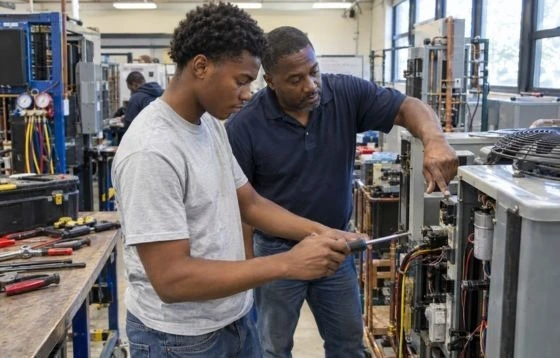
Building a trade career with no experience becomes manageable when you break it into concrete steps. Here is the practical sequence most successful students follow.
The through-line is simple. Each step replaces something you started without — experience, connections, or confidence — with something concrete and earned.
Philadelphia and the surrounding region give someone starting from nothing a real runway. The area’s mix of construction, shipbuilding, manufacturing, healthcare facilities, and infrastructure work keeps demand for skilled trades steady, which matters when you are counting on your new skills to lead to a paycheck.
That demand reaches well beyond the city center. Graduates of a trade school in Philadelphia find opportunities across North, South, and West Philadelphia, and into nearby communities such as Yeadon, Lansdowne, Darby, and Drexel Hill, as well as South Jersey towns including Camden, Pennsauken, Cherry Hill, and Collingswood. Because trade skills and certifications are portable, training centrally in Philadelphia positions you to take work wherever the best opportunity appears across Pennsylvania, New Jersey, and Delaware.
For a career changer or first-time earner, that geographic breadth is a safety net. You are not dependent on a single employer or one corner of one industry; you are entering a regional workforce that consistently needs the skills you are building.
So, can you build a trade career starting from nothing — no money, no experience, no connections? Yes. The skilled trades remain one of the clearest, most honest paths from zero to a stable, well-paying career, precisely because they reward what you can do rather than what you arrive with. With focused, hands-on training, realistic options for affordability, and genuine trades that pay well without a degree in demand across the Philadelphia region, the gap between “starting over” and “starting work” is measured in months, not years.
If you are ready to take that first step, explore PTTI’s skilled trades programs and talk with admissions about the training path and the financial options that fit your situation.
Yes. The skilled trades hire based on demonstrated ability, and a trade career with no experience is realistic with hands-on training. For students with no money upfront, financial aid, payment plans, scholarships, and veteran benefits can make trade school accessible, depending on eligibility.
Welding, pipefitting and steamfitting, HVAC, automotive repair, manufacturing and automation, and sterile processing are all trades that pay well without a degree. Earnings vary by trade, experience, certification, and location, but many offer solid pay with no four-year degree required.
Most trade programs take under a year, with many running six to twelve months for entry-level readiness. The focused, skills-based format is what makes finishing quickly possible, which is a major advantage over a four-year degree for anyone who needs to start earning soon.
No. Employers in the skilled trades hire on ability, not networks. Training at a school with employer relationships and career services can give a beginner direct introductions, interview preparation, and job leads that replace the connections you may not have.
Talk to a trade school about both program options and affordability. Learning what financial aid or payment plans you qualify for turns cost from a barrier into a plan, and enrolling in hands-on trade training is the concrete bridge from “no experience” to a working career.