
If you are weighing a future in the skilled trades, one question dominates the conversation: is pipefitting harder than plumbing to learn? Both trades move liquids and gases through pipes, both pay well, and both stay in steady demand. Yet they are not the same job, and the training does not feel the same either. Any honest plumbing vs pipefitting career discussion has to start by admitting that “harder” means different things depending on the person and the type of work.
The straight answer to the question, is pipefitting harder than plumbing, is that it depends on the kind of difficulty you are measuring. Pipefitting leans on precision, math, and welding inside high-pressure industrial systems. Plumbing leans on code knowledge, licensing, and adaptable troubleshooting across unpredictable residential and commercial jobs. This is exactly the kind of skilled trades career comparison that deserves a clear, experience-based look rather than a one-line verdict.
This guide delivers that honest comparison. It covers what each trade actually involves, where the learning curve is steepest, how salary and job outlook stack up, what licensing and certifications each path requires, and how the right pipefitting training in Philadelphia can shorten your route into either trade. It is written for high school students, recent graduates, career changers, veterans, and adult learners across the Philadelphia region who want to make a confident, informed decision.
Different kinds of hard: In this skilled trades career comparison, pipefitting leans on precision, math, and welding, while plumbing leans on code, licensing, and residential troubleshooting.
Pipefitting is more industrial: Pipefitters work with high-pressure steam, process, and mechanical systems, so tolerances and safety stakes run higher.
Plumbing is more code-driven: Plumbers must master local codes and typically hold a license, adding regulatory complexity.
Pay is strong for both: Nationally, plumbers, pipefitters, and steamfitters earn a median near $63,000, with top earners exceeding $105,000.
Steady demand: About 44,000 openings per year are projected nationally through 2034, driven largely by retirements.
Training shortens entry: Hands-on training builds job-ready pipefitting skills in months before an apprenticeship begins.
Local opportunity: Philadelphia’s industrial base, hospitals, and construction market keep both trades in demand.

Pipefitting and plumbing both involve installing and maintaining piping, but they serve different systems. Plumbers focus on water supply, drainage, waste, and venting in homes and buildings. Pipefitters focus on high-pressure and industrial piping that carries steam, chemicals, gases, and process fluids in factories, power plants, and commercial mechanical systems.
That difference in setting shapes everything else about the two trades. A plumber’s day often moves between residential and commercial jobs, diagnosing leaks, installing fixtures, and ensuring systems meet local code. A pipefitter’s day is more likely to involve fabricating and fitting pipe to tight tolerances, welding joints, reading complex isometric drawings, and working within pressurized systems where a small error carries large consequences. For a deeper look at how the roles diverge, PTTI’s breakdown of how pipefitting differs from plumbing is a useful starting point.
Understanding this distinction is the foundation of any fair skilled trades career comparison, because the honest answer to is pipefitting harder than plumbing changes depending on which of these two worlds you step into.
Pipefitting is often considered technically harder to learn because it requires precise measurement, applied math, blueprint interpretation, and welding skill within high-pressure industrial systems. Plumbing is not easier so much as differently demanding, emphasizing local code mastery, licensing, and adaptable troubleshooting across varied residential and commercial jobs.
Many students ask, “is pipefitting harder than plumbing?” before they enroll, hoping for a simple ranking. The more useful answer breaks the difficulty into two separate learning curves.
Pipefitting concentrates several demanding skills into one role. New students often find these the steepest parts of the climb:
Because pipefitting blends fabrication, welding, math, and mechanical systems, many instructors consider its early learning curve steeper. Students exploring this path often review the most in-demand pipefitting skills before committing, so they understand what the trade actually asks of them. Structured pipefitting training in Philadelphia is designed to make that curve manageable rather than overwhelming.
Plumbing carries its own difficulty, which is easy to underestimate:
So when someone asks is pipefitting harder than plumbing, the fairest answer is this: pipefitting is usually harder on the technical and fabrication side, while plumbing is harder on the regulatory, licensing, and customer-facing side. That framing matters more in a plumbing vs pipefitting career choice than any single “harder” label.
The table below summarizes the practical differences that matter most in this skilled trades career comparison.
| Factor | Pipefitting | Plumbing |
| Primary systems | Steam, gas, process, high-pressure industrial | Water supply, drainage, waste, venting |
| Typical setting | Factories, plants, commercial mechanical rooms | Homes, businesses, commercial buildings |
| Core skills | Welding, fabrication, isometric drawings, precise layout | Code knowledge, fixture install, diagnostics |
| Math intensity | Higher (offsets, angles, pressure) | Moderate |
| Licensing | Often certification-based, no universal state license | Licensing/registration typically required |
| Customer interaction | Lower, more crew-based | Higher, more client-facing |
| Learning curve | Steeper technically early on | Steeper on code and regulation |
Neither column is “better.” A sound plumbing vs pipefitting career decision depends on whether you would rather master fabrication and industrial systems or code, service, and customer problem-solving. For a broader view, PTTI’s overview of the pipefitter career path, roles, and salary adds helpful context.
Learning how to become a pipefitter follows a clear, repeatable path, and it is more accessible than most beginners expect. You do not need a four-year degree or years of prior experience. You need foundational training, the right certifications, and hands-on practice on real equipment.
Here is the typical route for how to become a pipefitter from a standing start:
This is why understanding how to become a pipefitter is really a question of choosing the right training, not gathering years of experience first. Students who want a realistic on-ramp often review how to become a pipefitter with no experience, which lays out each step in plain terms. The same fundamentals learned in quality pipefitting training in Philadelphia apply whether you plan to work locally or take your skills elsewhere.
Both trades follow a similar arc: foundational training, then an apprenticeship to reach journeyman level. A focused steam and pipe fitting program can compress the foundational phase into months, giving you real skills before you enter the field, while the apprenticeship that follows typically runs several years to full journeyman status.
The key insight for beginners is that you do not have to learn everything before you start earning. Effective pipefitting training in Philadelphia builds the core competencies employers and apprenticeship sponsors expect, so you enter the workforce as a credible candidate rather than starting from zero. For a demanding trade, the precision and safety habits that define good pipefitting are built through repetition on real equipment, which is why lab time matters so much in the early phase of any steam and pipe fitting program.
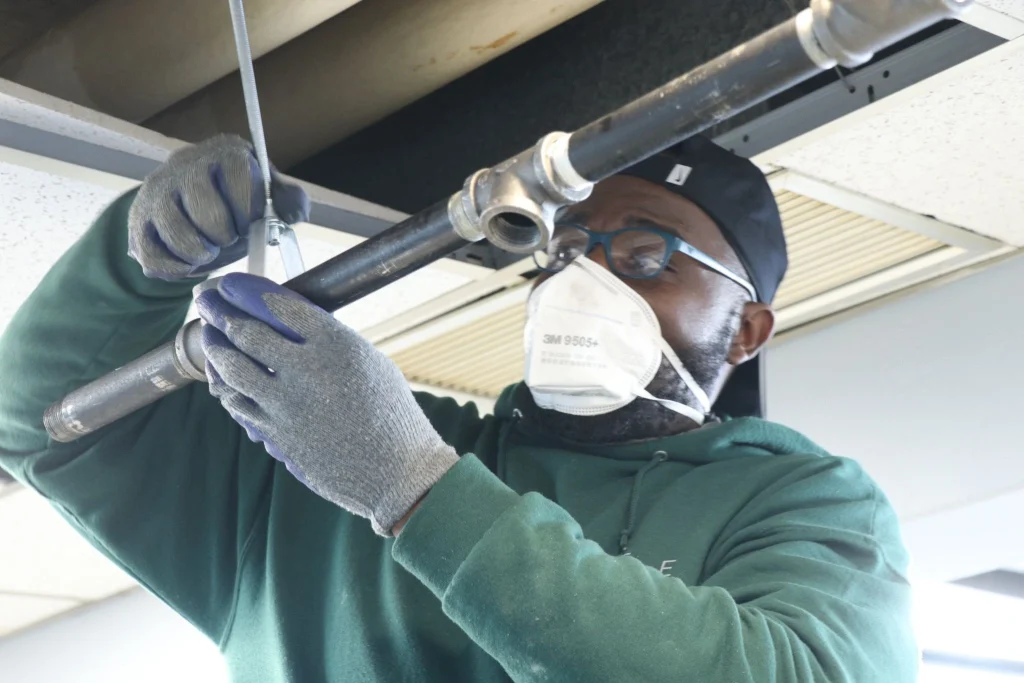
Plumbers usually need a license or registration, and in Philadelphia licensed plumber requirements are enforced at the local level. Pipefitters generally do not need a single state license, but they rely heavily on certifications such as welding qualifications and industry credentials that prove their skill to employers.
This is one of the clearest practical differences in the plumbing vs pipefitting career comparison. Plumbing’s path is more formalized through licensing, while pipefitting’s path is proven through demonstrated, testable skill. In both cases, credentials matter, but they take different forms:
Because pipefitting rewards stackable, verifiable skills, students frequently pair it with welding. Anyone interested in that combination should compare the pipefitter versus welder career paths to see how the skills reinforce one another. Certification readiness is a core reason to choose structured pipefitting training in Philadelphia over learning piecemeal on the job.
Pay is strong in both trades. The Bureau of Labor Statistics groups plumbers, pipefitters, and steamfitters together and reports a median wage of roughly $63,000 per year, with the top 10 percent earning more than $105,000. Entry-level pay starts lower, and experienced, certified, or union workers earn the most.
When people research the pipefitter salary in Pennsylvania, they usually find figures a little above or below that national midpoint, depending on region, employer, and specialization. Philadelphia and the surrounding counties tend to pay competitively thanks to a strong union presence and steady industrial demand. Several factors push earnings higher: certifications, specialization, union membership, overtime, and industrial or high-demand work.
| Career Stage | Approximate Annual Range (Region) |
| Entry-level / apprentice | $40,000 – $50,000 |
| Experienced journeyman | $60,000 – $80,000 |
| Certified / specialized / union | $90,000 – $105,000+ |
The pipefitter salary in Pennsylvania climbs meaningfully as you add welding certifications and move into industrial and turnaround work. Licensed plumbers who run service work or move into commercial projects can reach a similar ceiling, which is why pay alone rarely settles a plumbing vs pipefitting career decision. A realistic pipefitter salary in Pennsylvania rewards skill and credentials more than seniority alone, so the better question is which work you will enjoy enough to master. For a wider view of trade earnings, PTTI’s guide to Philadelphia trade jobs that pay well without a degree puts these numbers in context.
The job outlook is steady and dependable. Nationally, the Bureau of Labor Statistics projects about 44,000 openings each year for plumbers, pipefitters, and steamfitters through 2034, with much of that demand driven by experienced workers retiring. That replacement demand creates consistent opportunity for newly trained workers, and it strengthens the case for the pipefitter salary in Pennsylvania holding firm over the coming decade.
Several forces reinforce demand across the Philadelphia region specifically:
This diversity matters. Whether you choose the plumbing side or the pipefitting side, your skills transfer into a market that is not tied to a single employer or industry. Readers exploring long-term stability can review why pipefitting technicians remain in demand in 2026.

Choosing in this skilled trades career comparison comes down to how you like to work and what kind of difficulty energizes you rather than drains you. Use these honest prompts:
There is no wrong answer here, only a better fit. Many students discover their preference only after getting their hands on real equipment, which is exactly why hands-on training beats trying to decide in the abstract. If you are still comparing, PTTI’s article on whether a pipefitter is the same as a plumber clarifies the day-to-day reality of each role and makes this skilled trades career comparison easier to navigate.
For students leaning toward the industrial side, hands-on training is the fastest route to job readiness. PTTI’s Steam, Sprinkler & Pipe Fitting technician program is a steam and pipe fitting program built around the practical skills employers and apprenticeship sponsors expect: pipe fabrication, layout, system installation, safety discipline, and the fundamentals that make the steep early learning curve manageable.
What makes pipefitting training in Philadelphia effective for a demanding trade is the environment. Practicing on industry-standard equipment, under instructors with real field experience, is how precision and safety habits become second nature. Prospective students can see that environment firsthand at the Steam, Sprinkler & Pipe Fitting campus, where the learning mirrors the job site.
Because pipefitting rewards stackable skills, this steam and pipe fitting program also positions graduates to keep growing, adding certifications, moving toward union apprenticeships, and specializing over time. That is the practical advantage of building pipefitting skills on a strong foundation rather than by trial and error on the job, and it is central to protecting a strong pipefitter salary in Pennsylvania over a full career.
So, is pipefitting harder than plumbing? Technically, pipefitting usually presents a steeper early climb because of its precision, math, and welding demands, while plumbing challenges you more through code, licensing, and customer-facing diagnostics. In this full skilled trades career comparison, the question is pipefitting harder than plumbing matters less than which trade fits you, because both pay well, stay in demand, and reward people who commit to the craft.
The most reliable way to settle your own plumbing vs pipefitting career decision is to train with your hands on real equipment and let the work tell you. For students across the Philadelphia region leaning toward the industrial side, structured, hands-on training is the fastest path from curious beginner to job-ready technician.
Ready to take the next step? Explore PTTI’s skilled trades programs, request information from admissions, or schedule a campus visit to see the pipefitting labs in person. If you have questions about how to become a pipefitter, contact the PTTI team to learn how quickly you could begin.
Whether pipefitting is harder than plumbing depends on the difficulty you mean. Pipefitting is often technically harder because it requires precise measurement, applied math, blueprint reading, and welding within high-pressure systems. Plumbing is differently demanding, emphasizing code mastery, licensing, and adaptable troubleshooting.
Plumbers install and repair water, drainage, and waste systems mostly in homes and buildings, while pipefitters work with high-pressure industrial piping that carries steam, gas, chemicals, and process fluids in plants and commercial settings. The setting and systems are the core difference in any plumbing vs pipefitting career discussion.
Pay is comparable because the Bureau of Labor Statistics groups them together, reporting a median near $63,000 and top earners above $105,000. The pipefitter salary in Pennsylvania rises with welding certifications and industrial work, while licensed plumbers on commercial or service work can reach a similar ceiling.
The clearest way to learn how to become a pipefitter is to enroll in a hands-on steam and pipe fitting program, master fabrication, layout, welding, and safety, then earn certifications and enter the field or an apprenticeship. Quality pipefitting training in Philadelphia builds those job-ready skills in months.
Pipefitters generally do not need a single state license, but they rely on certifications such as welding qualifications and industry credentials. Plumbers, by contrast, typically need a license or registration, and Philadelphia enforces licensed plumber requirements locally.
Yes. With about 44,000 annual openings projected nationally through 2034, strong regional demand, and work that is difficult to automate, pipefitting offers steady, well-paying opportunity and a dependable pipefitter salary in Pennsylvania.
Guide to pipefitting basics : Beginning of a career
The most in demand pipefitting skills in 2026
Demand for pipefitter : What is the future of pipefitter