
If you are weighing two hands-on career paths, the pay question matters, and the honest answer is more interesting than a single number. When you compare masonry vs. auto manufacturing jobs using current federal wage data, masonry edges out most entry-level factory and assembly roles at the median, while advanced manufacturing and automation jobs can out-earn both. Where you land depends on the specialty you choose and how far you push your skills.
This guide breaks down masonry vs. auto manufacturing jobs the way a hands-on masonry training instructor or a workforce advisor would: real salary ranges from the U.S. Bureau of Labor Statistics, the local Philadelphia job picture, the day-to-day work, and the training it actually takes to start. By the end, you will understand which path pays more, which grows faster, and how to pick the one that fits your goals rather than someone else’s headline. Both routes are legitimate skilled trades that reward people who show up, learn the craft, and earn the right certifications.
Here is the quick side-by-side before we dig into each path. All wage figures are national medians from the Bureau of Labor Statistics (May 2025); local Philadelphia pay varies with union membership, overtime, specialization, and employer.
| Factor | Masonry Careers | Auto Manufacturing Jobs |
| Typical median pay | Brickmasons ~62,120;cementmasons~57,020 | Assemblers ~45,450;autotechnicians~50,620; industrial machinery mechanics ~$64,520 |
| Entry education | High school diploma + training | High school diploma + training |
| Work setting | Outdoor and indoor job sites | Plants, shops, and production floors |
| Projected growth (2025–35) | Slow (~1–2%) | Mixed: assembly slow, automation strong (~18%) |
| Physical demand | High | Moderate to high |
| Fast local entry | Yes | Yes |
The headline takeaway: the typical masonry salary beats basic factory assembly and tops the median auto repair technician, but the single highest-paying lane in this comparison sits inside modern manufacturing, specifically automation and industrial maintenance. That nuance is exactly why the “which trade pays more” question deserves a real answer instead of a slogan.
Masonry pays competitively for a trade you can enter without college debt. According to the BLS (May 2025), brickmasons and blockmasons earn a median of about $62,120 per year, cement masons and concrete finishers about $57,020, and masonry workers overall about $58,270, or roughly $28 an hour. In a union-strong market like Philadelphia, experienced masons often earn more.
Masonry salary grows with specialization and reputation. A mason who can lay clean brick, finish structural concrete, read layout, and run a crew becomes far more valuable than someone who only handles one task. Masonry careers also reward reliability: contractors pay a premium for tradespeople who produce quality work on schedule, because a bad pour or a crooked wall is expensive to fix.
The work itself is physical and visible. Masons build and repair walls, walkways, foundations, chimneys, and façades using brick, block, stone, and concrete. It is demanding, outdoor-heavy work, but many people in the skilled trades prefer it precisely because the result is something real you can point to at the end of the day. For someone who wants fast entry, strong pay, and tangible work, masonry remains one of the trades that pay well without a degree.

“Auto manufacturing jobs” covers a wide pay range, so the answer depends on the role. Basic assembly and fabrication work sits at the lower end, around $45,450 a year (BLS, May 2025). Automotive service technicians earn about $50,620. But industrial machinery mechanics, the people who keep modern production lines and automated equipment running, earn about $64,520, the highest figure in this comparison.
That spread is the single most important thing to understand about auto manufacturing work. The factory floor is no longer just repetitive line work. Today’s plants run robotics, programmable controls, and automated systems that require trained technicians to install, troubleshoot, and maintain. Those advanced manufacturing roles are where the strongest pay and the fastest growth live, which is why training in manufacturing automation and robotics has become one of the smarter moves in the skilled trades.
There is a second lane worth naming. If you are drawn to vehicles specifically, automotive repair technology training leads to work diagnosing and fixing increasingly computerized cars, including hybrid and EV systems. Auto technician pay starts moderate but rises with certifications and specialization, and the BLS projects faster-than-average growth for the field. Across all of these roles, the pattern holds: the more technical your skill set, the more you earn.
Over a full career, the ceiling is highest in advanced manufacturing automation, followed closely by skilled union masonry, while entry assembly and general auto repair start lower but still climb with experience. The best-paying path is not the one with the nicest starting number; it is the one where you keep stacking skills and certifications.
Three factors move your pay more than the trade label itself. First, specialization: a mason who finishes architectural concrete or an automation technician who programs controls earns well above a generalist. Second, certifications and licensing, which signal verified skill to employers. Third, location and union status, and here Philadelphia’s strong building-trades presence works in a mason’s favor, while the region’s manufacturing base rewards technical maintenance roles. When people ask what trade makes the most money, the honest answer is the one you commit to mastering.
This is also where choosing the best overall value matters. Smart students weigh tuition cost, program length, hands-on training quality, and realistic starting pay together, not in isolation. A shorter, skills-focused program that gets you earning sooner can outperform a longer, pricier path on total return, which is a core reason many students choose a focused trade school in Philadelphia over a traditional four-year degree.
The outlook is where masonry vs. auto manufacturing jobs diverge most. Masonry employment is projected to grow only about 1 to 2 percent through 2035 (BLS), though roughly 18,400 openings a year still appear, mostly from retirements. Auto manufacturing is mixed: assembly work is projected to grow slowly, but industrial machinery mechanics are projected to grow about 18 percent, well above average.
For masonry, slow projected growth does not mean weak demand. An aging workforce means experienced masons are retiring faster than new ones enter, so masonry careers are genuinely open to skilled newcomers across Philadelphia and the surrounding counties for infrastructure repair, commercial construction, and restoration. The work is also difficult to automate, which protects it.
For manufacturing, the story is about modernization. As plants adopt automation, the demand shifts from manual line labor toward technicians who can run and repair smart systems. That is the lane adding jobs the fastest. Both paths reward people who keep learning, but if long-term growth is your priority, advanced manufacturing automation currently has the edge, while masonry offers steadier, less technology-dependent stability.
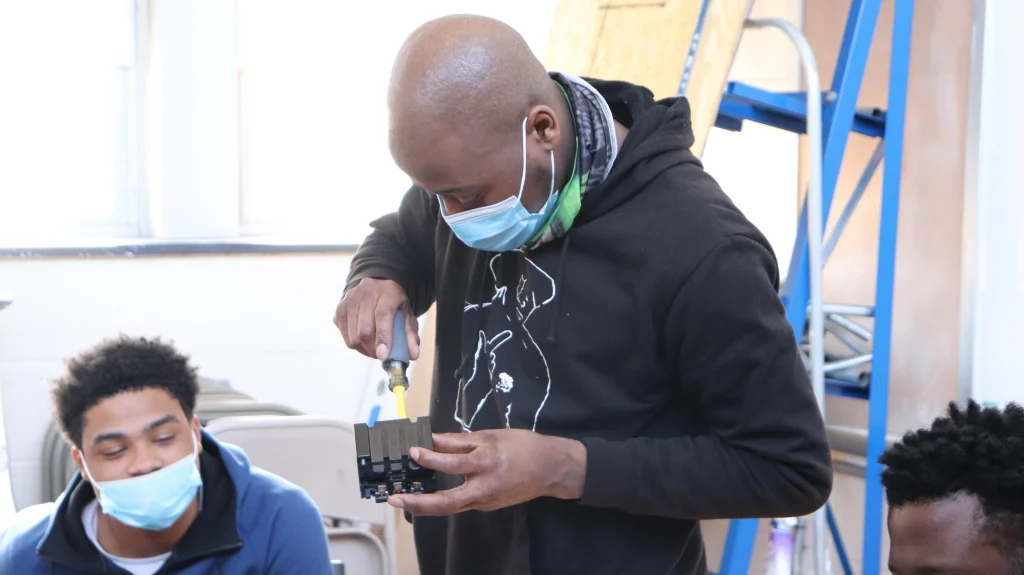
You can train for either path at a hands-on trade school in Philadelphia without taking on four-year college debt. Both masonry and manufacturing careers start with a high school diploma or GED plus focused technical training that builds real job-site skills, which is exactly what regional employers screen for when they hire.
The right program matters more than most students realize. For masonry, look for a school that teaches concrete, brick, block, and framing with genuine job-site-style practice rather than lecture alone, because contractors hire for demonstrated skill. Philadelphia Technician Training Institute (PTTI) built its concreting, masonry, and framing program around that hands-on standard, serving students across North, South, and West Philadelphia and nearby communities in Pennsylvania and New Jersey.
For the manufacturing side, the question is where to learn automation without going to a traditional college. A strong program covers industry-standard equipment, safety, and the automated systems employers actually run, so graduates walk in job-ready. Prospective students can compare options and timelines directly with the PTTI admissions team to match a program to their goals, schedule, and budget before committing.
Choose based on fit, not just the salary chart. Masonry rewards people who want physical, outdoor, visibly finished work and a strong union-market masonry salary. Auto manufacturing jobs, especially automation and diagnostics, reward people who like technology, systems, and troubleshooting. Both masonry careers and modern manufacturing roles are respected skilled trades with real local demand.
Ask yourself a few practical questions. Do you prefer being on a construction site or inside a plant or shop? Do you want to work with your hands on structures, or with tools and technology on machines and vehicles? Are you optimizing for fast, steady entry or for the highest long-term growth lane? Your honest answers point you toward the better choice more reliably than any single pay figure, because job satisfaction keeps people in a trade long enough to reach the higher earning tiers.
Does masonry or auto manufacturing pay more?
At the national median, masonry pays more than basic auto-manufacturing assembly and more than the typical auto repair technician, with brickmasons around $62,120 versus about $45,450 for assemblers (BLS, May 2025). However, advanced manufacturing roles like industrial machinery mechanics (about $64,520) out-earn both, so the highest pay sits in automation.
Which skilled trade pays the most without a degree?
Among the paths compared here, manufacturing automation and industrial maintenance currently offer the highest median pay, closely followed by skilled union masonry. In every case, specialization and certifications raise earnings far more than the trade label alone, and none of these careers require a four-year degree to begin.
Is masonry a good career in 2026?
Yes. Although projected growth is slow, steady retirements create ongoing openings, masonry salary is competitive, and the work is hard to automate. For someone who wants durable, hands-on skilled trades work with strong local demand in the Philadelphia area, masonry careers remain a solid choice.
Are auto manufacturing jobs being replaced by automation?
Basic assembly work is growing slowly as automation spreads, but automation is creating demand for technicians who install, program, and maintain smart equipment. Rather than eliminating opportunity, it shifts auto manufacturing jobs toward higher-skilled, higher-paying technical roles.
How long does trade school take for these careers?
Focused programs are built for fast entry, typically well under the time of a traditional degree, so students can start earning sooner. Exact length varies by program and schedule, so confirm current timelines and costs with the trade school in Philadelphia you are considering.
The masonry vs. auto manufacturing jobs question does not have a one-word winner, and that is good news: it means you get to choose the path that fits you. Masonry offers a strong masonry salary, steady local demand, and satisfying hands-on work. Auto manufacturing jobs span a wide range, with the best pay and fastest growth concentrated in automation and advanced maintenance. Both are legitimate skilled trades you can enter quickly with the right hands-on training, and in a union-strong, manufacturing-active region like Philadelphia, graduates of either path can build a stable, well-paying career.
Ready to take the next step? Explore PTTI’s hands-on trade programs or connect with admissions to find the masonry or manufacturing path that matches your goals.