
You run the machine. You hold tolerance. You catch problems before they scrap a part. Then a robot arrives on the floor, and someone tells you the future is automated. That news lands like a threat. It should not.
Here is the reality that shop-floor data supports. Automation does not delete the person who understands the process. It promotes them. Someone must install the cell, program the logic, and fix it at 2 a.m. when production stops. That person earns more than the operator did. Often, that person used to be the operator.
This guide maps the move from CNC to automation technician in plain terms. You will see the real career ladder, the pay at each rung, the skills that transfer, and the gap you must close. You will also see why Philadelphia is a practical place to make that jump.
Manufacturing did not shrink. It changed shape. Plants now run tighter cycles, tighter tolerances, and far more connected equipment. As a result, the value on the floor shifted. It moved away from running one machine. It moved toward keeping an integrated system running.
That shift is why the CNC to automation technician path exists. It is not a lateral move. It is a promotion built on skills you already started building.
Industry 4.0 is a buzzword, but the floor-level meaning is simple. Machines now talk to each other. Sensors report status constantly. PLCs coordinate the sequence. Robots handle repetitive motion.
Every one of those systems fails sometimes. When a cell goes down, the plant loses money by the minute. So employers pay most for the person who can find the fault fast. That person reads the ladder logic, checks the sensor, tests the actuator, and restores production.
Notice what this means. Automation did not remove the need for judgment. It concentrated that judgment into fewer, better-paid roles.
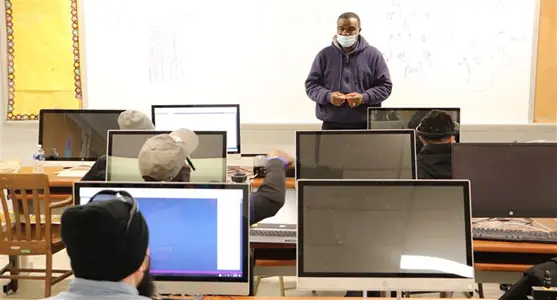
Philadelphia still makes things. Fabrication shops, food and beverage plants, packaging operations, life-sciences facilities, and logistics automation all run equipment daily. Each of those employers depends on controlled, sensor-driven systems.
That matters for anyone weighing advanced manufacturing careers here. The work sits across the region, not in one neighborhood. Plants and distribution operations run from North Philadelphia and the Allegheny West corridor out to Delaware County communities like Drexel Hill and Darby. They also run across the river in Camden, Pennsauken, and Cinnaminson.
Because the skill is portable, training centrally in Philadelphia opens the whole regional market. PTTI’s Manufacturing and Automation Program sits on West Girard Avenue, within reach of that entire footprint.
Automation is reshaping CNC work rather than erasing it. Federal projections show machine-operator and machinist roles flat or declining, while automated-equipment maintenance roles grow sharply. So the risk is not unemployment. The risk is standing still on a rung that no longer rises.
The data tells a clear story. Read the three projections together, because the contrast is the whole point.
According to the U.S. Bureau of Labor Statistics, employment of metal and plastic machine workers is projected to decline 7% from 2024 to 2034. Machinists are projected to decline 2% over the same decade. However, industrial machinery mechanics, machinery maintenance workers, and millwrights are projected to grow 13%. BLS calls that growth “much faster than the average for all occupations.”
That is the ladder, stated in federal data. The rungs closest to running machines are flat. The rung that keeps automated machines running is climbing.
One more number matters. BLS projects roughly 54,200 openings each year for those maintenance and millwright roles. Many come from retirements. Experienced techs are leaving faster than new ones arrive.
Think about what installing a robotic cell actually requires. Someone specifies the sensors. Someone writes and tests the logic. Someone integrates the safety circuit. Someone commissions the cell. Then someone maintains it for the next decade.
None of that happens by itself. A robot is a tool that expands what one skilled person can supervise.
Employers still pay for human judgment. These skills stay valuable:
PTTI covers this reality directly in its look at why AI can’t replace skilled trades jobs, which is worth reading alongside this guide.
The manufacturing career path is a ladder, not a lottery. You start by running equipment. You advance by understanding it. You advance again by controlling it. Each rung adds responsibility, and pay follows responsibility. Here is what each step looks like in practice.
You load material, run the program, check parts, and hold quality. You learn tooling, feeds, speeds, and inspection. This rung teaches discipline and attention to tolerance. Those habits matter later.
The limitation is real, though. Operating is the rung most exposed to automation, which the declining projections reflect.
Now you set up jobs, read complex prints, and make judgment calls. You understand why the process works, not only how to start it. Pay improves, and so does security.
Still, this rung sits in a slow-growth occupation. CNC career growth from here depends on adding a new capability, not more hours.
Here the ladder turns upward. You install, maintain, and troubleshoot automated systems. You work with PLCs, sensors, actuators, hydraulics, pneumatics, and robotic cells. When a line stops, the plant calls you.
This is the rung the robotics technician career path is built around, and it is where most CNC professionals should aim first.
At the top of the technician track, you focus on the logic and instrumentation that drive the process. You tune systems, refine control sequences, and support integration. This rung demands the deepest electrical and programming knowledge.
| Rung | Role | Median Annual Pay (BLS, May 2024) | Outlook 2024–34 |
| 1 | Metal & plastic machine workers | $46,800 | −7% |
| 2 | Machinist | $56,150 | −2% |
| 3 | Industrial machinery mechanics & millwrights | $63,510 | +13% |
| 3–4 | Electro-mechanical & mechatronics technicians | $70,760 | +1% |
| 4 | Electrical & electronic engineering technicians | $77,180 | +1% |
Source: U.S. Bureau of Labor Statistics, Occupational Outlook Handbook, May 2024 medians. National figures; regional pay varies by employer, shift, and overtime.
The spread from rung one to rung four exceeds $30,000. That gap is the reason to move.
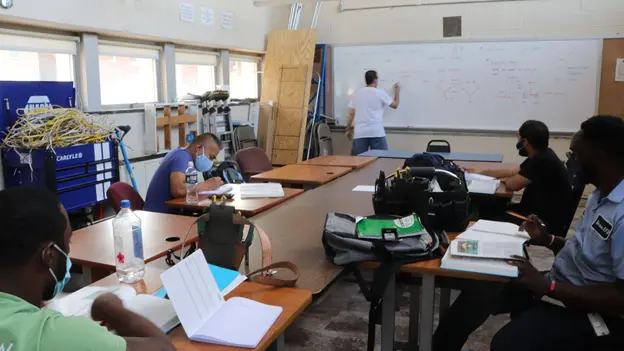
Moving from CNC to robotics means adding controls knowledge to the mechanical skills you already own. You keep your print reading, tolerance discipline, and process judgment. Then you add PLC programming, sensors, hydraulics, pneumatics, and troubleshooting. Structured, hands-on training closes that gap in months.
Do not underestimate your starting position. Shop-floor experience gives you real advantages:
Employers value this. A trained automation tech who has never run production often misses context. You will not.
The gap is specific and teachable. You need to control systems, not just operate them:
Beginners often ask where to get hands-on training in robotics or manufacturing automation. The answer should always involve real equipment and real lab hours.
PTTI’s program is built around the exact gap described above. It runs 26 weeks. The curriculum is 80% hands-on. That structure exists because controls work is learned by doing, not by watching.
Importantly, this program does not teach CNC machining. It teaches the automation layer that sits above it. If you already bring machining or shop-floor experience, the fit is direct.
The curriculum covers six connected areas:
Two themes repeat across the curriculum: mechatronics and troubleshooting the relationship between PLC and robotic systems. That is precisely what rung three requires.
Employers do not hire on coursework. They hire on capability. An automation tech must wire a sensor correctly, trace a fault, and restore a line under pressure.
You build that ability through repetition on real equipment. PTTI students set up, configure, and tune actual instrumentation and control stations. They troubleshoot PLC hardware and wiring problems, then take corrective action. Graduates of this approach often arrive ahead of college peers on practical readiness.
Certifications function like currency on the floor. They give an employer third-party proof that you can work safely and competently. For anyone climbing from CNC to automation technician, credentials shorten the interview.
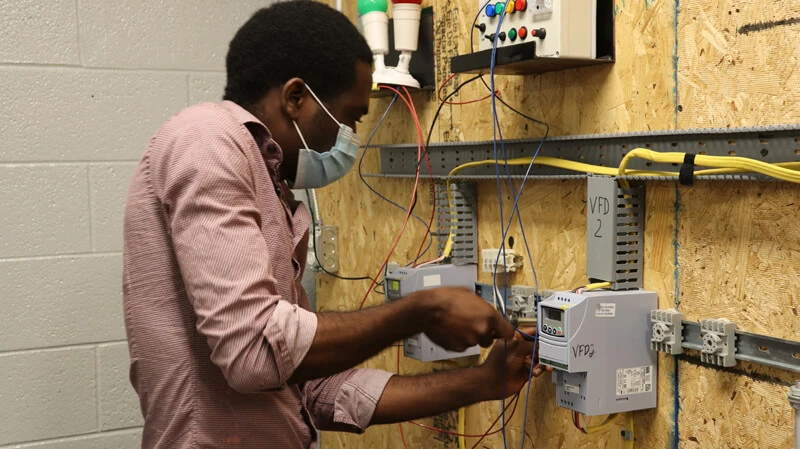
Safety credentials come first in industrial settings. Employers treat safe practice as non-negotiable around energized equipment and moving machinery. Foundational credentials show you understand that before you touch a panel.
PTTI’s program includes certification opportunities as part of the training experience. The school also breaks down which skilled trade certifications matter most, including OSHA and NCCER, which is useful context when planning your path.
Beyond formal credentials, certain demonstrated skills carry weight:
Employers increasingly want breadth here. PTTI explores this in its analysis of why employers prefer multi-skilled trades workers. A CNC background plus controls training is exactly that combination.
You earn more in manufacturing by adding capability, not by adding years. Pay rises when you can do something the plant cannot easily replace. Controls knowledge, robotics troubleshooting, and instrumentation are the clearest levers available today.
Time served raises pay slowly. Capability raises it in steps. Look again at the ladder table above. The jump from machinist to automation and mechatronics roles is worth roughly $14,000 to $21,000 in median terms.
So stack deliberately:
Each addition makes you harder to replace and easier to promote.
Where you work matters as much as what you know. Plants that run continuous or automated production feel downtime most. Those employers pay for fast diagnosis.
Across the Philadelphia region, look toward packaging and food production, life-sciences and pharmaceutical facilities, logistics automation, and metal fabrication. Demand is not confined to the city, either. Opportunities extend through Delaware County and into South Jersey communities such as Camden and Maple Shade.
PTTI supports this step through Careers & Jobs Opportunities and reports a 92% job placement rate for students who complete its manufacturing training program. The school notes that placement rates vary month to month and represent an average over a sample period.
Not every path to advanced manufacturing careers works equally well. The differences are practical, and they show up in interviews.
A four-year degree takes years and often heavy debt. It also delays earning. An engineering degree prepares you to design systems, which is a different job.
A focused program aims at the technician role directly. PTTI’s runs 26 weeks. You reach the hiring conversation far sooner, with the specific skills employers screen for.
Online courses can explain ladder logic. They cannot let you miswire a sensor and trace the fault. Controls work is physical. You need panels, sensors, actuators, and equipment that misbehaves.
Self-teaching has the same ceiling, plus two more gaps. You get no certification structure and no employer connections. Generic vocational programs often fail differently, by teaching theory broadly without depth on real equipment.
The distinction comes down to five things employers actually test:
Practical questions decide whether people finish. So here are the real numbers and structures.
Tuition and fees for the Manufacturing and Automation Program total $18,038, plus a $150 registration fee and a $12 insurance fee. That brings total tuition to $18,200. Books and supplies are $0.
Financing may be available through grants, scholarships, federal and private loans, and institutional financing plans. PTTI’s financial aid team walks students through each step, including entrance counseling and repayment planning.
If you currently run a machine, you cannot quit to retrain. PTTI runs morning classes from 8:00 a.m. to 3:00 p.m. and evening classes from 3:00 p.m. to 10:00 p.m. That flexibility exists for working adults and career changers.
Support continues beyond the lab. At roughly 700 hours, students enter professional development through Career Services. That includes resume writing, career identification, and interview coaching. The curriculum also offers internships and externships to build a portfolio.
Not sure this is your track? The Program Matchmaker Quiz helps you compare it against PTTI’s other programs before you commit.
Automation is not the thing that ends your manufacturing career. It is the thing that advances it, provided you move. The CNC to automation technician path rewards people who already understand production and choose to learn the controls layer above it.
The data supports the move. The Philadelphia employer base supports it. What remains is the decision.
Take the Program Matchmaker Quiz to confirm the fit. Then schedule an appointment to see the automation lab, or contact admissions to talk through your timeline. Bring the experience you already have. Add the skills that pay for it.
How do I move from CNC to robotics? Keep your mechanical skills and add controls knowledge. You need PLC programming, sensors, hydraulics, pneumatics, and mechatronics troubleshooting. PTTI’s 26-week Manufacturing and Automation Program teaches exactly that layer, with an 80% hands-on curriculum built for people who already understand the shop floor.
What is the career path in manufacturing? The ladder runs from CNC operator to machinist, then to automation and robotics technician, and finally toward controls. Each rung adds responsibility and pay. The largest jump comes when you move from operating equipment to maintaining and programming automated systems.
Will automation replace CNC jobs? Automation is reshaping the work, not eliminating people who understand it. BLS projects machinist roles to decline 2% through 2034, while industrial maintenance roles grow 13%. Automated systems still need technicians to install, program, and troubleshoot them, which is where PTTI’s training points.
How do I earn more in manufacturing? Add capability rather than waiting for seniority. Median pay climbs from roughly $46,800 for machine operation to $70,760 for mechatronics roles. Controls, PLC, and robotics troubleshooting are the clearest levers, and PTTI’s program is structured around those specific skills.
Do I need a degree to become an automation technician? No. Employers hire on demonstrated capability with PLCs, sensors, and automated systems. A focused, hands-on program is a faster and more direct route. PTTI’s program takes 26 weeks and includes certification opportunities plus career services support toward employment.