
HVAC training gets you ready for one of the most stable trades in the country. You’ll learn refrigeration, electrical systems, and real diagnostic skills, all before you ever step onto a job site. Therefore, this guide breaks down exactly what a strong HVAC training program covers and how it leads straight to a paycheck.
Demand for HVAC technicians is increasing day by day due to rapid construction, and it continues to rise. HVAC jobs are projected to grow 8 percent from 2024 to 2034, far faster than average, with about 40,100 openings every year. This skilled trade program allows a customized career path. Real estate companies hire lots of HVAC technicians. You can start your own business or work with a local business owner. Additionally, new refrigerants and smart diagnostic tools mean today’s technicians need current, hands-on training, not outdated textbook knowledge.
Overall, that combination makes HVAC training one of the smartest fast-track career moves available right now.
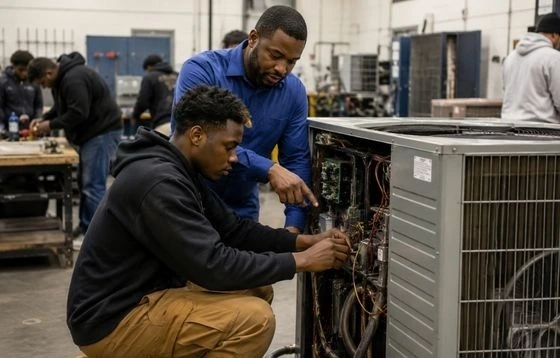
Refrigeration sits at the core of every HVAC training program. You’ll start by learning how pressure, temperature, and refrigerant behavior work together to cool a space.
Furthermore, the program offers basic awareness, from residential systems to dealing with large commercial refrigeration. How to maintain the temperature and install systems: You’ll practice measuring pressure, handling refrigerants safely, and installing thermostats for accurate temperature control. You will be guided through areas such as climate-controlled spaces and checking fluid levels. Additionally, you’ll learn how compressors and filters keep a system running efficiently.
Every HVAC unit depends on motors, controls, and wiring. Therefore, electrical systems training makes up a major part of the curriculum. The wiring system of HVAC units, like knowledge about cold wires and heaters, is important. You’ll learn to test circuits, troubleshoot wiring faults, and repair the electrical components that keep a system alive.
Moreover, this electrical foundation carries over into diagnostics. A technician who understands both refrigeration and electrical systems can solve problems other trades can’t touch.
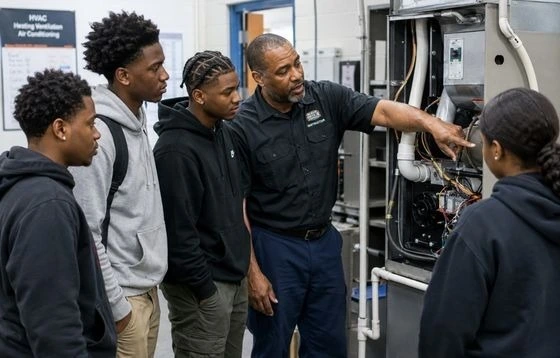
Two certifications matter most in this field, and strong programs include both at no extra cost.
Consequently, graduating with both credentials already in hand puts you ahead of technicians who still need to catch up after hiring.
Reading about refrigeration cycles and actually diagnosing a broken compressor are two very different skills. However, which skill you want to pursue depends on your interests, which you will come across. Therefore, strong HVAC training programs run roughly 80 percent hands-on, using real, current industry equipment.
Additionally, coursework covers both residential and commercial systems. Because both systems you will be handling in the future . You’ll progress from basic AC units into commercial refrigeration, installation, and full system design. This structure builds real confidence before you ever face a live job site.
Hands-on training doesn’t stop in the shop. Though an externship is possible, that depends on your course progressiona nd also how much you have achieved. Most HVAC programs finish with a real externship, placing students alongside experienced technicians on active job sites.
Furthermore, this step is crucial to landing your first role. Understanding electrical systems and troubleshooting issues in HVAC units are the main skills required to become an HVAC Technician. Externship students are smart, hardworking, and understand all the procedures, from safety to installation. Therefore, employers trust externship-trained graduates because they’ve already proven they can perform under real working conditions, not just in a controlled classroom.
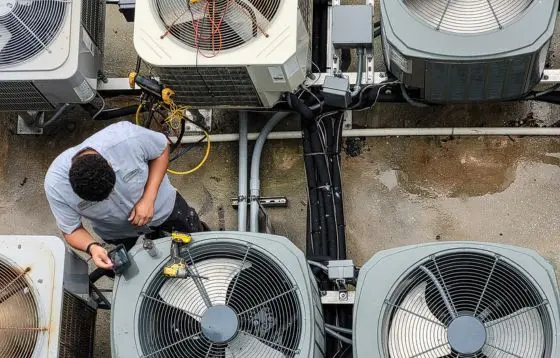
Career changes shouldn’t require quitting your current job. PTTI offers flexible scheduling by offering day or evening classes. Flexible scheduling helps maintain work-life balance for any working professional. Therefore, quality HVAC training programs offer both morning and evening class options. Morning classes often run 8:00 a.m. to 3:00 p.m., while evening sections start around 3:00 p.m. for working adults.
Additionally, many students return to school after years away and still finish on schedule. The program is built for real life, not a traditional college calendar.
Graduating with EPA 608, OSHA 30, hands-on experience, and externship hours gives employers exactly what they’re looking for. During externship hours, students observe work procedures by observing the work environment and helping their crew members. Consequently, job application support and resume help typically round out the program, so you leave with more than just a diploma.
Furthermore, financing options like FAFSA, grants, and institutional financing plans make this training accessible, regardless of your financial starting point.
PTTI’s HVAC Certification Program builds every piece covered above directly into the curriculum. Students train on refrigeration fundamentals, electrical systems, and both residential and commercial equipment. Additionally, EPA 608 and OSHA 30 certifications are included in tuition, at no extra cost.
Furthermore, PTTI offers flexible morning and evening scheduling, so working adults can train without pausing their income. Students graduate with a diploma, both certifications, real externship experience, and job application support.
Call 215-381-9403 or email info@ptt.edu to see PTTI’s HVAC labs and start training today.
No. HVAC training programs are built for complete beginners with no prior background.
A big YES. Federal law requires it for anyone who legally handles refrigerants.
Yes. You can attend, as most programs offer evening classes designed for working adults.
Most focused programs get students job-ready in under a year.
Yes. A real externship rounds out most programs before graduation.
Overall, strong HVAC training covers refrigeration fundamentals, electrical systems, safety certifications, and real hands-on hours. HVAC careers are in high demand; for this, there are several reasons. One is the developing infrastructure. Another is the severe nationwide climatic conditions. The extreme temperatures, heat waves , floods, etc. When the season appears, the demand gets high . From installation to maintenance. Therefore, graduates walk away exam-ready, job-ready, and equipped to land a real position fast. If you want a stable, in-demand trade career, HVAC training remains one of the clearest paths available today.