
On a modern factory floor, the person who can make a stalled production line run again is often the highest-paid technician in the building. That person usually has one thing in common: strong PLC and controls skills. As factories across Pennsylvania and New Jersey adopt more automated equipment, employers are paying a premium for workers who can program, wire, and troubleshoot the systems that keep machines running. For anyone weighing a career in the skilled trades, this is where the money and the demand are concentrated, and it is exactly what hands-on Manufacturing & Automation training is built to develop.
This article breaks down what PLC and controls skills actually are, which specific automation abilities employers pay the most for, what controls technicians earn, and how someone with no prior experience can realistically build these skills in the Philadelphia area. Whether you are a high school graduate, a career changer, or a veteran, you will leave with a clear picture of the fastest-growing, best-paid corner of the manufacturing trades.
PLC and controls skills are the abilities used to program, wire, operate, and troubleshoot the automated systems that run industrial machinery. At the center is the PLC, or programmable logic controller, a rugged industrial computer that tells machines what to do. Controls work combines electrical knowledge, programming, and mechanical troubleshooting into one high-value skill set.
In plain terms, a controls technician is the person who makes automated equipment behave. When a conveyor jams, a robot stops mid-cycle, or a packaging line throws a fault code, the technician reads the PLC program, checks the sensors and wiring, and gets production moving again. That blend of software, electrical, and mechanical ability is rare, which is a big reason employers pay so well for it. Unlike a single-discipline role, industrial automation work rewards people who can move fluidly between a laptop, a wiring diagram, and a wrench.

Employers pay top wages for these skills because downtime is expensive and qualified people are scarce. When an automated line stops, a plant can lose thousands of dollars per hour. A technician who can diagnose and fix the problem fast protects revenue directly, so companies compete to hire and keep that talent.
Three forces push these wages higher. First, Industry 4.0 has filled plants with PLCs, robots, sensors, and networked equipment that all require skilled upkeep. Second, many veteran technicians are retiring, and there are not enough trained replacements entering the field. Third, the skill set is genuinely hard to fake. You cannot bluff your way through a live electrical fault or a misbehaving PLC program. These same pressures are driving why manufacturing and automation jobs across Philadelphia are expanding, and they are not expected to ease anytime soon.
There is also a durability factor. Unlike routine tasks that automation itself can absorb, controls work is the job that keeps automation working. As more machines are installed, more technicians are needed to program, maintain, and repair them, which gives this career unusual stability within the broader manufacturing economy.
Not every automation skill carries the same market value. The abilities below are the ones hiring managers specifically look for and reward, and they form the backbone of serious controls work.
PLC programming is the single most valuable ability in industrial controls. Technicians who can read, edit, and write ladder logic for platforms like Allen-Bradley and Siemens can modify how a machine behaves, add safety interlocks, and clear faults that would stop a less-skilled worker cold. Strong programming skill turns a maintenance worker into a controls professional, and it is usually the first skill employers screen for.
Human-Machine Interface (HMI) screens and SCADA systems are how operators see and control a plant. Technicians who can configure these interfaces, build screens, set alarms, and connect them to the PLC make operations safer and more efficient. This ability pairs naturally with controller programming and raises a technician’s value considerably.
Modern plants run on industrial networks such as EtherNet/IP, PROFINET, and Modbus. An automation technician who understands how devices talk to one another can troubleshoot communication faults that baffle others. As factories grow more connected, networking fluency has moved from a bonus skill to a core expectation.
Automated systems depend on accurate inputs. Knowing how to wire, calibrate, and troubleshoot sensors, encoders, and analog instrumentation is essential controls work. When a machine reads the wrong value, a technician with strong instrumentation skills finds the cause quickly rather than guessing.
Industrial robots are now standard in packaging, welding, and material handling. Technicians who can program basic robot movements, recover robots from faults, and integrate them with the surrounding PLC system are in high demand. You can see why this matters in the way AI and automation are reshaping manufacturing careers rather than eliminating them.
Underneath every automation skill sits electrical competence. Reading schematics, using a multimeter, understanding motor controls, and following lockout/tagout and arc-flash safety are non-negotiable. Employers treat electrical troubleshooting and safety discipline as the foundation that makes every other controls ability usable on a live job site.
| Skill | Why Employers Pay for It |
| PLC programming / ladder logic | Directly controls machine behavior and clears faults |
| HMI / SCADA configuration | Makes operations safer and more efficient |
| Industrial networking | Resolves communication faults across connected equipment |
| Sensors and instrumentation | Ensures machines read accurate data |
| Robotics integration | Keeps automated cells running |
| Electrical troubleshooting & safety | Foundation for all controls work |
Roles built on PLC and controls skills generally pay well above the all-occupations median. The U.S. Bureau of Labor Statistics reports a median wage of about $73,900 (May 2025) for electro-mechanical and mechatronics technologists and technicians, the standard occupation closest to controls work, compared with roughly $50,980 for all occupations. Salary aggregators place dedicated PLC and controls specialists in the 70,000–85,000 range, with experienced specialists and automation engineers frequently exceeding $90,000 to $100,000.
Pay varies by experience, employer, shift, industry, and how many of the high-value skills above a technician actually holds. Someone who only monitors equipment earns less than someone who can program a PLC, configure an HMI, and troubleshoot a network fault. The more of these abilities you stack, the higher your earning potential climbs.
| Career Stage | Typical Annual Range (U.S.) |
| Entry-level automation / controls technician | $45,000 – $60,000 |
| Experienced PLC / controls specialist | $70,000 – $85,000 |
| Senior controls or automation specialist | $90,000 – $110,000+> |
These figures are national reference points, not guarantees, and individual outcomes depend on skills, location, and market conditions. Still, the pattern is clear: among manufacturing trades, controls work sits near the top of the pay scale, and it rewards continuous skill-building more than almost any other technical role.
The outlook for industrial automation careers is steady and resilient. The Bureau of Labor Statistics projects modest overall growth for electro-mechanical and mechatronics technicians, but raw growth numbers understate the real picture, because a large share of openings comes from replacing the many experienced technicians now retiring. In practice, skilled technicians in this field rarely struggle to find work.
Several trends reinforce demand. Reshoring and new manufacturing investment are bringing more automated plants online. E-commerce has filled the region with highly automated warehouses and distribution centers that need automation technicians to keep sortation and conveyance systems running. And every new robot or smart machine installed adds to the long-term maintenance workload. Industrial automation is one of the few technical fields where the technology creating the jobs and the technology being maintained are the same thing.
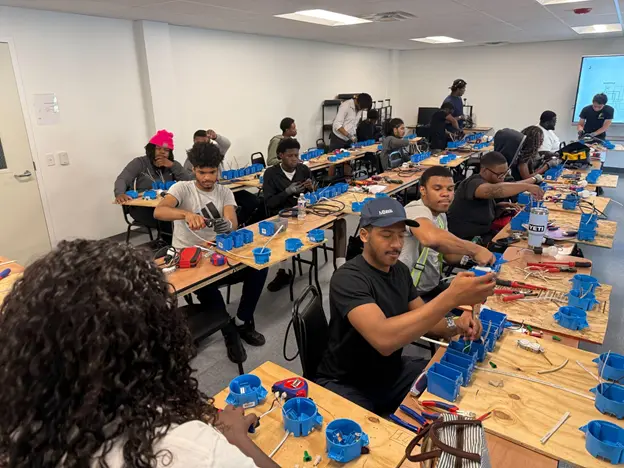
The fastest realistic path is structured, hands-on training rather than trying to learn controls from videos alone. These skills are physical and diagnostic. You need to wire real panels, load real programs onto real controllers, and chase down real faults. That is why employers value graduates of programs that put students in front of actual equipment, and why quality automation training emphasizes lab time over lectures.
A practical learning path usually moves through electrical fundamentals, then PLC programming basics, then HMI and networking, and finally integrated troubleshooting on complete systems. Along the way, safety training and blueprint reading are woven in because they are used constantly on the job. For beginners who want a clear on-ramp, hands-on training in robotics and manufacturing automation built for people starting from scratch is the kind of foundation that leads to employable skills.
Philadelphia is a logical place to train for this work. The region’s manufacturers, warehouses, and processing plants all run automated equipment, so the skills you build map directly onto local hiring needs. Training on industry-standard controllers and panels that mirror what you will see on the job is what turns knowledge about automation into the ability to do the work.
No, a four-year degree is not required to become a controls technician. Most entry points into industrial automation value demonstrated ability over academic credentials. Employers want to see that you can program a PLC, read a schematic, and troubleshoot a system, which you prove through hands-on training, certifications, and practical skill rather than a bachelor’s degree.
That said, this is a field where learning never fully stops. New platforms, networks, and robots arrive constantly, so the technicians who keep sharpening their programming and controls knowledge are the ones who move into the highest-paying specialist roles. The entry barrier is low; the ceiling is high.
One advantage of industrial automation training is how widely the skills apply. Graduates of a dedicated manufacturing and automation campus find work not only across Philadelphia neighborhoods, from the industrial corridors of North Philadelphia and Southwest Philadelphia to areas near Mantua and Allegheny West, but throughout the surrounding region.
Opportunities extend into nearby Pennsylvania communities such as Yeadon, Lansdowne, Darby, and Drexel Hill, and across the river into South Jersey, including Camden, Pennsauken, Cherry Hill, and Maple Shade. Automated warehouses, food and beverage plants, pharmaceutical and life-sciences facilities, and metal fabrication shops all rely on automation technicians who can keep their equipment online. Because controls skills transfer between industries, a technician trained in Philadelphia can move toward whichever employer offers the best opportunity across the tri-state area.
Among all the skilled trades, few reward ambition like industrial automation and controls. The abilities at the center of this work, from PLC programming to networking and robotics, sit at the intersection of software, electrical, and mechanical knowledge, and that rare combination is exactly why employers pay the most for strong PLC and controls skills. Demand is steady, the earning ceiling is high, and a four-year degree is not the entry requirement, which makes this one of the smartest career moves available to someone willing to learn by doing.
If you are ready to build these skills through hands-on automation training, explore PTTI’s Manufacturing & Automation program and contact the admissions team to see how quickly you could start a career in automation.
They are the abilities used to program, wire, and troubleshoot automated machinery. The core is working with the PLC, the industrial computer that controls equipment, along with the sensors, drives, and interfaces connected to it. These abilities combine electrical, mechanical, and software knowledge.
Programming the PLC is the most valued, followed closely by HMI and SCADA configuration, industrial networking, instrumentation, and robotics troubleshooting. Technicians who stack several of these abilities, rather than mastering just one, command the highest pay in industrial automation.
Experienced PLC and controls professionals commonly earn 70,000–85,000, and senior automation specialists often exceed 90,000–100,000. Entry-level pay is lower while you build skills. Actual earnings depend on experience, employer, location, and the specific abilities you bring, so figures should be treated as references rather than promises.
No. Most employers prioritize demonstrated skill over degrees. Focused automation training, hands-on practice, and relevant certifications are usually enough to enter the field as an automation technician, after which your pay grows as your skills grow. PTTI’s career and job support is designed to help graduates make that transition.
You can build employable PLC fundamentals within a focused automation training program, often in under a year, especially when the curriculum is hands-on. Becoming an advanced controls specialist takes continued experience on the job, but the entry-level skills that get you hired are achievable relatively quickly.