
Walk through almost any Philadelphia neighborhood and you are looking at masonry. The brick rowhomes of South Philadelphia, the stone churches of North Philadelphia, the concrete foundations and sidewalks across West Philadelphia, these were all built by skilled hands. That built environment is exactly why pursuing masonry training in Philadelphia makes practical sense: the city runs on brick, block, stone, and concrete, and it constantly needs people who can build and repair it.
This guide explains what concrete and masonry training actually involves, how long it takes, what masons and concrete finishers earn in the local market, and what the job outlook looks like heading through the decade. It is written for high school students, graduates, career changers, veterans, and adult learners who want a hands-on trade rather than a four-year degree. By the end, you will understand why Philadelphia is one of the stronger places in the country to learn this work, and what to look for in a quality masonry program.
Concrete and masonry work is the craft of building and repairing structures using brick, concrete block, stone, and poured concrete. Masons lay and bind these materials to create walls, foundations, walkways, facades, and structural elements. Concrete finishers place, level, and finish poured concrete surfaces. Together, these trades form the backbone of nearly every building project.
In practice, the work covers a wide range. Brick and block masonry builds walls, partitions, and veneers. Stone masonry handles both structural and decorative applications. Concrete finishing produces everything from sidewalks and driveways to commercial slabs and foundations. Many skilled workers also learn framing, the process of building the structural skeleton of a building, which pairs naturally with concrete and masonry on real job sites.
Understanding masonry units matters here. Masons work with different materials, each with its own properties: clay brick, concrete masonry units (CMU, or concrete block), natural and manufactured stone, and various mortars. A strong concrete and masonry training program teaches you how each material behaves, how to mix and apply mortar, how to read a layout, and how to build a wall that is level, plumb, and structurally sound.
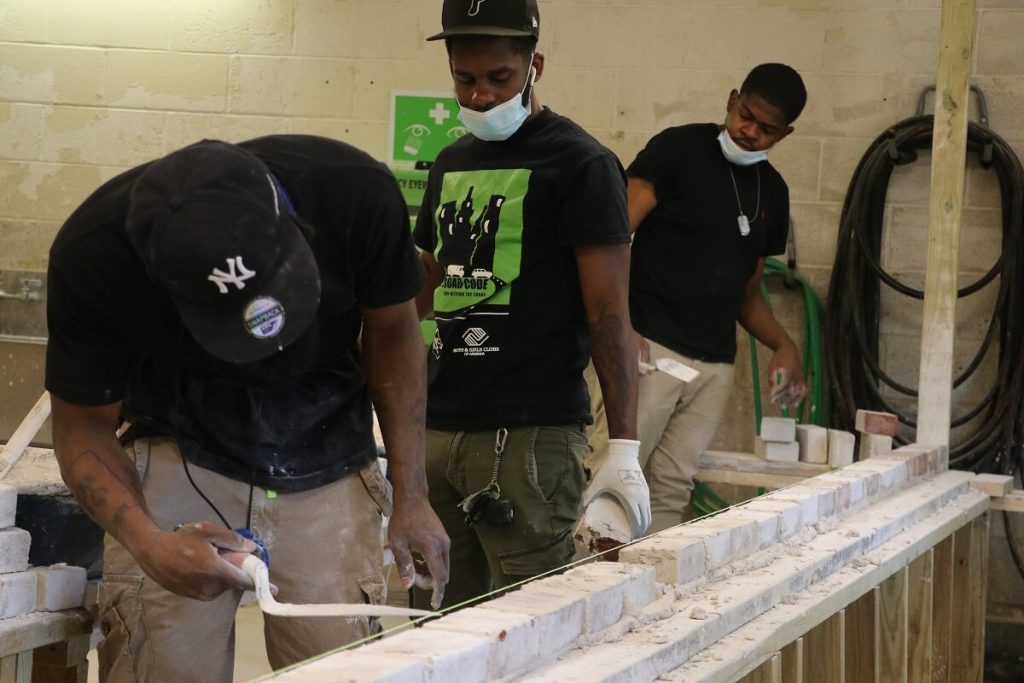
Philadelphia is an unusually good place to learn masonry because the city itself is a masonry city. Its dense stock of brick rowhomes, stone institutional buildings, and aging concrete infrastructure creates constant demand for both new construction and skilled repair, restoration, and maintenance work. Learning the trade where the work actually exists is a real advantage.
That local relevance runs deep. Brick and stone are not just common here; they define the architecture. Historic masonry across North, South, and West Philadelphia needs ongoing repointing, restoration, and repair, work that cannot be shipped elsewhere or easily automated. At the same time, new commercial and residential development requires concrete foundations, block walls, and finished flatwork. A trade school in Philadelphia that trains for this market is training for genuine, nearby opportunity.
Geography helps too. A student who completes masonry training in Philadelphia is positioned to work not only across the city’s neighborhoods, from Spring Garden to Mantua to Northeast Philadelphia, but throughout the surrounding region. Skilled masonry and concrete work extends into nearby Pennsylvania communities such as Ardmore, Drexel Hill, Lansdowne, and Yeadon, and across the river into South Jersey towns including Camden, Cherry Hill, Pennsauken, Collingswood, and Maple Shade. Because masonry skills travel, central training opens doors in every direction.
A quality concrete and masonry training program builds skill in layers, starting with fundamentals and moving toward job-site readiness. The goal is not just knowing how to lay brick, but understanding how to approach a real project safely and correctly from start to finish.
Core areas of instruction typically include:
This combination is deliberate. Employers in construction rarely want someone who can only do one narrow task. A worker who understands concrete, brick, block, stone, and basic framing is far more useful on a job site, and that versatility is a central reason the concrete, masonry, and framing program approach prepares graduates for a broader range of roles.
The best place to learn concrete, masonry, and framing in Philadelphia is a hands-on trade school that trains on real materials in a job-site-style environment rather than relying on lectures. The quality of the practical training, how much time you spend actually building, is the single most important factor in becoming job-ready.
This matters because masonry is a physical craft learned through repetition. You cannot master a straight, level brick course or a smooth concrete finish by reading about it. You learn it by mixing mortar, setting units, checking your work with a level, and doing it again until it is right. A program built around that kind of applied learning, with instructors who have worked in the field, is what separates a resume line from a real, employable skill.
When comparing a masonry program in Philadelphia, prospective students should weigh a few practical factors:
| What to Look For | Why It Matters |
| Hands-on lab time | Masonry skill comes from doing, not watching |
| Industry-standard tools and materials | You should train on what you will actually use |
| Instructors with field experience | Real job-site knowledge beats theory alone |
| Framing and concrete included | Versatility makes you more employable |
| Career and job-readiness support | Help moving from training into work |
A strong masonry school in Philadelphia delivers on all of these, giving students realistic practice that mirrors actual construction conditions.
Masonry training is typically measured in months rather than years. Focused, hands-on programs concentrate on the practical skills employers need, so students can move from beginner to entry-level job readiness far faster than a traditional college degree would allow, often well under a year.
The reason the timeline is short comes down to how construction trades are evaluated. Employers hire masons and concrete finishers based on demonstrated ability, not academic credentials. Once you can lay a sound wall, finish concrete cleanly, and work safely as part of a crew, you are hireable. A structured program built around those outcomes delivers that competence efficiently.
This is one of the clearest advantages of a construction-focused trade school in Philadelphia over a four-year path. Instead of spending years and accumulating debt, students invest a focused period of hands-on training and enter a trade where skill, reliability, and work ethic drive advancement. For many high school graduates, career changers, and adult learners, that trade-off is decisive.
Masons in the Philadelphia area average roughly $31 per hour, with the local range running from about $23 to over $42 per hour depending on experience, specialization, and employer. Nationally, brickmasons and blockmasons earn a median of about $62,120 per year, and cement masons and concrete finishers earn a median of about $57,020, according to the U.S. Bureau of Labor Statistics.
Several factors shape what a given worker earns. Experience is the biggest driver: entry-level workers start lower and build earning power as their speed and quality improve. Specialization matters too, as restoration, decorative, and commercial concrete work can command premiums. Union membership, overtime, and the type of project all influence take-home pay as well.
| Career Stage | Typical Earning Pattern |
| Entry-level mason / concrete finisher | Starting wages, building speed and quality |
| Experienced mason | Mid-range pay with proven skill and reliability |
| Specialized / lead / union worker | Higher pay, often with overtime and benefits |
A few honest notes belong here. These figures are regional and national estimates that vary by employer, project, and individual, and no training program can guarantee a specific wage or job outcome. What concrete and masonry training provides is the foundational skill that makes you a credible candidate for this pay range. Earnings grow with demonstrated competence over time.

The job outlook for masonry and concrete workers is steady, driven heavily by replacement demand. According to the U.S. Bureau of Labor Statistics, roughly 18,400 openings for masonry workers are projected each year, and cement masons and concrete finishers are projected to grow about 2 percent over the decade. Most openings come from the need to replace workers who retire or move to other occupations.
That replacement dynamic is important to understand. Even where overall employment grows slowly, the trade continually needs new skilled workers because the existing workforce is aging and steadily leaving the field. For someone entering now, that means real opportunity rather than a crowded market.
Philadelphia reinforces this outlook in specific ways:
The practical takeaway is that masonry remains one of the more stable skilled trades to enter, and learning it through a construction-focused masonry program in Philadelphia positions graduates directly in a market with genuine, nearby demand.
No four-year degree is required to become a mason in Pennsylvania, and there is no single statewide masonry license. The standard entry point is a high school diploma or equivalent combined with hands-on training and demonstrated skill. Employers hire based on what you can actually build.
That said, credentials and formal training carry real weight. Completing a structured concrete and masonry training program signals to employers that you understand safety, materials, tools, and proper technique, which makes you a far stronger candidate than someone with no training. Some workers also pursue safety certifications such as OSHA construction safety credentials, which many job sites value.
This information is educational and not legal advice. Licensing, permitting, and contractor registration requirements can vary by municipality and change over time, so verify current rules with the relevant Pennsylvania or local authority before making career or business decisions.
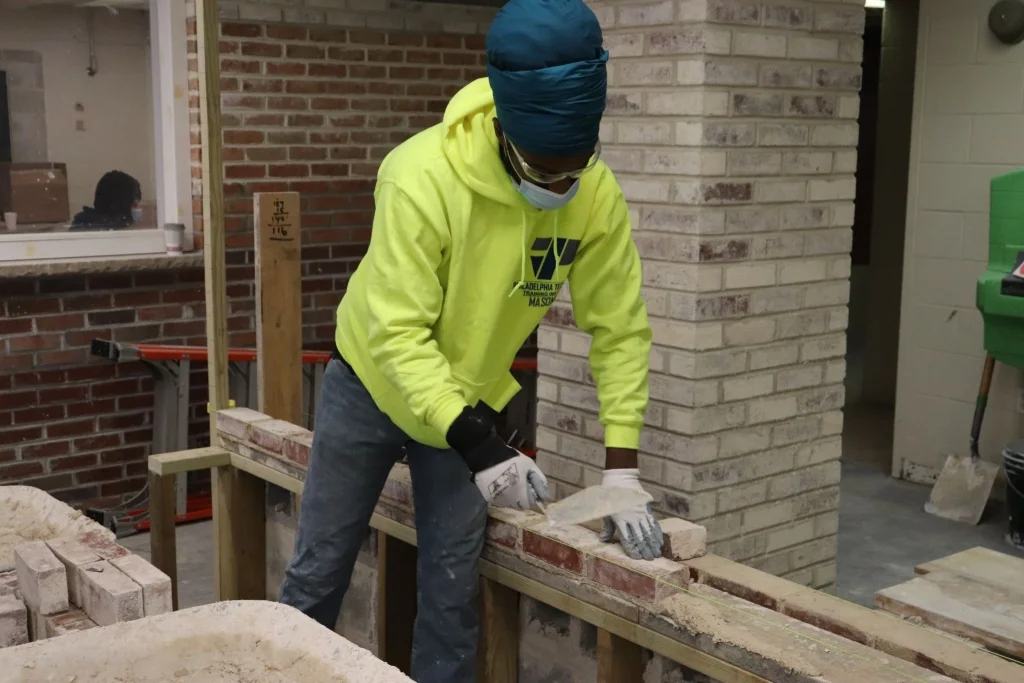
Concrete and masonry training suits a wide range of people, which is part of its appeal. If you prefer building something real over sitting at a desk, and you want a trade with steady demand, this work is worth serious consideration.
Masonry rewards precision, physical capability, and consistency. Those who take pride in visible, lasting work tend to thrive, and a quality masonry school in Philadelphia gives them the foundation to start.
Beyond technique, employers consistently value workers who show up ready for the realities of construction. Strong training programs build these job-site competencies alongside the hands-on craft:
These are the construction skills employers actually hire for, and they are exactly what applied, hands-on concrete and masonry training is designed to develop.
Few cities make the case for learning a trade as plainly as Philadelphia makes the case for masonry. The brick, block, stone, and concrete all around you are not just architecture; they are evidence of ongoing, local demand for people who can build and repair them. Pursuing concrete and masonry training here means learning a durable, hands-on craft in exactly the market where it is needed, with a focused timeline, no required degree, and genuine room to grow your skill and earnings over time.
If you want a career you can see and stand behind, explore PTTI’s concrete, masonry, and framing program and reach out to admissions to find out how quickly you could start building your future in the trade.
Concrete and masonry work is the craft of building and repairing structures using brick, concrete block, stone, and poured concrete. Masons build walls, foundations, and facades, while concrete finishers place and finish concrete surfaces. Many workers also learn framing, since it pairs naturally with the trade on job sites.
Masonry training is typically measured in months rather than years. A focused, hands-on masonry program in Philadelphia concentrates on the practical skills employers need, so students can reach entry-level job readiness in well under a year, far faster than a traditional college degree.
Masons in the Philadelphia area average roughly $31 per hour, with a local range from about $23 to over $42 per hour. Nationally, brickmasons earn a median near $62,000 per year and concrete finishers near $57,000, though earnings vary by experience, specialization, and employer.
No. Masonry does not require a four-year degree. A high school diploma or equivalent plus hands-on training and demonstrated skill is the standard entry point. Employers hire masons and concrete finishers based on their ability to do quality, safe work.
Philadelphia is built largely of brick, block, stone, and concrete, which creates steady demand for new construction and for repair and restoration of its aging building stock. Learning masonry where the work genuinely exists gives graduates strong, nearby opportunity across the city and the surrounding region.