
The car in a modern repair bay has more in common with a networked computer than the vehicles most people learned to drive on. A single late-model car can run dozens of electronic control units, miles of wiring, and a web of cameras, radar, and sensors that keep it in its lane and stop it before a collision. However, Advanced Auto Diagnostics training in Philadelphia is offered by PTTI. Fixing it is no longer mainly about turning wrenches. It is about reading data, interpreting it correctly, and knowing where the real fault lives.
That shift is exactly why auto diagnostics training in Philadelphia has become so important for students entering the trade. The technicians employers want today can plug into a vehicle, pull live data, follow a logical troubleshooting path, and verify the repair, often before they ever loosen a bolt. The good news for career-focused students across Philadelphia, Pennsylvania, New Jersey, and Delaware is that these skills are learnable in a hands-on program, well before the first day on the job.
This article explains how Philly students build advanced diagnostic skill before entering the workforce: the systems they learn, the tools they train on, the certifications that prove their ability, and what the career pays. It is written for high school students, graduates, career changers, veterans, and adult learners who want a clear, realistic picture of where this trade is heading and how to get in.
Take the next step. Explore PTTI’s Manufacturing and Automation program
The role of the automotive technician has changed more in the last decade than in the previous three. Understanding that change is the key to understanding why diagnostic training matters so much for new students.
Vehicles now generate enormous amounts of information. Engine performance, braking, steering assistance, climate control, and safety systems all communicate over internal networks. When something goes wrong, the vehicle often records exactly where and why. A technician who knows how to retrieve and read that information solves problems faster and more accurately than one relying on guesswork.
This is why the modern technician is often described as part data analyst, part craftsperson. The hands-on skill still matters, but it now sits on top of a foundation of electrical knowledge and structured diagnostic logic. PTTI explores this evolution in depth in its look at the modern automotive technician.
Advanced diagnostics is not a single task. It is a set of connected competencies that students build in sequence. The core domains include:
Each of these is teachable in a structured, lab-based environment, which is precisely how students develop real skill before employment.
You can learn auto diagnostics and modern automotive electronics through a hands-on automotive training program in Philadelphia such as PTTI’s. Students train on industry-standard scan tools, electrical systems, and real vehicles, building diagnostic skill in a lab environment before they ever start an entry-level technician job.
The most effective programs combine classroom theory with significant shop time, because diagnostics is a skill you build by doing it repeatedly under guidance. Reading about a circuit is not the same as tracing a fault through one. You can see how this works on PTTI’s auto repair campus.
Diagnostic ability is built in layers. A strong program moves students through these stages in order, so each new skill rests on a solid foundation. Here is how that progression typically works.
Everything in modern diagnostics starts with electricity. Before touching a scan tool, students learn how circuits behave, how to measure voltage, resistance, and current, and how sensors and actuators function. This foundation is what separates a technician who can interpret a fault from one who can only replace parts and hope.
Once the electrical foundation is in place, students learn to communicate with the vehicle. Using OBD-II scan tools, they pull diagnostic trouble codes, view live sensor data, and learn what “normal” looks like so they can recognize what is not. The skill here is interpretation: a code points to a system, not always the failed part, and good technicians know the difference.
For deeper faults, students move to lab scopes and advanced meters. These tools let them see electrical signals as they actually behave over time, revealing intermittent problems that a basic code reader would miss. This is where diagnostic skill becomes genuinely advanced and where employers see real value.
Advanced driver assistance systems are now standard on a large share of vehicles, and they must be calibrated precisely after many repairs. Students learn how forward-facing cameras, radar, and related sensors work, and why calibration matters. The stakes are real: according to NHTSA research, automatic emergency braking can reduce front-to-rear crashes significantly, but only when the underlying systems are serviced correctly.
The industry is formalizing this area quickly. The National Institute for Automotive Service Excellence is developing a dedicated ADAS calibration technician credential to standardize competency across the field, on top of its existing L4 ADAS Specialist certification. For students, exposure to these systems during training is a clear head start.
Electric and hybrid vehicles are a growing share of the fleet, and they require specialized knowledge, which is why schools are increasingly focused on training technicians for the EV boom. Diagnosing these vehicles safely is non-negotiable, because high-voltage systems carry real danger when handled improperly.
Students learn to approach EV and hybrid systems with strict procedure, including:
PTTI covers this growing skill area in its resource on EV battery repair skills, which technicians increasingly need as more electric vehicles reach repair bays.
A serious diagnostic program puts industry-standard equipment in students’ hands. Training on the same categories of tools used in professional shops is what makes graduates productive quickly. The table below outlines the core toolkit.
| Tool / Technology | What Students Learn to Do |
| OBD-II scan tools | Retrieve trouble codes, view and interpret live data |
| Digital multimeters | Measure voltage, resistance, and current in circuits |
| Lab oscilloscopes | Capture and read electrical signals to find intermittent faults |
| ADAS calibration equipment | Understand camera and radar calibration requirements |
| EV/hybrid service tools | Safely diagnose high-voltage systems following OEM procedure |
| Wiring diagrams and service data | Trace circuits and follow manufacturer troubleshooting paths |

Employers hiring entry-level technicians want more than mechanical aptitude. Hiring managers consistently look for a blend of technical ability and professional habits. Understanding this helps students focus their training.
The technical skills that get new technicians hired include:
Just as important are the workplace skills that keep technicians employed and promotable:
These expectations mirror what a hands-on program reinforces daily, which is why employer-aligned training matters. Learn more about the full path in PTTI’s guide on how to become an automotive technician in Philadelphia.
Certifications give employers a trusted, third-party signal that a technician can do the work. For diagnostic roles, a few credentials carry particular weight.
ASE (Automotive Service Excellence) certifications are the industry standard in the United States. They are organized by system, so technicians can build a credential profile that matches their specialty.
Key points students should know about ASE:
PTTI outlines the broader landscape in its overview of automotive technician certifications.
Because advanced safety systems are now everywhere, the industry is moving to standardize how technicians are certified to calibrate them. In 2026, ASE began developing a dedicated ADAS calibration technician credential designed to serve a broad range of professionals, from general repair technicians to glass and collision specialists. Students who already understand these systems will be well-positioned as the credential rolls out.
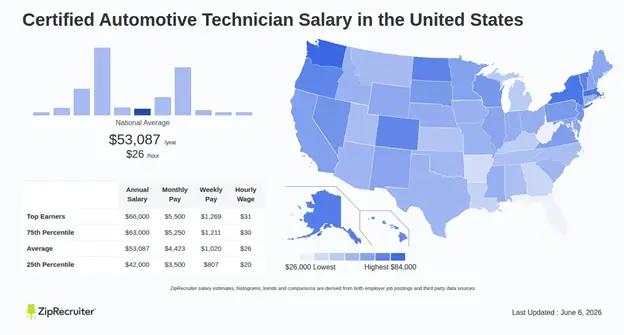
Moreover, Career-focused students rightly want to know what diagnostic skill is worth. The data shows a stable trade with meaningful room to grow, especially for those who specialize.
Automotive service technicians and mechanics earned a national median wage of $49,670 in May 2024, according to the U.S. Bureau of Labor Statistics. Pay rises with experience, certification, and specialization, and technicians skilled in diagnostics, ADAS, and EV systems often command premiums.
| Career Stage | Approximate Annual Range |
| Entry-level technician | $38,000 – $46,000 |
| Experienced technician | $50,000 – $62,000 |
| Specialized/diagnostic / ADAS / master technician | $65,000 – $80,000+ |
However, A few factors shape these numbers in the Philadelphia area: many shops pay on a flat-rate or productivity basis, which rewards efficient technicians; specialized skills like ADAS calibration and EV service are scarce and therefore valued; and certifications support both base pay and advancement.
Yes. The Bureau of Labor Statistics projects about 70,000 openings for automotive service technicians and mechanics each year, on average, through 2034, with overall employment growing around 4 percent. Much of that demand comes from replacing technicians who retire or leave the field, creating consistent opportunities for new, well-trained workers.
Demand is sharpened by a skills gap: the supply of technicians trained in modern diagnostics, electronics, and EV systems has not kept pace with how quickly vehicles have changed.
Foundational diagnostic skills can be developed in a focused, hands-on automotive program, often within months rather than years. Mastery deepens on the job, but students can graduate genuinely job-ready, able to perform core diagnostics and continue specializing in ADAS and EV systems as their careers grow.
Therefore, the key is intensity and structure. A program built around sequential skill development and extensive lab time produces capable entry-level technicians far more quickly than informal, self-directed approaches. PTTI’s perspective on this evolution is captured in its piece on the future of automotive diagnostics.
Many students weigh a focused trade program against a community college route. Both can lead to a career, but they differ in important ways for automotive training specifically.
| Factor | Automotive Trade Program | Community College |
| Focus | Concentrated on hands-on automotive skill | Broader, includes general-education courses |
| Time to job-ready | Faster, skill-first | Typically longer |
| Lab/shop time | Core of the program | Varies by program |
| Cost approach | Focused tuition | Varies; may include unrelated coursework |
| Employer alignment | Built around job-site expectations | Depends on program design |
Neither is universally “better.” But for students who learn by doing and want to enter the workforce efficiently, a hands-on automotive program is often the more direct route. Compare options on PTTI’s Automotive Training and Repair Technician program page.
Ultimately, one advantage of training in Philadelphia is the size and spread of the regional job market. Dealerships, independent repair shops, fleet operations, and collision centers operate throughout the city’s neighborhoods, from North and South Philadelphia to West Philadelphia, Mantua, Powelton Village, and the Spring Garden corridor.
Opportunity extends well beyond city limits. Graduates find roles across nearby Pennsylvania communities, including Yeadon, Lansdowne, Darby, Drexel Hill, and Ardmore, and across the river in South Jersey towns such as Camden, Pennsauken, Collingswood,. Also in Cherry Hill, Maple Shade, Cinnaminson, Haddonfield, Gloucester City, and Audubon, with additional demand reaching into Delaware. Because diagnostic and electronic skills transfer across employers and vehicle brands, a technician trained in Philadelphia can pursue the best opportunity in any direction.
This path suits a wide range of motivated people:
If you like solving problems, working with technology, and seeing tangible results, automotive diagnostics rewards exactly those instincts.
Where can I learn auto diagnostics and modern automotive electronics in Philadelphia?
You can learn through a hands-on automotive technician program in Philadelphia such as PTTI’s, where students train on industry-standard scan tools, electrical systems, and real vehicles. The combination of classroom theory and heavy lab time builds genuine diagnostic skill before employment.
Do new automotive technicians really need to know ADAS and EV systems?
Increasingly, yes. A 2026 industry training survey ranked electrical/electronic systems, hybrid/EV, and ADAS among the most requested topics. Vehicles now ship with these systems as standard, so familiarity with them is a strong advantage for new technicians.
How long does it take to learn automotive diagnostics?
Foundational diagnostic skills can be built in a focused, hands-on program, often in months rather than years. Students can graduate job-ready for entry-level roles and continue specializing in ADAS and EV diagnostics as they gain experience.
What certifications prove diagnostic skill to employers?
ASE certifications are the U.S. industry standard, organized by system such as engine performance and electrical/electronic. Advanced credentials like the ASE L4 ADAS Specialist recognize higher-level diagnostic ability, and a dedicated ADAS calibration credential is being developed.
How much do automotive technicians make?
The national median wage for automotive service technicians and mechanics was $49,670 in May 2024, per the BLS. Experienced and specialized technicians, especially those skilled in diagnostics, ADAS, and EV systems, often earn meaningfully more.
Is there demand for automotive technicians?
Yes. The BLS projects roughly 70,000 openings each year through 2034, driven largely by retirements and turnover. A shortage of technicians trained in modern diagnostics and EV systems makes job-ready graduates especially valuable.
The automotive trade has not become less hands-on; it has become smarter. The technicians employers compete for are the ones who can read a vehicle’s data, reason through a fault, and verify the fix, on top of solid mechanical ability. Therefore,That is why students who learn advanced diagnostics, ADAS, and EV systems before entering the workforce hold a real, durable advantage.
For students across Philadelphia and the surrounding tri-state region, the path is clear and achievable: a focused, hands-on program that builds diagnostic skill on real equipment, prepares you for recognized certifications, and connects directly to local employer demand. It is a stable, technology-forward career you can begin without a four-year degree or years of debt.
However, Advanced automotive diagnostics is a career you can start sooner than you might think, with hands-on training that prepares you for real technician roles across the Philadelphia region. The smartest first move is to see the diagnostic labs for yourself and talk through your options with someone who can map out a realistic timeline. Explore PTTI’s automotive programs to compare your path, or schedule a campus tour to experience the training environment in person.
Read more: