
Most people believe healthcare means nursing school. They picture four years of tuition, prerequisites, waitlists, and debt. So they assume the door is closed. That assumption costs thousands of capable people a stable, meaningful career every single year.
Here is what those people never hear. Every surgery performed in Philadelphia depends on a role most patients never see. Someone has to decontaminate, inspect, assemble, and sterilize every instrument in that operating room. That person is a sterile processing technician. The job is essential, hospitals hire for it constantly, and you can train for it in roughly six months.
This guide explains the role honestly. You will learn what the work involves, why hospitals need it, how long training takes, what the pay looks like, and how the certification path actually works. If you want healthcare but cannot commit years to a degree, read on.
A sterile processing technician decontaminates, inspects, assembles, packages, and sterilizes the surgical instruments and equipment that hospitals reuse. They work in the sterile processing department, often called central service or SPD. Every instrument used in surgery passes through their hands before it reaches a patient.
The U.S. Department of Labor classifies the role as a Medical Equipment Preparer. You will also see it listed under several job titles, which confuses a lot of job seekers.
Employers use different titles for nearly identical work. Recognizing them helps you search job boards effectively.
If you searched only one of these terms, you missed most of the openings. That single insight helps many graduates land interviews faster.
The role follows a disciplined workflow. Technicians receive contaminated instruments, then decontaminate them. Next they inspect each item for damage or residue. They assemble instrument trays according to exact specifications. Finally they sterilize, package, and store everything for the next procedure.
Precision matters enormously here. A single missed step can compromise patient safety. That is why hospitals value trained technicians so highly. This is also why hands-on training beats classroom theory alone. You need to handle real instruments and real equipment before you handle them in a hospital.
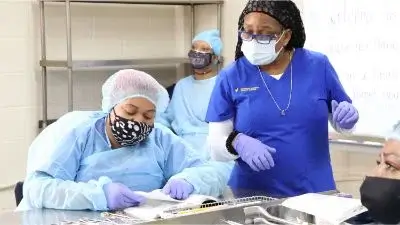
Hospitals need sterile processing technicians because no surgery happens without sterile instruments. The department runs continuously, supporting operating rooms, labor and delivery, endoscopy, and clinics. When SPD stops, procedures get delayed or cancelled. That makes the role operationally essential rather than optional.
Understanding this changes how you view the career. You are not on the edge of healthcare. You are inside the part that keeps it running.
Several forces keep hiring steady across the region. None of them are going away soon.
The U.S. Bureau of Labor Statistics projects healthcare and social assistance to be the fastest-growing sector through 2034. The Department of Labor also flags Medical Equipment Preparers with a Bright Outlook designation, which signals expected growth or strong openings.
Philadelphia is one of the densest healthcare markets in the country. The region supports major hospital systems, teaching hospitals, specialty centers, and a growing network of outpatient surgical facilities. Education and health services remain the area’s largest employment sector.
That density matters practically. A trained technician here is not limited to one employer. Opportunities extend across the city and into surrounding communities like Camden, Cherry Hill, Drexel Hill, Darby, and Lansdowne. Because the skills transfer directly, graduates can pursue healthcare trade jobs throughout Pennsylvania, New Jersey, and Delaware.
You get into healthcare without a degree by choosing a role that hires on verified skill rather than academic credentials. Sterile processing is one of the clearest examples. A high school diploma or GED plus focused, hands-on training qualifies you to apply. Employers care whether you can do the work safely and correctly.
This surprises people who assume every healthcare path runs through nursing school. It does not. Hospitals employ many technical roles that never require a four-year degree.
Nursing is a great career for the right person. But it demands years, prerequisites, competitive admissions, and significant cost. Many capable people cannot absorb that. Others simply do not want bedside patient care.
Sterile processing offers a different fit. You work in a technical, detail-driven environment. You support patient safety directly. You get there in months. For anyone comparing nursing against sterile processing, the honest answer depends on your goals, timeline, and finances.
Instructors see clear patterns among students who thrive.
If that sounds like you, the Central Processing & Sterile Services program is worth a direct look.
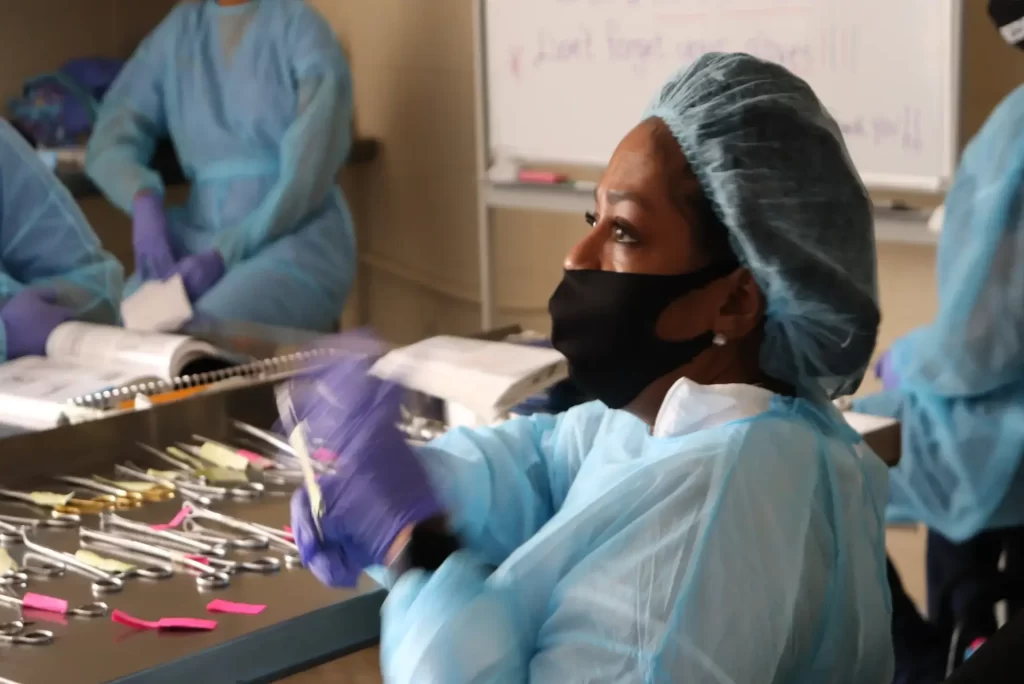
Sterile processing training takes about 26 weeks at PTTI, which is roughly six months. That timeline covers instrument identification, decontamination, sterilization methods, infection control, and CRCST exam preparation. Compared with a four-year degree, you enter the workforce years earlier and with far less financial risk.
Six months is short. It is not shallow. The curriculum concentrates entirely on what the job requires.
Sterile processing technician training is technical and sequential. Each phase builds on the last.
| Training Focus | What You Master |
| Foundations | Medical terminology, anatomy basics, infection control principles |
| Decontamination | Cleaning protocols, PPE discipline, chemical safety |
| Instrumentation | Identifying, inspecting, and assembling surgical instruments |
| Sterilization | Steam, low-temperature methods, monitoring and documentation |
| Workflow & Compliance | Tray assembly, storage, distribution, regulatory standards |
| Career Readiness | CRCST exam prep, résumé support, interview practice |
That last row matters more than students expect. Technical skill gets you qualified. Career preparation gets you hired.
Most students cannot quit working to train. PTTI offers day and evening options so you can keep earning while you prepare for a new career. This flexibility is often the deciding factor between finishing and dropping out.
Schedule fit is a practical concern, not a minor one. Parents, full-time workers, and adults with commutes all need a program that bends to their reality. You can review options and start dates with admissions before you commit.
The CRCST credential from the Healthcare Sterile Processing Association is the industry standard for a central service technician career. It requires passing an exam and documenting 400 hours of hands-on experience in a sterile processing department. Importantly, a provisional pathway lets you pass the exam first, then complete those hours within six months.
That provisional route is the detail almost nobody explains clearly. It is also why a 26-week program works so well.
Here is the practical sequence for most new technicians.
You do not need years of experience before you start. You need training, an exam pass, and a foot in the door. That is a genuinely accessible path.
CRCST requires annual renewal with 12 continuing education credits. This is not busywork. Sterilization technology, AAMI standards, and infection-control guidance all evolve. Employers and accreditation surveyors verify that staff hold active credentials.
PTTI’s curriculum is built around this credential. You can read more about achieving CRCST certification and why the certification matters to employers.
National figures from the U.S. Bureau of Labor Statistics place median annual earnings for medical equipment preparers near $47,000, with top earners exceeding $57,000. Pay varies by employer, shift, certification, specialization, and geographic location. Entry-level wages start lower but steadily increase as you gain experience, earn industry-recognized credentials, and take on greater responsibilities. Be realistic here. This is not a six-figure starting salary. Instead, it offers a stable, livable wage you can reach in about six months, along with clear opportunities for career growth, higher earnings, and long-term advancement within the healthcare industry.
Too many people treat sterile processing as a stepping stone. That undersells it badly. The field has real depth and a defined ladder.
| Stage | Role | What Changes |
| Entry | Sterile Processing Technician | Core decontamination and sterilization work |
| Growth | Certified Technician (CRCST) | Higher pay, more responsibility, better postings |
| Specialist | Instrument Specialist / Endoscope Reprocessing | Advanced credentials, premium roles |
| Leadership | Lead Tech, Supervisor, SPD Manager | Team oversight, scheduling, compliance |
| Adjacent | Surgical support, quality, vendor roles | Skills transfer into related healthcare careers |
Each rung is reachable. HSPA offers additional certifications beyond CRCST for instrument specialization, endoscope reprocessing, and leadership. Those credentials open doors that no degree requirement blocks.
Several factors move your pay meaningfully over time.
You can explore growth opportunities in sterile processing in more detail, or review how PTTI supports graduates through careers and job opportunities.
Sterile processing is a skills trade inside a hospital. You cannot learn instrument identification from a video. You cannot practice sterile technique in a browser tab. Employers know this, which is why applied training carries weight that online-only certificates do not.
This distinction matters when you compare your options honestly.
A degree takes years and delays your earning. A focused program gets you working in months. For this specific career, the degree adds no requirement employers ask for. Many students choose trade training over traditional college for exactly that reason.
You can technically study for the CRCST exam alone. But you still need 400 documented hands-on hours. Without a program, you must find an employer willing to train you from zero. That is a much harder door to open.
Structured training solves three problems at once. It builds real skill on real equipment. It prepares you for the exam. It connects you to employers who hire graduates.
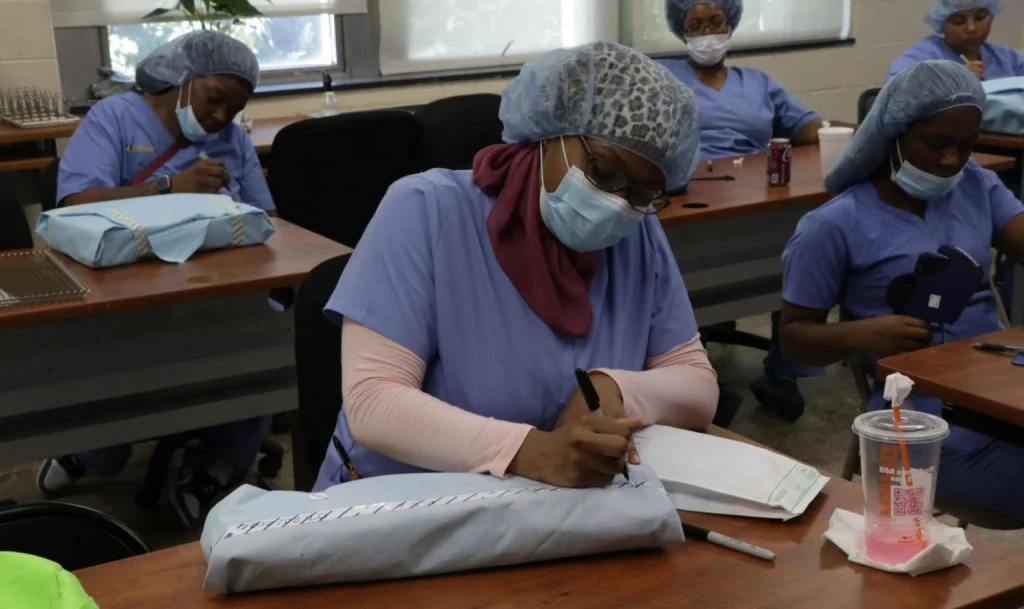
Getting started is simpler than most people assume. You do not need prior healthcare experience. You need a high school diploma or GED, and a willingness to learn a precise, disciplined craft.
Here is the practical path from curiosity to first day of class.
Bring these to your appointment. Good answers build confidence.
Ready to move? Book an appointment with PTTI and get real answers about your timeline, or reach out through contact us with your questions first.
Healthcare does not require four years and a mountain of debt. It requires a role that hospitals genuinely need, training that builds real skill, and a credential employers recognize. Sterile processing delivers all three in about six months.
The work matters. Every surgical team in Philadelphia depends on someone doing it correctly. That someone could be you, six months from now.
Take the next step. Book an appointment with PTTI to talk through your timeline, schedule, and costs. See the lab, ask your questions, and decide with real information instead of assumptions.
A sterile processing technician decontaminates, inspects, assembles, and sterilizes surgical instruments in a hospital’s central service department. Every instrument used in surgery passes through their hands. PTTI trains students for this role using hands-on labs and CRCST-focused preparation.
Choose a role that hires on verified skill rather than academic credentials. Sterile processing requires only a high school diploma or GED plus focused training. PTTI’s Central Processing & Sterile Services program prepares you for hospital jobs without a degree in about six months.
PTTI’s program takes roughly 26 weeks, or about six months. That covers decontamination, instrumentation, sterilization methods, infection control, and CRCST exam preparation. Day and evening schedules let you keep working while you train.
The CRCST credential from HSPA is the industry standard. It requires passing an exam plus 400 documented hands-on hours, which a provisional pathway allows you to complete after the exam. PTTI’s curriculum is built around this certification.
It is a genuine career with a defined ladder. You can advance from technician to certified specialist, then to lead, supervisor, or department manager. Specialty credentials in instrumentation and endoscope reprocessing raise both responsibility and pay.