
Heating, ventilation, and air conditioning work sits behind nearly every comfortable room you have ever been in, yet most people never think about it until something breaks. That invisibility is part of what makes HVAC a durable career, and it is also why the trade is worth an honest evaluation before you commit time and money to training. If you are weighing HVAC against college, another trade, or your current job, you deserve the full picture, not a recruitment pitch.
This guide lays out the honest pros and Cons of becoming an HVAC Technician in Today’s Market. It covers what the job pays in the Philadelphia region, how strong demand actually is, the certifications you will need, and the parts of the work that recruiters tend to skip over, from seasonal crunch and on-call nights to the physical toll and the new refrigerant rules reshaping the trade in 2026. The goal is simple: give you enough grounded information to decide whether this path fits your goals, your body, and your life.
Strong demand: The U.S. Bureau of Labor Statistics projects about 8% job growth for HVAC technicians through 2034, faster than the average occupation.
Solid pay, no degree: HVAC technicians in the Philadelphia area typically earn roughly $55,000 to $75,000, with commercial and union specialists reaching $100,000 or more.
Fast start: Focused training plus EPA 608 certification can get you into an entry-level HVAC job in well under a year.
Real trade-offs: The work is physical, seasonal, and often includes on-call hours, attic and rooftop labor, and exposure to heat and cold.
Certification matters: EPA Section 608 is legally required to handle refrigerant, and A2L refrigerant training is now essential for new systems.
Adjacent skills carry over: Mechanical, piping, and electrical-controls training builds directly toward HVAC competency.
Local training exists: PTTI offers hands-on HVAC and related mechanical-trades training for students across Philadelphia, PA, and South Jersey.
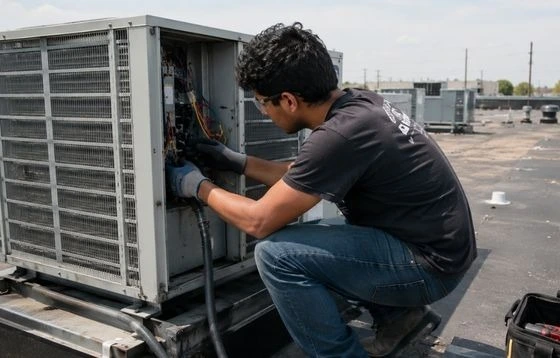
An HVAC technician installs, maintains, diagnoses, and repairs the systems that heat, cool, and ventilate homes and buildings. On a typical day, that can mean troubleshooting a unit that quit in a heat wave, replacing a compressor or blower motor, charging or recovering refrigerant, checking airflow and electrical connections, and performing preventive maintenance so equipment lasts longer.
Understanding the day-to-day is the foundation for an honest pros-and-cons discussion, because most of the advantages and drawbacks flow directly from the nature of the work itself.
There are real, structural reasons HVAC keeps drawing career changers and young workers. Here are the strongest.
The job outlook is one of HVAC’s clearest advantages. The U.S. Bureau of Labor Statistics projects roughly 8% employment growth for heating, air conditioning, and refrigeration mechanics and installers from 2024 to 2034, faster than the average for all occupations, with tens of thousands of openings projected each year. Demand is driven by the sheer installed base of aging equipment, new construction, and the push toward energy-efficient heat pumps. Buildings will always need climate control, and someone qualified has to keep it running.
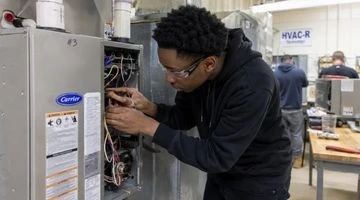
HVAC pays competitively for a career that does not require a bachelor’s degree or the debt that often comes with one. In the Philadelphia region, technicians commonly earn in the mid-$50,000s to mid-$70,000s, and experienced commercial, controls, and union technicians can move well beyond that. National figures place the median HVAC wage near $60,000, with Pennsylvania and the Philadelphia-Camden-Wilmington market trending at or above that level.
| Career Stage | Approximate Annual Range (Philadelphia Area) |
| Entry-level technician | $45,000 – $52,000 |
| Experienced technician | $58,000 – $72,000 |
| Commercial / controls / union specialist | $80,000 – $100,000+ |
Figures are regional estimates drawn from BLS and market compensation data and vary by employer, specialty, overtime, and certifications.
Unlike degrees measured in years, HVAC training is measured in months. A focused program that pairs hands-on lab work with EPA 608 preparation can move you from beginner to entry-level employable in well under a year. That short runway is a genuine advantage for career changers, veterans, and adults who cannot afford to stop earning for four years.
HVAC is not a dead-end job. Technicians can move into commercial refrigeration, controls and building automation, system design, service management, or business ownership. Each step up in specialization or responsibility tends to raise pay. The trade rewards people who keep learning, and the ceiling is high for those who pursue advanced certifications or run their own shop.
Climate control is not optional in a Philadelphia summer or a January cold snap. Because HVAC systems must keep running regardless of the economy, skilled technicians tend to stay busy through downturns. Essential, hands-on, judgment-heavy work is also difficult to automate, which adds a layer of long-term stability that many office roles no longer offer.
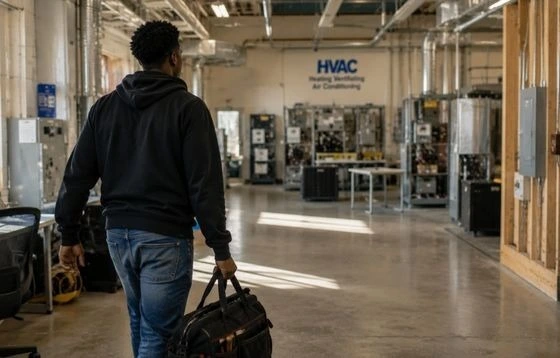
An honest evaluation has to weigh the drawbacks just as seriously. These are the parts of the job that matter most before you commit.
HVAC is hard on the body. Technicians crawl through attics and crawlspaces, work on rooftops, lift heavy equipment, and spend long stretches bending, kneeling, and standing. Summer service calls happen in hot spaces with failed cooling; winter no-heat calls happen in the cold.
HVAC demand spikes in peak summer and deep winter, which means long hours exactly when customers are most desperate. During heat waves and cold snaps, technicians frequently work overtime, weekends, and evenings. The overtime can boost income significantly, but it also compresses your personal time when the season peaks. Shoulder seasons can be slower, so income may fluctuate across the year depending on your employer.
Many HVAC roles include on-call rotations.That unpredictability can be difficult for people who need a fixed, predictable schedule.
The credentialing side of HVAC has become more demanding, not less. EPA Section 608 certification is legally required to purchase and handle refrigerant, and the industry’s shift to A2L refrigerants such as R-454B and R-32, driven by the AIM Act phasedown of older refrigerants, has added new training and equipment requirements. Manufacturer warranties increasingly expect an A2L safety endorsement, and standard recovery equipment rated for older refrigerants is not certified for A2L use. Staying current is part of the job, and it costs time and money throughout your career.
While experienced HVAC pay is strong, the first year or two is more modest, often in the $45,000 range locally as you build speed, diagnostic skill, and certifications. The high six-figure numbers you see online generally belong to seasoned commercial specialists, union technicians, or shop owners, not first-year hires. Knowing that up front prevents disappointment.
Technicians work with electricity, pressurized refrigerant, sharp sheet metal, and now mildly flammable A2L refrigerants that require careful handling. The hazards are manageable with proper training and discipline, but they are real, and safety practice is non-negotiable in this trade.
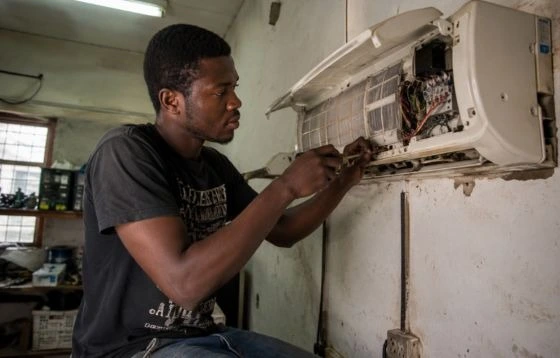
For the right person, yes. HVAC in 2026 offers strong demand, competitive pay without a four-year degree, a short training runway, and clear advancement, balanced against physical work, seasonal intensity, on-call hours, and ongoing certification requirements. If you like hands-on problem-solving and can handle the physical and scheduling demands, the trade-offs are very manageable.
The honest summary is that HVAC rewards people who want tangible, essential work and are willing to keep learning. It is a weaker fit for someone seeking a low-physical-effort desk role with a fixed nine-to-five and no continuing education. Weigh it against your own priorities rather than a generic ranking.
Most people can complete focused HVAC training in under a year, then earn the credentials employers expect. Training builds core mechanical, electrical, and refrigeration skills, while certification proves you can work legally and safely.
EPA Section 608 is a federally mandated certification required for anyone who maintains, services, or disposes of equipment containing regulated refrigerant. It comes in Type I, Type II, Type III, and Universal levels, and the exams are affordable and can often be prepared for within a structured program. This is the single most important credential for a new technician, because without it you cannot legally handle refrigerant.
Beyond EPA 608, A2L refrigerant knowledge has become essential because most new residential systems now ship with R-454B or R-32. Many employers and manufacturers expect an A2L safety endorsement for new-install and warranty work. NATE certification is not legally required but is widely respected and can raise a technician’s billable value, making it a smart mid-career investment. Training that keeps pace with these 2026 realities is what separates job-ready graduates from those who need remediation on their first day.
The Philadelphia-Camden-Wilmington market is one of the larger HVAC job markets in Pennsylvania, with thousands of technician positions across residential service, commercial and industrial systems, and new construction. Demand is spread across the region rather than concentrated in one setting, which gives new technicians options.
Opportunities extend well beyond Center City. Work is available across North, South, and West Philadelphia, in neighborhoods from Spring Garden and Mantua to the Northeast, and throughout nearby communities such as Yeadon, Lansdowne, Darby, Drexel Hill, and Ardmore. Across the river, South Jersey towns including Camden, Pennsauken, Cherry Hill, Maple Shade, Collingswood, Cinnaminson, and Haddonfield add further demand, and the market reaches into Delaware as well. Because HVAC skills are portable, training in Philadelphia positions you to work in whichever direction the best opportunity appears.
Prospective students often weigh HVAC against welding, pipefitting, or automotive work. Each is a strong path; the right one depends on the environment and tasks you prefer.
| Factor | HVAC | Pipefitting / Steamfitting | Welding |
| Core work | Heating, cooling, refrigeration systems | Piping, steam, and mechanical systems | Joining and fabricating metal |
| Key credential | EPA 608 + A2L | Certification + apprenticeship hours | AWS weld test |
| Work setting | Homes, rooftops, mechanical rooms | Commercial and industrial sites | Shops, fabrication, field |
| Seasonality | High (summer/winter peaks) | More steady | Varies by industry |
| Training runway | Under a year possible | Under a year to start; apprenticeship to advance | Under a year possible |
HVAC and the mechanical trades share a lot of DNA. Skills in piping, refrigeration lines, mechanical systems, and electrical controls overlap meaningfully, which is why training in one area can strengthen your options in another.
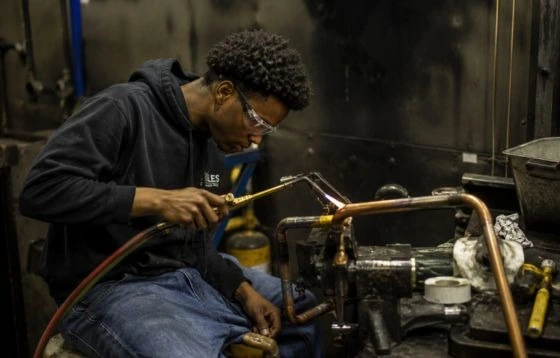
HVAC tends to suit:
It is a weaker fit for anyone who cannot accommodate physical work, seasonal overtime, or on-call scheduling. That honesty is the point of this guide.
Philadelphia Technician Training Institute (PTTI) offers hands-on HVAC training built around real equipment, safety practice, and certification readiness, alongside closely related mechanical programs. Because HVAC draws on piping, refrigeration, mechanical, and electrical-controls skills, students benefit from applied lab time rather than lecture alone.
Two features matter most for job readiness. First, hands-on labs on industry-standard equipment mirror the conditions technicians actually face, from diagnostics to refrigerant handling
Explore your options. See PTTI’s programs, including its HVAC and related mechanical training, and learn how quickly you could be job-ready.
Becoming an HVAC technician is a strong choice for the right person, and a poor fit for the wrong one, which is exactly why an honest pros-and-cons look matters more than a sales pitch. The advantages are substantial: faster-than-average demand, competitive pay without a four-year degree, a short training runway, essential and recession-resistant work, and clear room to grow. The drawbacks are equally real: physical strain, seasonal intensity, on-call hours, modest first-year pay, and ongoing certification demands in a trade that keeps evolving.
If you value hands-on, essential work and can handle the physical and scheduling realities, HVAC offers a genuinely durable career. The best next step is to see the training environment for yourself and talk through the path with people who know the trade.
Ready to look closer? Explore PTTI’s programs, schedule a campus tour, or contact admissions to talk through whether HVAC or a related mechanical trade fits your goals.
For many people, yes. HVAC offers strong demand, competitive pay without a four-year degree, and a short path to your first job, balanced against physical work, seasonal hours, and ongoing certification. If you like hands-on problem-solving, the trade-offs are manageable.
The biggest drawbacks are the physical demands, seasonal overtime during summer and winter peaks, on-call and emergency work, modest entry-level pay in the first year or two, and the need to keep certifications current as refrigerant rules change.
Most technicians in the Philadelphia area earn roughly $55,000 to $75,000, with entry-level pay near $45,000 and experienced commercial, controls, or union specialists reaching $100,000 or more. Overtime during peak seasons can add meaningfully to income.
Focused HVAC training can often be completed in under a year, after which you can earn EPA 608 certification and pursue entry-level roles. Advancement and specialty certifications continue throughout your career.
Yes. EPA Section 608 is federally required to purchase and handle refrigerant. A2L refrigerant training is also increasingly expected for work on newer systems, and NATE certification, while optional, is well respected.
It can be. Technicians work in attics, crawlspaces, and on rooftops, lift heavy equipment, and work in seasonal heat and cold. Good technique and safety habits reduce the strain, but the physical demands are real.
Yes. The Bureau of Labor Statistics projects about 8% growth through 2034, faster than average . The Philadelphia-Camden-Wilmington market has thousands of technician jobs across residential, commercial, and new construction work.
PTTI provides hands-on training in HVAC and related mechanical systems for students across Philadelphia. The surrounding Pennsylvania counties and South Jersey, with a focus on real equipment and certification readiness.