
Metal trades are having a moment. As manufacturing reshoring, aging infrastructure, and a retiring workforce collide, employers across Philadelphia and the wider tri-state region are competing for skilled hands. For anyone weighing a hands-on career that pays well without a four-year degree, two paths stand out: welding and CNC machining. Both build real things, both reward skill over pedigree, and both can start with focused training rather than years of college.
But they are not the same career, and in 2026 they carry different risk-and-reward profiles. Welding tends to offer broader, more site-based demand that resists automation at the skilled level. CNC machining sits closer to the cutting edge of precision manufacturing and Industry 4.0, with a higher technical ceiling but more automation exposure at the entry level. This guide compares the two across the factors that actually decide a career: pay, job outlook, automation risk, training time, certifications, and day-to-day work. The goal is not to crown one winner for everyone, but to help you choose the metal trade with the better future for you.
| Factor | Welding | CNC Machining |
| Core work | Joining and cutting metal with heat | Programming and running machines that cut precise parts |
| Typical entry pay | ~$45,000–$52,000 | ~$40,000–$50,000 |
| Experienced/specialist pay | $70,000–$80,000+ | $67,000–$80,000+ (programmers highest) |
| National outlook (2024–34) | +2% growth, ~45,600 openings/yr | −2%, ~34,200 openings/yr |
| Automation exposure | Lower at skilled/field level | Higher at operator level, low for programmers |
| Work setting | Shops, job sites, shipyards, field | Climate-controlled machine shops |
| Fastest path | Hands-on program, under a year | Hands-on program, under a year to ~2 years |
| Key credential body | American Welding Society (AWS) | National Institute for Metalworking Skills (NIMS) |
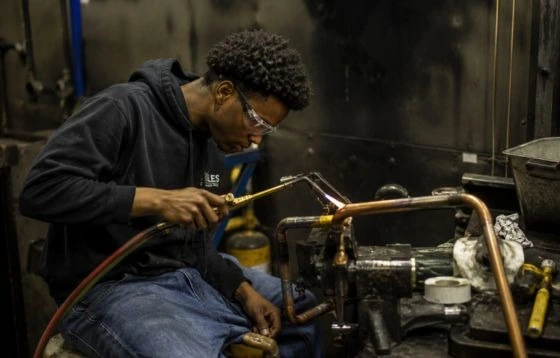
Welding is the trade of joining, cutting, and repairing metal using heat, most often through arc processes like MIG, TIG, stick, and flux-cored welding. Welders read blueprints and welding symbols, set up equipment, and produce sound welds that must pass inspection. The work spans industries: structural steel, shipbuilding, pipefitting, manufacturing, and infrastructure repair.
The defining feature of welding is that much of it happens where the metal is, which frequently means the field, awkward positions, and unique job-site conditions. That physical, judgment-heavy reality is why skilled welding resists full automation. A robot can weld a repeatable seam on a production line, but it cannot easily climb a bridge, adapt to bad fit-up, or certify a repair in a shipyard. That distinction matters when you are betting a career on future demand.
CNC (computer numerically controlled) machining is the trade of producing precise metal and plastic parts using programmable machines like mills and lathes. A CNC machinist interprets engineering drawings, selects tooling, sets up the machine, writes or edits the program, runs the job, and inspects parts to tight tolerances. At the higher end, CNC programmers and CAM specialists write the code that drives multi-axis machines producing aerospace, defense, and medical components.
CNC machining is where the skilled trades meet advanced manufacturing. The trade rewards precision, math, computer comfort, and problem-solving. The trade-off is that entry-level machine operating, the most repetitive tier, is more exposed to automation, while the programming and setup tiers, which require judgment and skill, remain in high demand. In other words, the future in machining belongs to those who move up the skill ladder rather than staying at the button-pushing level.
Pay between the two trades is closer than most people assume. Nationally, welders earn a median wage in the high-$40,000s to around $50,000, while machinists earn a median of roughly $56,000, according to the U.S. Bureau of Labor Statistics. In both trades, specialists earn far more than the median, and in the Philadelphia market union presence and industry mix push wages higher.
| Role | Typical U.S. Pay Range |
| Entry-level welder | $45,000 – $52,000 |
| Experienced / certified / union welder | $68,000 – $80,000+ |
| CNC machine operator (entry) | $36,000 – $50,000 |
| CNC machinist (median) | ~$56,000 |
| Setup / senior machinist | ~$67,000 |
| CNC programmer | $80,000+ |
The pattern is clear. Both trades start in a similar range, and both reward specialization heavily. In welding, the premium goes to certified pipe, structural, and specialty welders. In machining, it goes to setup machinists and programmers who can run multi-axis work. If maximizing income is your goal, the deciding factor is less which trade you pick and more how far up the skill ladder you climb, and how many certifications you stack.
Want to see real earning paths? Explore PTTI’s Welding Technology program and Manufacturing & Automation program to compare outcomes side by side.
Both trades hire steadily, but for the same underlying reason: an aging workforce is leaving faster than new workers arrive. Welding shows modest projected growth of about 2 percent from 2024 to 2034, with roughly 45,600 openings each year. Machining shows a projected decline of about 2 percent over the same period, yet still generates around 34,200 openings annually. In both cases, the openings come overwhelmingly from retirements and career changes rather than from new job creation.
Here is the nuance that headline numbers miss. A “declining” occupation can still be desperate for workers if enough people are leaving it. The National Association of Manufacturers and the Manufacturing Institute have estimated that around 2.1 million manufacturing jobs could go unfilled by 2030, and CNC machining is among the hardest roles to fill. Aerospace, defense, and medical-device shops routinely report shortages of qualified setup machinists and programmers.
So which is more in demand? Welding has the larger raw pool of annual openings and slightly positive growth, which makes it the safer bet on pure volume. CNC machining has fewer openings but intense hiring pressure for skilled roles, especially programmers, where the workforce is small and specialized. Neither trade is going quiet.
This is the question that decides many careers in 2026, and the honest answer is that automation cuts differently across the two trades. In welding, robots handle repetitive production seams, but the skilled, site-specific, judgment-heavy work of field welding, repair, and inspection is very difficult to automate. In machining, automation is more embedded: CNC itself is automation, and entry-level operating is more exposed, while programming and setup, the roles that direct the machines, remain firmly human.
The practical takeaway is the same for both trades: the future belongs to the skilled, not the button-pushers. A welder who can pass demanding certifications and handle complex field work is future-proof. A machinist who can program multi-axis machines and troubleshoot is future-proof. What is at risk in either trade is the lowest-skill, most repetitive tier. Training that builds genuine skill, not just familiarity, is the best insurance either way.
Curious how technology is reshaping these trades? Read Will welding be automated? The role of robotics and AI and Top automation technologies every manufacturing student should master.
Both trades can be entered quickly through focused, hands-on training, which is a major advantage over a four-year degree. Welding can prepare you for entry-level work in under a year because it is performance-based: once you can pass a weld test, you are hireable. CNC machining can also start in under a year for operating and basic setup, though reaching the higher-paid programming tier typically takes additional time and experience.
The reason both are fast is that employers hire on demonstrated ability. A welder proves skill by depositing a sound weld under inspection. A machinist proves skill by producing a part to tolerance and running a job cleanly. Neither requires a bachelor’s degree. What both require is real time on real equipment, which is why the quality of hands-on training matters far more than classroom hours alone.
Ready to start fast? See the quickest welding program path in Philadelphia or explore why manufacturing and automation graduates get ahead.
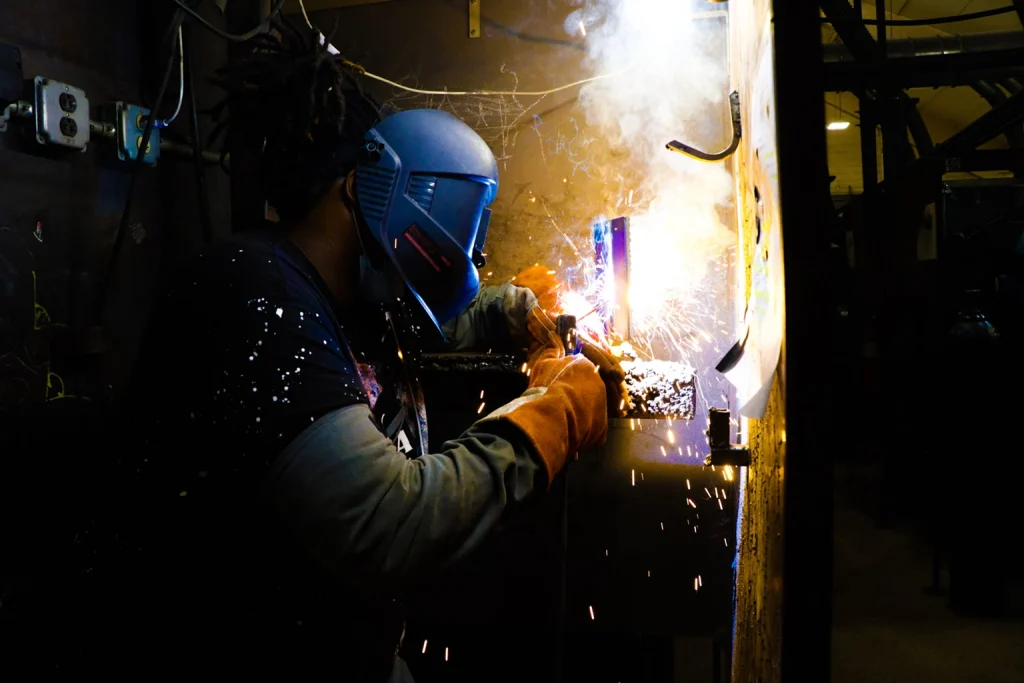
Certification is where both trades turn training into hireability, and each has a respected national body. For welders, the American Welding Society (AWS) offers the performance-based Certified Welder credential, earned by passing a weld test at an accredited facility and maintained with a short verification form. For machinists, the National Institute for Metalworking Skills (NIMS) offers stackable credentials that combine a knowledge exam with a hands-on performance evaluation across machining skill levels.
| Welding (AWS) | CNC Machining (NIMS) | |
| Governing body | American Welding Society | National Institute for Metalworking Skills |
| Format | Performance-based weld test | Exam + hands-on performance evaluation |
| Structure | Transferable, maintained every 6 months | Stackable, entry to advanced levels |
| Employer value | Widely required for quality/structural work | Recognized measure of machining job readiness |
In both trades, certifications directly raise earning potential and open doors to better work. The smartest approach in either path is to stack credentials over time, because each one expands the range of jobs you can take and the pay you can command.
Since pay and demand are broadly comparable, the better choice often comes down to fit. Consider how you like to work.
Welding may fit you better if you:
CNC machining may fit you better if you:
Neither answer is wrong. Both are stable, respected, well-paid trades with genuine futures. The person who thrives is the one who picks the work they will actually enjoy doing every day and then commits to building real skill.
The Philadelphia region is unusually strong for both metal trades, which is part of why they are worth pursuing here. Welders find work across shipbuilding and ship repair, structural steel, pipefitting, and infrastructure projects throughout the city and suburbs. CNC machinists and manufacturing technicians find work in fabrication shops, precision manufacturing, aerospace and defense suppliers, and the region’s growing medical-device and life-sciences sector.
That demand extends well beyond the city center. Graduates take jobs across North, South, and West Philadelphia and neighborhoods like Mantua, Powelton Village, and the Spring Garden corridor, as well as surrounding Pennsylvania towns such as Yeadon, Lansdowne, Darby, Drexel Hill, and Ardmore. Across the river, South Jersey communities including Camden, Pennsauken, Collingswood, Cherry Hill, Cinnaminson, Maple Shade, Haddonfield, Gloucester City, and Audubon add still more opportunity. Because welding and machining skills are portable, training centrally in Philadelphia positions you for work throughout the tri-state market, including Delaware.
Yes, and this is the practical advantage of choosing a school that teaches both metal trades. Philadelphia Technician Training Institute (PTTI) offers hands-on training in Welding Technology and in Manufacturing & Automation, using industry-standard equipment in applied lab environments. Rather than committing to a trade blind, prospective students can compare programs, tour the labs, and speak with instructors who have worked in the field.
Both programs emphasize what employers actually expect on day one: safety discipline, blueprint reading, hands-on competency, and certification readiness. That combination, real equipment, employer-relevant skills, and support moving into the workforce, is what turns a training program into a career. Whether you lean toward sparks and steel or precision and programming, the region’s demand supports the choice.
See the labs for yourself. Explore PTTI’s programs, schedule a campus tour, or contact admissions to talk through which metal trade fits your goals.
In 2026, welding and CNC machining are both smart bets. Pay is comparable, both hire steadily from a retiring workforce, and both reward skill far more than credentials. Where they differ is character: welding leans physical, varied, and site-based with strong resistance to automation, while CNC machining leans precise, technical, and tied to advanced manufacturing with a high ceiling for programmers. Neither trade has a “better future” in the abstract. The better future is the one that matches how you want to work and how far you are willing to build your skill.
The most reliable way to decide is to get hands-on. Compare the work, see the equipment, and train where employers are already hiring.
Take the next step. Explore PTTI’s Welding Technology and Manufacturing & Automation programs, request information, or schedule a campus tour to choose your metal trade with confidence. Ready to begin? Contact admissions and start building a career this year.
Both are strong, stable metal trades with comparable pay and steady demand. Welding offers broader, harder-to-automate field demand and the fastest path to certification, while CNC machining offers a higher precision-tech ceiling and strong programmer pay. The better choice depends on whether you prefer physical, site-based work or precision, computer-driven work.
They are close. Welders earn a national median in the high-$40,000s to around $50,000, and machinists around $56,000, per the Bureau of Labor Statistics. In both trades, specialists earn far more, with certified welders and CNC programmers frequently exceeding $70,000 to $80,000.
Automation affects both but does not eliminate skilled workers. In welding, repetitive production seams can be automated, but field, repair, and inspection work cannot easily be. In machining, entry-level operating is more exposed, while programming and setup remain in high demand. Skilled workers in either trade are future-proof.
Welding is typically the fastest path to a hireable credential because it is purely performance-based; you become employable once you can pass a weld test. CNC machining can also start in under a year at the operator level, with programming roles taking additional experience.
Welders pursue the AWS Certified Welder credential, a performance-based weld test. Machinists pursue NIMS credentials, which combine a knowledge exam with a hands-on performance evaluation. Both are respected nationally and both raise earning potential.
Both are in demand. The region’s shipbuilding, structural steel, and pipefitting work drives welding demand, while fabrication shops, aerospace and defense suppliers, and the medical-device sector drive machining demand. Either trade offers strong local opportunity.
Yes. PTTI offers both Welding Technology and Manufacturing & Automation programs, so you can compare hands-on training, tour the labs, and choose the metal trade that fits you best.