
If you’ve searched for how to get an HVAC license in Pennsylvania, you’ve probably found conflicting answers — and a lot of noise. Here’s the part almost no one leads with: there is no statewide HVAC license in Pennsylvania. No state exam, no state board, and no single card that says you’re a licensed HVAC technician across the Commonwealth.
That surprises people, and it should. It changes the entire question. Instead of asking “How do I get an HVAC license in Pennsylvania?” the smarter question is “What do I actually need to work legally and get hired in Philadelphia and the surrounding counties?” The real answer is a short, specific list — one federal certification, a few local rules depending on where you work and what you install, and the one thing that actually gets you a job: verifiable, hands-on skill.
This guide breaks it all down in plain English for 2026, with a focus on Philadelphia. Whether you’re a high school graduate weighing your options, a career changer, or a veteran looking for a stable trade, you’ll leave knowing exactly what’s required, what’s optional, and where to start.
No. Pennsylvania does not require or issue an HVAC license for technicians, apprentices, or contractors. There is no state-administered HVAC exam and no state licensing board for the trade. Instead, requirements are set at the federal level for refrigerant handling and at the local city or county level for permits and specific work.
This is the single most important thing to understand before you spend money or time chasing the wrong credential. Because the state stays out of it, two things become true at once: the barrier to entering the field is lower than in states with heavy licensing, and the burden of proving you’re qualified shifts almost entirely onto training and certification. Employers can’t rely on an HVAC license in Pennsylvania to tell them you’re competent, so they look at your EPA 608 card, your hands-on ability, and your certifications instead.
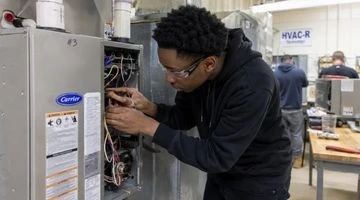
If there’s a “license” that matters most in Pennsylvania, it’s this one — and it’s federal, not state.
EPA Section 608 certification is required under the Clean Air Act for anyone who maintains, services, repairs, or disposes of equipment that could release regulated refrigerants. In practical terms: if you’re going to open a refrigerant line, recover refrigerant, or even purchase refrigerant, you must hold this certification. It’s a per-technician credential — you own it, it moves with you between employers and states, and once you pass, it does not expire.
You earn certification by passing a Core section plus one or more equipment-specific “Type” exams. Which type you need depends on the equipment you’ll touch, not the refrigerant inside it.
| Certification | What it covers | Typical use |
| Type I | Small appliances (5 lbs of refrigerant or less) | Window units, PTACs, refrigerators, ice makers |
| Type II | High- and very-high-pressure systems | Most residential split systems, heat pumps, rooftop units |
| Type III | Low-pressure systems | Chillers and low-pressure commercial equipment |
| Universal | All three types combined | Maximum flexibility — the credential most employers prefer |
Most technicians aim for Universal certification because it qualifies them to legally work on virtually any system they’ll encounter, which is why it’s the version employers value most. A quality HVAC program prepares you for the 608 exam as part of the curriculum, so you graduate already certified — rather than scrambling for it afterward.
Callout: EPA 608 is the closest thing to a required HVAC license in Pennsylvania. Skip it, and you legally cannot handle refrigerant or even buy it. Everything else is situational.
Most confusion online comes from blending two very different roles into one search.
Working as an HVAC technician (employee) is the path most people take first. As an employee working under a company, your core requirements are straightforward: get trained, earn EPA 608 (if you’ll handle refrigerant), and — in Philadelphia specifically — register appropriately if you’re doing sheet metal work. You generally do not need to personally hold a contractor license to be hired.
Operating as an HVAC contractor (business owner) is a different world. The moment you run your own business, pull permits in your own name, and sign contracts with homeowners, you take on registrations, local business licenses, insurance requirements, and permit obligations. That’s where the “licensing” people worry about actually lives.
For a student or career changer, this distinction is freeing. You do not need to solve the contractor puzzle to start earning — you need training and EPA 608 to get hired, then build experience.
Because there’s no statewide HVAC license in Pennsylvania, Philadelphia sets its own rules through the Department of Licenses and Inspections (L&I), and this layer matters most for anyone working inside city limits.
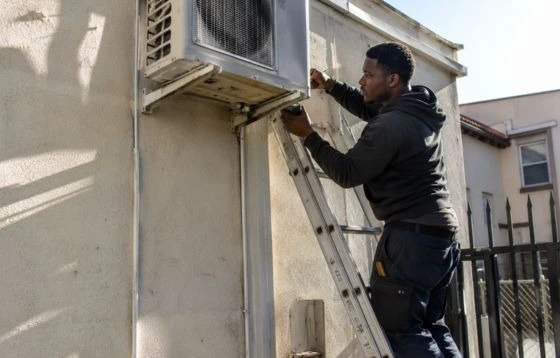
Most HVAC installations, replacements, and alterations in Philadelphia require a mechanical permit, applied for through the city’s eCLIPSE portal. The city requires that permitted work be performed by a licensed contractor who holds an active license, is current on City of Philadelphia taxes, and has current insurance on file with L&I. In other words, the company carries the compliance weight for permitted jobs — another reason employees can enter the field without navigating all of it on day one.
Philadelphia does regulate one HVAC-adjacent skill directly: sheet metal work. The city recognizes a Sheet Metal Apprentice credential (for those in a registered apprenticeship working under supervision) and a Sheet Metal Systems Technician credential for those who install, maintain, and service HVAC sheet metal systems. The technician level generally requires thousands of hours of documented practical experience plus classroom instruction, with fees and multi-year renewal cycles set by the city.
Contractors physically operating in Philadelphia typically also need a city business license (often referenced as a Commercial Activity License) and must keep insurance and tax status current with the city. Because city fees and credential names are updated periodically, always confirm current specifics directly with Philadelphia L&I before applying.
Statewide, Pennsylvania does regulate one thing that touches HVAC: residential home improvement work. Under the Home Improvement Consumer Protection Act (HICPA), contractors performing residential home improvements — HVAC installation and replacement included — must register with the Pennsylvania Office of Attorney General and receive a PA Home Improvement Contractor (PAHIC) number.
Two points matter here. First, this is a registration, not a competency license — it doesn’t test your HVAC skill. Second, it applies to the business, and the PAHIC number must appear on residential contracts. For a technician working as an employee, this is your employer’s obligation.
Beyond the mandatory EPA 608, Pennsylvania leaves the door open for you to stand out. NATE certification (North American Technician Excellence) is widely treated as the gold standard in the trade. It isn’t required, but it signals verified competence and is frequently tied to higher pay and faster advancement. Manufacturer-specific certifications, OSHA safety training, and specialty credentials in heat pumps or commercial refrigeration also raise your value. In a state with no HVAC license, these are how you prove you’re better than the next applicant.
Pay is one of the strongest reasons to consider this trade. According to the U.S. Bureau of Labor Statistics, the national median annual wage for heating, air conditioning, and refrigeration mechanics and installers was $59,810 in May 2024, with the lowest 10% earning under $39,130 and the top 10% earning more than $91,020.
| Level | Approximate annual range (Philadelphia area) |
| Entry-level / apprentice | ~$40,000–$52,000 |
| Experienced technician | ~$56,000–$74,000 |
| Specialized / commercial / lead | ~$75,000–$90,000+ |
Overtime, emergency calls, commercial specialization, union membership, and eventually business ownership can push earnings well beyond these ranges. The key driver is skill and certification — not a license — which puts your income under your own control.
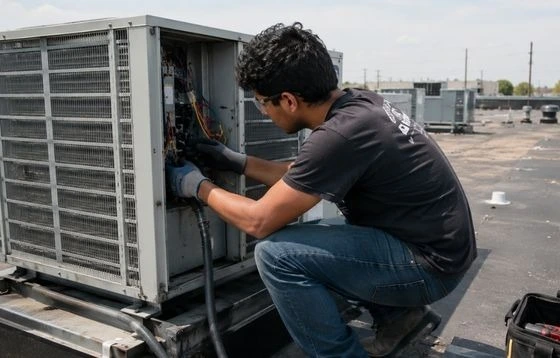
This is not a field where you’re gambling on demand. BLS projects HVAC employment to grow 8% from 2024 to 2034 — much faster than the average for all occupations — with roughly 40,100 openings expected each year, largely driven by retirements.
The reasons are structural and local. Every building in Philadelphia — homes, hospitals, schools, warehouses, high-rises — needs heating, cooling, and ventilation, and the region’s cold winters and humid summers make those systems non-negotiable. Add aging equipment, rising efficiency standards, the shift toward electric heat pumps, and new refrigerant regulations, and you have steady, recession-resistant demand that can’t be outsourced or automated.
Here’s the realistic 2026 path from zero experience to working technician:
Notice what’s not on that list: waiting years for an HVAC license in Pennsylvania. The fastest route to a paycheck is training plus EPA 608.
Because Pennsylvania doesn’t gate HVAC behind a state license, the quality of your training is your credential. Employers can’t lean on a license to vet you, so they hire on what you can prove — and the best proof is being job-ready on day one.
That’s exactly the gap a strong program fills. Philadelphia Technician Training Institute (PTTI) offers a hands-on HVAC program built around real equipment, taught by instructors with field experience, and structured to move you from beginner to job-ready in months rather than years. Students train on live systems, prepare for EPA 608 certification, and learn the diagnostic and installation skills Philadelphia-area employers are hiring for. PTTI backs that with dedicated career support — resume help, interview prep, and placement connections — plus financial aid through FAFSA (school code 042213), veterans’ education benefits, and institutional financing.
Ready to start? Explore PTTI’s HVAC program, review your financial aid options, or schedule a campus tour to see the labs for yourself.
Pennsylvania’s lack of a statewide HVAC license isn’t a loophole — it’s an opportunity. It means you can enter a high-demand, well-paid trade faster than in heavily licensed states, as long as you get the two things that actually matter: real, hands-on training and EPA 608 certification. The field is growing, the pay is strong, and the barrier isn’t bureaucracy — it’s skill.
Take the next step this year. Explore PTTI’s HVAC program, request more information, or contact admissions to see how quickly you can go from beginner to job-ready HVAC technician in Philadelphia. Veterans can review dedicated benefits here.
Not a state license — there is no HVAC license in Pennsylvania. What you legally need is EPA Section 608 certification to handle refrigerant, plus any local requirements (like Philadelphia’s permit and sheet metal rules) depending on where and what you work on.
Yes. EPA Section 608 is a federal requirement under the Clean Air Act and applies in every state. Anyone who handles, recovers, or purchases regulated refrigerant must be certified, and it doesn’t expire once earned.
Philadelphia doesn’t have a single “HVAC license.” The city, through L&I, requires permits via eCLIPSE for most work, specific registration for sheet metal technicians and apprentices, and business licensing for companies. Confirm current requirements directly with Philadelphia L&I.
A focused, hands-on program can prepare you for entry-level work in well under a year — often around 6 to 12 months depending on schedule and specialty.
The national median was $59,810 in May 2024 (BLS). Philadelphia-area estimates commonly range from the high-$50,000s into the $70,000s for experienced technicians, with specialized roles reaching $90,000+ before overtime.
A technician works as an employee and mainly needs training and EPA 608. A contractor runs a business and takes on registrations, local licensing, permits, and insurance. Most people start as technicians and pursue contractor status later.