
Philly teens are choosing HVAC training over a four-year college; let’s see why. Today’s teens are the most aware generation. The changing job and career landscape is known to them. College debt keeps climbing, while HVAC technicians keep landing steady, well-paying jobs. However, this shift isn’t just about avoiding student loans. Below, we break down the real reasons high schoolers across Philadelphia are picking this path and what it takes to get started.
Every traditional degree after high school promises a four-year degree. Four-year college used to feel like the only “real” option after high school. Upon completion, you can end up getting a job. However, that story doesn’t add up the way it used to. Tuition fees keep rising, and many graduates leave school with debt but no clear job waiting.
Here’s what’s inspiring students to rethink a 4-year traditional college:
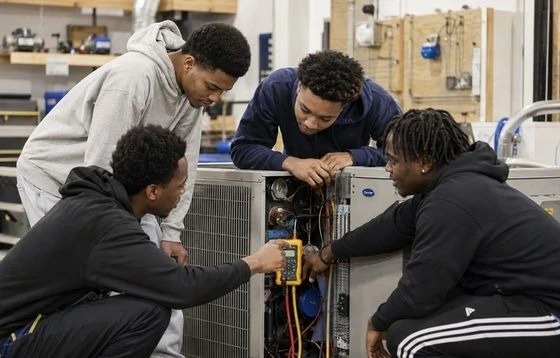
Therefore, more students are asking a simple question: Is there a faster way?
HVAC technician career paths solve a lot of the problems college creates. Additionally, heating and cooling systems are present in every home, school, and business, so the work never really slows down.
Here’s why HVAC training is standing out:
Overall, HVAC training gets students working and earning much faster.
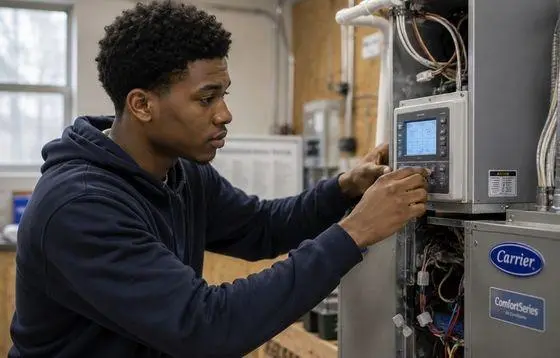
Here’s a simple table comparing both paths lets have a look :
| Program Length | Under 1 year | 4+ years |
| Average Cost | Lower | Much higher |
| Time to First Paycheck | Months | 4+ years |
| Hands-On Skill Building | High | Often limited |
| Debt Load | Lower | Often significant |
Moreover, this comparison shows why so many students are rethinking what “success after high school” actually looks like.
Moreover, regarding HVAC training programs, many people assume HVAC work is just fixing a broken AC unit. However, HVAC technician training covers a lot more ground than that. The knowledge ranges from correct heating and ventilation systems to refrigeration basics to fixing ventilation systems in large warehouses. Installing a digital thermostat.Inspecting the air conditioning in an entire building. The circulation of air, the configuration, and a lot more. So an HVAC career is not limited to fixing AC; it includes everything from basic to practical tasks, including handling larger units.
Let’s understand a few basics: about 30% refrigeration and cooling systems, 25% heating systems, 25% electrical fundamentals, and 20% safety and certification prep. That’s roughly how balanced training time looks in a strong program.
| Refrigeration | Cooling system repair | Core year-round skill |
| Heating Systems | Furnace and boiler repair | Needed for winter demand |
| Electrical Basics | Wiring and circuits | Required for diagnostics |
| Certification Prep | EPA 608, OSHA 30 | Opens doors with employers |
Overall, this training builds real, well-rounded technical skills, not just one narrow specialty.
Heating and cooling systems break down every single year, no matter the economy. Therefore, HVAC technician jobs stay in demand even when other industries slow down.
The report suggests a vacancy of around 440,000 job openings in the HVAC industry. According to the U.S. Bureau of Labor Statistics, employment for heating, air conditioning, and refrigeration mechanics is projected to grow steadily over the next decade, driven by construction activity and equipment replacement needs.
Here’s why job security matters so much to high schoolers weighing their options:
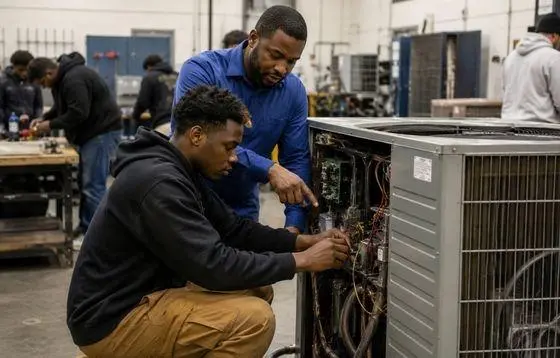
Strong HVAC training programs include certifications that matter to employers. Additionally, these certifications often come at no extra cost within the program itself.
Common certifications include:
Finally, these certifications give students real credibility when applying for jobs right after training.
Philadelphia Technician Training Institute (PTTI) offers an HVAC training program built for students ready to skip the four-year wait. The program includes hands-on lab work, EPA Section 608 certification, and free OSHA 30 certification.
Here’s how enrollment works:
Finally, PTTI reports a placement rate near 92%, meaning most graduates actually land jobs in the field.
Philly high schoolers choosing HVAC training over four-year college aren’t taking a shortcut — they’re taking a smarter route. This will help them achieve financial stability for long-term future goals. However, this path only works if students commit to real hands-on training and certification. The PTTI career service department helps students with resume writing and interviewing. Between lower cost, faster earning potential, and strong job security, HVAC training checks a lot of boxes college often can’t. Overall, this shift reflects a bigger truth: success doesn’t always require four years and a mountain of debt.
Ready to explore HVAC training? Contact PTTI at 215-381-9403 or info@ptt.edu to speak with an advisor.
Lower cost, faster training time, and strong job demand make HVAC training an appealing alternative.
Programs like PTTI’s are designed to finish faster than a traditional four-year degree.
Most programs require a high school diploma or equivalent to enroll.
Programs like PTTI’s include EPA Section 608 and OSHA 30 certifications.
Yes. PTTI accepts FAFSA applications under school code 042213.