
If you are considering a hands-on trade that offers steady demand, strong pay, and a fast route into the workforce, heating and cooling is one of the smartest fields to enter right now. And nearly every path into it begins in the same place: the EPA 608 certification. This is the federal credential that legally allows a technician to handle refrigerants, and without it, you cannot service most air conditioning, refrigeration, or heat pump equipment in the United States.
For anyone asking how to become an HVAC technician, understanding this one requirement clears up much of the confusion. The EPA 608 certification is not a school diploma, a state license, or an optional résumé booster. It is a legal requirement under federal environmental law. This guide explains exactly what the certification is, the four types you can earn, how the exam works, what the 2026 refrigerant transition means for new technicians, and how mechanical trades training in Philadelphia can build the foundation you need to launch a stable, well-paid career.

EPA 608 certification is a federal credential issued under Section 608 of the Clean Air Act that any technician must hold to service, maintain, repair, or dispose of equipment containing refrigerant. It exists because refrigerants can damage the ozone layer and contribute to climate change, so federal law restricts who is legally allowed to handle them.
The credential is administered through EPA-approved certifying organizations, and it applies to stationary equipment such as air conditioners, heat pumps, and refrigeration systems. The distinction that sets the EPA 608 certification apart from every other HVAC credential is simple: it is not about looking qualified, it is about being legally allowed to do the work. Without it, a technician cannot open a refrigerant circuit, and suppliers cannot legally sell that technician refrigerant. That is why it is universally recognized as the true first step into an HVAC career.
Most skilled trades let you learn as you go, but refrigerant work is different. You cannot legally touch the refrigerant side of a system until you are certified, which is why the EPA 608 certification comes before almost everything else in an HVAC/R career. Employers treat it as a baseline hiring requirement, and many will not put a new technician on refrigerant-handling tasks without it.
Beyond the legal requirement, earning the certification signals something important to employers: that you understand refrigerant recovery, environmental regulations, and safe handling procedures. For a hiring manager, that reduces risk and shortens the ramp-up time for a new hire. In a field where employers are competing for qualified people, walking in with your refrigerant handling certification already in hand puts you ahead of applicants who have not taken that step.
There are four EPA 608 certification types, and every one of them requires passing a Core section first. The Core covers universal knowledge such as ozone depletion, recovery techniques, and regulations. After passing the Core, you pass one or more type-specific sections depending on the equipment you plan to service.
| Certification | Equipment Covered | Typical Use |
| Core | Required foundation for all types | Refrigerant fundamentals and regulations |
| Type I | Small appliances with 5 lbs or less of refrigerant | Household refrigerators, window AC units, water coolers |
| Type II | High-pressure and very high-pressure systems | Most residential and commercial HVAC service work |
| Type III | Low-pressure systems | Large commercial chillers, industrial equipment |
| Universal | All of the above combined | Broadest flexibility across all regulated equipment |
Each section typically contains 25 multiple-choice questions, and most require roughly a 70% score to pass. For technicians planning a long-term HVAC career, Universal certification is usually the smartest choice because it removes equipment restrictions and is the option most employers prefer. If you know you will only ever service small appliances, Type I may be enough, but Type II is the practical minimum for mainstream HVAC work.
Planning your path? Explore PTTI’s Steam, Sprinkler & Pipe Fitting program to build the mechanical foundation that supports refrigerant and HVAC/R work
EPA 608 covers stationary equipment such as home and commercial HVAC systems, refrigeration, and chillers. EPA 609 is a separate certification that covers motor-vehicle air conditioning. A technician who services both buildings and vehicles needs both credentials, but for anyone entering the HVAC field, the EPA 608 certification is the one that matters first.
This distinction trips up a lot of newcomers. If your goal is to work on the heating and cooling systems inside homes, apartments, hospitals, schools, and commercial buildings, EPA 608 is your credential. EPA 609 only becomes relevant if your work crosses into automotive A/C, which is more common for fleet-service or auto-focused technicians.

Earning your EPA 608 certification follows a clear, achievable path. Here is how most new technicians approach it:
Because the certification is a knowledge-based exam, the technicians who pass most confidently are usually those who have trained in a real, hands-on environment where refrigerant concepts connect to actual equipment.
No. Once you earn your EPA 608 certification, it does not expire. Unlike many credentials that require periodic renewal, this is a one-time achievement that stays valid for your entire career, as long as you keep proof of it. That permanence is one reason it is such a high-value first step.
The only practical caveat is documentation. The certification never lapses, but your proof of it can be lost, so responsible technicians keep a personal copy of their card. Because the credential follows you rather than your employer, it is fully portable across companies, cities, and states.
The HVAC industry is going through its biggest refrigerant change in a generation, and it makes certified, safety-trained technicians more valuable than ever. Under the EPA’s implementation of the American Innovation and Manufacturing (AIM) Act, the industry is phasing down high-global-warming-potential refrigerants like R-410A in favor of lower-GWP A2L refrigerants such as R-454B and R-32.
As of 2026, nearly all new residential and light-commercial systems are built for these A2L refrigerants. There is one key difference technicians must understand: A2L refrigerants are mildly flammable, which means they require updated safety practices, refrigerant-specific leak detection, and proper handling procedures. Industry surveys have ranked A2L readiness as the single top technical training priority for HVAC contractors.
Here is what this means for someone entering the field now: the EPA 608 certification remains required for all refrigerant work, and on top of it, employers increasingly want technicians who are comfortable with modern A2L systems and safety protocols. Entering the trade during this transition is an advantage, because you learn the new standard from the start rather than having to relearn old habits. Technicians who understand both the certification and the current refrigerant landscape are exactly what the market is hiring for.
The HVAC technician job outlook is one of the strongest in the skilled trades. According to the U.S. Bureau of Labor Statistics, employment of heating, air conditioning, and refrigeration mechanics and installers is projected to grow 8% from 2024 to 2034 — much faster than the average for all occupations — with roughly 40,100 openings each year across the decade.
Several forces drive that demand: new construction, aging systems that need replacement, the ongoing refrigerant transition, and a wave of experienced technicians reaching retirement. Every home, apartment, hospital, school, and data center needs climate control, which keeps the work steady regardless of economic swings.
On pay, HVAC technicians earn a national median of about $59,810 per year, or roughly $28.75 per hour, according to BLS data. Earnings climb with experience and specialization:
| Career Stage | Approximate Annual Earnings |
| Entry-level technician | $40,000 – $48,000 |
| Experienced technician | $55,000 – $65,000 |
| Commercial / specialty / certified technician | $70,000 – $82,000+ |
In metropolitan markets like Philadelphia, commercial work, union positions, and specialty refrigeration skills tend to push earnings toward and beyond the upper end of these ranges. One notable advantage of HVAC/R compared with some trades is the shorter training path: a motivated student can move into the field through focused hands-on training rather than a four-year degree. For a deeper look at demand, see PTTI’s overview of the HVAC technician employment outlook.
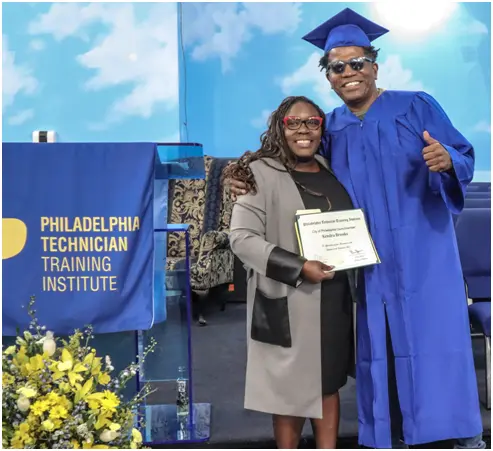
Here is an honest, practical point for local students. The EPA 608 certification exam is administered by EPA-approved certifying organizations, but passing it and, more importantly, succeeding on the job depends on real mechanical skill. That is where hands-on trade training in Philadelphia comes in. At Philadelphia Technician Training Institute (PTTI), the Steam, Sprinkler & Pipe Fitting program develops the mechanical, piping, and systems knowledge that overlaps heavily with HVAC/R work.
Students learn to read mechanical systems, work with piping and pressurized lines, follow safety protocols, and troubleshoot — the same core competencies that make a strong refrigerant technician. Training happens in applied, real-world labs on industry-standard equipment, which is far more effective preparation than classroom theory alone. For students weighing whether hands-on training beats a traditional four-year path, PTTI’s comparison of a trade school versus a traditional college route lays out the trade-offs clearly.
Location is a real advantage here too. PTTI serves students across Philadelphia neighborhoods including North, South, and West Philadelphia, Spring Garden, Mantua, Powelton Village, and the Wynnfield and Overbrook Park areas, along with nearby Pennsylvania communities such as Yeadon, Lansdowne, Darby, Drexel Hill, and Ardmore. The reach extends into South Jersey towns like Camden, Pennsauken, Collingswood, Cherry Hill, Maple Shade, and Haddonfield. Because skilled mechanical work exists across this entire tri-state region, training centrally in Philadelphia positions graduates to find opportunities in whichever direction the best job appears. If you are researching how to retrain quickly, PTTI also explains why a skilled trades career makes sense in 2026.
Certification gets you in the door, but employers hire and keep technicians who can actually do the work. Based on what hiring managers in the mechanical trades consistently look for, the following skills matter most:
These are precisely the competencies that hands-on programs are designed to build. Pairing a recognized credential like the EPA 608 certification with strong mechanical training is the combination that turns an entry-level applicant into a confident, employable technician. Students interested in stacking additional credentials can review PTTI’s guidance on the certifications that strengthen a skilled trades career.
For anyone serious about entering the heating and cooling trade, the message is clear: the EPA 608 certification is the doorway. It is a one-time, non-expiring federal credential that legally allows you to handle refrigerants, and it is the baseline every employer expects. Pair it with real mechanical skill and an understanding of today’s A2L refrigerant standards, and you become exactly the kind of technician the 2026 job market is competing to hire.
The strongest way to prepare is with hands-on training that builds the piping, systems, and safety foundation the trade demands. That is what mechanical trades education in Philadelphia is designed to deliver.
Take the next step. Explore PTTI’s mechanical trades programs, request information, or schedule a campus tour to see the labs firsthand. Veterans and adult learners can also review financial aid and veterans’ benefits to plan an affordable path into the trade.
EPA 608 certification is a federal credential required under Section 608 of the Clean Air Act for any technician who services, maintains, repairs, or disposes of equipment containing refrigerant. It is administered through EPA-approved organizations and is the baseline requirement for legally handling refrigerants in HVAC work.
Anyone who works on stationary refrigerant-containing equipment — air conditioners, heat pumps, refrigeration systems, and chillers — must hold it. Without the certification, a technician cannot legally open a refrigerant circuit or even purchase refrigerant from suppliers.
The four types are Type I (small appliances), Type II (high-pressure systems), Type III (low-pressure systems), and Universal (all equipment). Every type requires passing the Core section first. Most career-focused technicians pursue Universal for the broadest flexibility.
No. Once earned, the EPA 608 certification does not expire and remains valid for your entire career. Just keep a personal copy of your certification card, since the credential is tied to you rather than your employer.
Exam costs are modest, typically ranging from about $20 to $100 depending on the certifying organization and the type you pursue. Costs may be higher if you add prep courses or pursue Universal certification, which covers all types.
EPA 608 covers stationary equipment such as building HVAC and refrigeration systems, while EPA 609 covers motor-vehicle air conditioning. Technicians who service both vehicles and buildings need both, but HVAC careers start with EPA 608.
Yes. The BLS projects 8% job growth for HVAC technicians through 2034, much faster than average, with about 40,100 openings each year. Strong demand, solid median pay near $60,000, and the ongoing refrigerant transition make it a stable, future-focused trade.
Begin with hands-on mechanical trades training, earn your EPA 608 certification through an approved organization, and build the piping, safety, and troubleshooting skills employers expect. PTTI’s mechanical and pipe-fitting training in Philadelphia provides a strong foundation for that path.