
For a lot of young people in Philadelphia, the question is not whether they want a good career; it is how to get one without spending four years and a mountain of debt to find out. A trade school in Philadelphia answers that question directly. Instead of general academics, you learn a specific, in-demand skill with your hands, and you build it fast enough to start working within months, not years.
But training alone is only half the story. The part that actually changes a young person’s life is what happens after the last class: résumé help, interview prep, employer connections, and real support until you are hired. That is the difference between a certificate and a career.
This guide explains how
skilled trade career support works for Philadelphia youth, what “get trained until you hire” really means, which trades pay well without a degree, how long training takes, and what to look for in a program. It is written for high school students, recent graduates, career changers, and young adults across the Philadelphia region who want a faster, more practical route into stable, well-paying work.

“Get trained until you hire” means a school does not consider its job finished when you complete coursework; it keeps supporting you with career services until you land a role. In practice, that includes résumé building, interview coaching, employer introductions, and ongoing job placement support that bridges the gap between finishing a program and starting work.
This matters because the hardest moment for many young graduates is not learning the skill, it is getting the first job that uses it. A strong trade school in Philadelphia treats that transition as part of the program, not an afterthought. Instructors who have worked in the field know what local employers expect, and dedicated career staff help students present their new abilities the right way.
The goal is simple: turn completed career training into an actual paycheck. When a school commits to supporting students through hiring, the training becomes a launch point rather than just a line on a résumé.
💬 Want to see how career services work in practice? Talk with PTTI’s admissions team about the support students receive from enrollment through hiring.
Skilled trade careers offer something many young people are actively looking for: a direct, affordable path to stable, well-paying work. You can enter the field without a four-year degree, start earning quickly, and build skills that employers consistently need. For youth weighing their options after high school, that combination is hard to beat.
Demand is a big part of the appeal. According to the U.S. Bureau of Labor Statistics, the skilled trades face ongoing replacement demand as experienced workers retire, which keeps openings steady even when overall growth is modest. Fields like welding alone see tens of thousands of projected openings each year nationally. In a region like Philadelphia, with active construction, manufacturing, healthcare, and automotive sectors, that national pattern shows up as real local jobs.
There is also the question of debt. Many young adults watch peers take on large student loans without a clear career outcome. A focused trade school in Philadelphia flips that equation: shorter programs, lower cost, and a specific skill at the end. For students who learn better by doing than by sitting through lectures, hands-on training is not a compromise; it is the right environment.
Several trades that pay well without a degree are available to Philadelphia students, including welding, HVAC, pipefitting and steamfitting, automotive repair, manufacturing and automation, and sterile processing. Each rewards hands-on skill, offers clear advancement, and is in steady regional demand. None requires a four-year college degree to begin.
Here is a closer look at how these career paths line up with practical training:
| Skilled Trade | What You Do | Why It Pays |
| Welding Technology | Join and fabricate metal for construction, manufacturing, and infrastructure | Certified and specialized welders command premium wages |
| HVAC | Install and service heating, cooling, and ventilation systems | Year-round demand; essential systems in every building |
| Steam, Sprinkler & Pipe Fitting | Install and maintain piping, sprinkler, and steam systems | Commercial and union work pays strongly |
| Automotive Repair Technology | Diagnose and repair modern vehicles, including hybrid and EV systems | Advanced diagnostics raise earning potential |
| Manufacturing & Automation | Operate and maintain automated production equipment | Growing need for technicians who understand modern systems |
| Central Processing & Sterile Services | Sterilize and prepare medical instruments for healthcare facilities | Steady healthcare demand with fast entry |
The trades that pay well without a degree share a common thread: they reward demonstrated ability over credentials on paper. That is exactly what focused career training is designed to build.
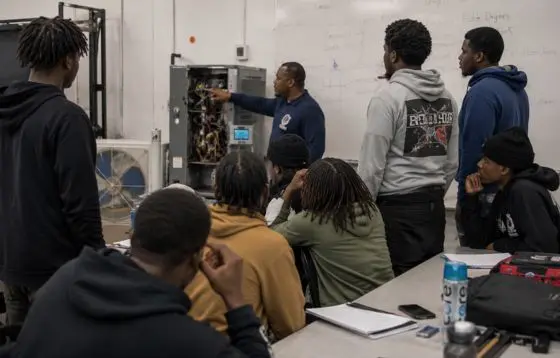
Most skilled trade programs in Philadelphia can be completed in under a year, with many running roughly 6 to 10 months depending on the trade. That short timeline is possible because career training focuses only on the specific, employer-relevant skills needed for the job, rather than general education requirements.
For a young adult, that speed is the whole point. Finishing in months means you move into the workforce and start earning while peers who chose a four-year path are still in school. It also means lower overall cost and less time before career training starts paying off.
Length varies by field. A sterile processing program may be shorter than a comprehensive welding or automotive program, and the time you invest in practice directly affects how job-ready you are at the end. What stays consistent across a quality trade school in Philadelphia is the structure: concentrated hands-on training, clear milestones, and preparation aimed squarely at getting hired.
⚙️ Compare program lengths and start dates. Explore PTTI’s skilled trade programs to see which path fits your timeline.
Not every program offers the same level of support, so it helps to know what separates strong career services from basic ones. When comparing any trade school in Philadelphia, look closely at how the school helps you after training ends, because that is where your first job actually comes from.
Prioritize programs that offer:
A program that checks these boxes treats your career training as a complete journey. The combination of strong hands-on training and committed job placement support is what turns a motivated young person into an employed technician.

Schools help students move from training to employment through structured career services: résumé and interview coaching, direct employer connections, help scheduling job interviews, and continued support until hiring. The strongest programs also build professionalism and workplace readiness into the curriculum so students arrive prepared.
This transition support is where “get trained until you hire” becomes concrete. A young graduate rarely struggles because they lack skill; they struggle because they do not yet know how to navigate hiring. Career staff who understand local employers close that gap. They help translate new abilities into a strong application, prepare students for real interviews, and make introductions that a first-time job seeker could not make alone.
For Philadelphia youth especially, this guidance can be the single most valuable part of a program. Technical skill opens the door; career training and placement support walk you through it.
One advantage of training locally is how far the opportunity reaches. A trade school in Philadelphia positions graduates for work not only within the city, from North and South Philadelphia to West Philadelphia, Mantua, Powelton Village, and the Spring Garden area, but across the surrounding region as well.
Skilled trade careers extend into nearby Pennsylvania communities such as Yeadon, Lansdowne, Darby, Drexel Hill, and Ardmore, and across the river into South Jersey towns including Camden, Pennsauken, Collingswood, Cherry Hill, Maple Shade, and Haddonfield. Because technical skills and industry certifications travel with you, training centrally in Philadelphia gives young workers flexibility to follow the best opportunity in any direction, including into Delaware and the wider tri-state market.
That regional reach is a real benefit for young adults who may not yet know exactly where they will work. The skill is portable, the demand is spread across many communities, and the career training you complete in Philadelphia applies throughout the area.
For many Philadelphia students, the honest comparison is between a focused trade program and a traditional college path. Both have value, but they serve different goals.
| Factor | Trade School in Philadelphia | Four-Year College |
| Time to start earning | Often under a year | Typically four years |
| Cost | Lower, focused tuition | Often significant debt |
| Learning style | Hands-on, applied | Largely classroom-based |
| Career support | Direct job placement support | Varies widely |
| Outcome | Specific, in-demand skill | Broad degree, less job-specific |
College is the right fit for some careers. But for students who want practical skills, a faster route to income, and strong job placement support, a trade school is not a lesser option; it is often the smarter one. The key is choosing a program that pairs real career training with genuine hiring help.
Skilled trade career training fits a wide range of young people and adults, including:
If you prefer building real things over sitting in lectures, want skills employers actually need, and value a school that supports you until you are hired, skilled trade careers deserve a serious look.
For Philadelphia youth, the fastest route to a stable, well-paying career is rarely a four-year degree; it is focused, hands-on training backed by real support until you are hired. A trade school in Philadelphia that commits to that full journey, from first lab to first paycheck, gives young people something genuinely valuable: an in-demand skill, a clear path, and a team helping them get to work. Skilled trade careers reward ability over paperwork, and with strong job placement support, that ability becomes employment.
🚀 Ready to start? Request information from PTTI to learn how our programs train and support Philadelphia students until they’re hired.
The most direct path is a focused trade school in Philadelphia that combines hands-on training with job placement support. These programs teach a specific, in-demand skill in under a year and help graduates move into full-time technician roles, rather than spending four years on general academics.
Welding, HVAC, pipefitting and steamfitting, automotive repair, manufacturing and automation, and sterile processing are all trades that pay well without a degree. Each rewards hands-on skill, offers clear advancement, and is in steady demand across the Philadelphia region.
Most programs can be completed in under a year, with many running about 6 to 10 months depending on the trade. Because career training focuses only on job-relevant skills, students finish faster and start earning sooner than they would on a four-year path.
A strong program does. The best schools offer job placement support that includes résumé help, interview prep, employer connections, and continued guidance until you are hired. This career training support is what turns a completed program into an actual job.
Yes. Skilled trade careers give young adults a fast, affordable route to stable work without a four-year degree. With hands-on training and real support moving from classroom to employment, it is one of the most practical options for Philadelphia youth entering the workforce.