
Heating and cooling systems run everything from row homes in South Philadelphia to hospitals along Broad Street, and someone has to install, service, and repair them. That someone is an HVAC technician, and in 2026 it is one of the most dependable ways to enter a skilled trade that pays well without a four-year degree. If you want a clear plan to become an HVAC technician, this guide lays out the exact steps, the real cost, the timeline, and the certifications that matter.
The short version is encouraging: HVAC is a federally in-demand trade, the core credential is a straightforward federal certification rather than a lengthy license, and focused hands-on training can prepare you for entry-level work in well under a year. Whether you are a high school graduate, a career changer, a veteran, or an adult learner in the Philadelphia region, the path to become an HVAC technician is shorter and more affordable than most people assume. Below, we walk through every stage — from your first class to your first paycheck — with 2026 salary data, job-outlook figures, and Philadelphia-specific guidance.
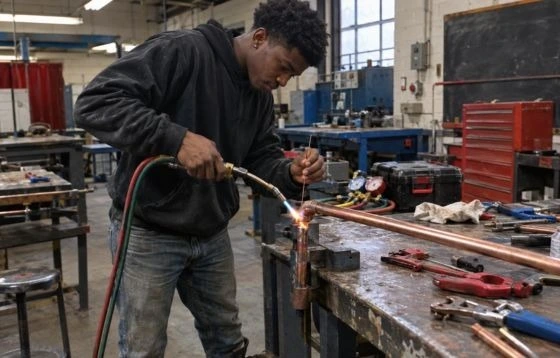
An HVAC technician installs, maintains, troubleshoots, and repairs the heating, ventilation, air conditioning, and refrigeration systems that keep buildings comfortable and safe. The work blends mechanical, electrical, and refrigeration knowledge with practical problem-solving.
On a typical day, a technician might install a new furnace or heat pump, diagnose why a rooftop unit is short-cycling, recover and recharge refrigerant, replace a failed compressor or blower motor, test electrical connections, or run seasonal maintenance on a commercial chiller. The role rewards people who like working with their hands, thinking through a problem, and seeing a system come back to life. It also spans settings — homes, schools, hospitals, warehouses, and office towers — which is a big reason the trade stays busy year-round.
HVAC is a smart 2026 trade because demand is strong, pay is competitive, and the barrier to entry is a short training program rather than a four-year degree. The U.S. Bureau of Labor Statistics projects employment of heating, air conditioning, and refrigeration mechanics and installers to grow 8% from 2024 to 2034, much faster than the average for all occupations, with about 40,100 openings each year over the decade.
Those openings are not driven by growth alone. A large share comes from replacement demand as experienced technicians retire or move on, which means steady hiring even in years when the overall job count grows modestly. Add in a national push toward electrification and high-efficiency equipment, aging building stock across the Northeast, and new construction, and the case for choosing to become an HVAC technician gets stronger. For a broader view of how this fits the local market, PTTI’s overview of Philadelphia trade jobs that pay high salaries without a degree is a useful companion read.
The route to become an HVAC technician is well defined. Here is the path most successful technicians in the Philadelphia region follow.
Want a personalized plan? Talk with PTTI’s admissions team about the fastest route to get job-ready and explore hands-on training programs that build mechanical and HVAC-ready skills.
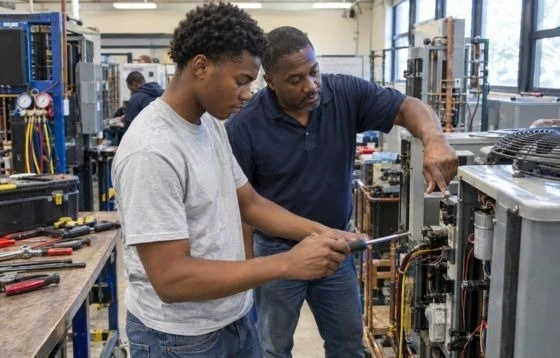
Focused HVAC training typically takes about six to twelve months to prepare you for entry-level work, which is a major reason the trade is so attractive. Because HVAC is skills-based, employers care about whether you can diagnose and repair a system, not how many years you spent in a classroom.
Here is a realistic timeline from your first class to your first job:
| Phase | Approximate Duration | What Happens |
| Foundations | First weeks | Safety, tools, electrical basics, and how HVAC systems work |
| Core systems | Early to mid-program | Refrigeration, heating, airflow, heat pumps, and controls |
| Certification prep | Mid to late program | EPA 608 exam preparation and hands-on diagnostics |
| Job readiness | Final phase | Résumé help, interview prep, and entry-level placement support |
Some motivated learners move faster, and accelerated formats exist. What matters is reaching the point where you can perform core installs and repairs and pass the EPA 608 exam. That is an achievable goal within a year, which is exactly why so many people choose to become an HVAC technician instead of committing to a long degree program. If you are weighing the broader timeline question for the trades, PTTI’s guide on starting a trade career in Philadelphia with no experience explains how quickly the transition can happen.
HVAC training in the Philadelphia area commonly costs between roughly $8,000 and $18,000 for a certificate program, with financial aid frequently available to those who qualify. The EPA 608 exam itself is inexpensive — often in the $20 to $40 range — and once earned, the certification never expires.
When you compare that cost against a four-year degree, the value becomes clear. You spend a fraction of the money, finish far sooner, and start earning years earlier. Many students also offset costs through financial aid, veterans’ benefits, or employer support. If affordability is a concern, review PTTI’s financial aid options early in your planning, since funding can significantly change your out-of-pocket cost. Veterans in particular should ask about how their benefits apply to hands-on trade training.
Pennsylvania has no statewide HVAC technician license, so the real requirement to work is federal: EPA Section 608 certification. Working as an employed technician is straightforward — get trained, earn EPA 608 if you will handle refrigerant, and you are eligible to be hired. Running your own HVAC business is a different matter, triggering local Philadelphia registrations, permits, and insurance obligations.
This distinction is genuinely freeing for a student or career changer. You do not need to chase a complicated state license before you can start earning. You need training, the right federal certification, and hands-on ability.
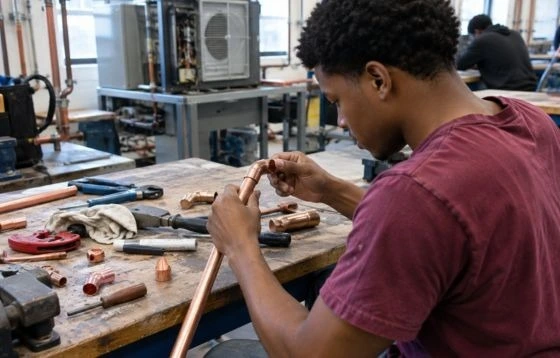
EPA Section 608 certification is required under the federal Clean Air Act for anyone who handles refrigerant, and it is the single most important credential for the field. The exam has a Core section plus Type I (small appliances), Type II (high-pressure systems), and Type III (low-pressure systems). Passing the Core plus a type gives you working certification, and Universal certification covers all types. Because it never expires, EPA 608 is a one-time investment that pays off for your entire career.
Beyond EPA 608, credentials like NATE (North American Technician Excellence) signal advanced competency to employers and customers. Industry data consistently shows NATE-certified technicians earn more than uncertified peers — often in the range of several thousand dollars more per year. Specializing in commercial refrigeration, controls, or chiller work tends to sit at the top of the wage scale.
HVAC technicians in Philadelphia commonly earn between about $55,000 and $75,000 per year, with the metro median near $64,600 — roughly 6% above the national median. Entry-level technicians start lower, while experienced, commercial, and union technicians earn more, and top specialists can approach or exceed six figures.
For national context, the U.S. Bureau of Labor Statistics reported a median annual wage of $59,810 for heating, air conditioning, and refrigeration mechanics and installers in May 2024, with top earners well above $80,000. Pennsylvania sits slightly above the national median and employs among the highest number of HVAC workers in the country, which reinforces steady local demand.
| Career Stage | Approximate Annual Range (Philadelphia Area) |
| Entry-level HVAC technician | $45,500 – $56,000 |
| Experienced technician | $60,000 – $72,000 |
| Commercial / refrigeration / specialized | $75,000 – $100,000+ |
A few factors move pay the fastest: earning EPA 608 and then advanced certifications, moving into commercial or refrigeration work, learning controls, and working overtime during peak heating and cooling seasons. For a wider comparison of earnings across the trades, PTTI’s breakdown of high-paying Philadelphia trade careers puts HVAC pay in context alongside welding, pipefitting, and automotive.
Hiring managers in HVAC are direct about what they want. Beyond a valid EPA 608 certification, the following skills separate technicians who get hired and promoted:
These are exactly the competencies that applied, hands-on training is built to develop. Real lab time on industry-standard equipment — taught by instructors who have worked in the field — is what turns classroom concepts into job-site readiness.
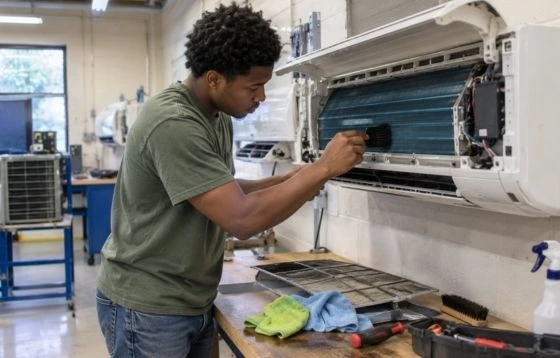
One reason HVAC training in Philadelphia pays off is the reach of the local job market. Technicians find work not only across city neighborhoods — from North and West Philadelphia to Spring Garden, Mantua, Powelton Village, Overbrook Park, and the Allegheny West and Woodland Avenue corridors — but throughout the surrounding region.
Opportunities extend across nearby Pennsylvania communities such as Yeadon, Lansdowne, Darby, Drexel Hill, and Ardmore, and across the river into South Jersey towns including Camden, Pennsauken, Collingswood, Cherry Hill, Maple Shade, Cinnaminson, Haddonfield, Gloucester City, and Audubon. Because EPA 608 certification is federal, a technician trained in Philadelphia can carry that credential into New Jersey, Delaware, and beyond — though HVAC business owners should confirm the specific local permit and registration rules in each municipality.
For many students and career changers, the real question is whether to enter HVAC or pursue a traditional degree. Here is a straightforward comparison.
| Factor | HVAC Training | Four-Year College |
| Time to earn | Under a year possible | About four years |
| Cost | Lower, focused tuition | Often significant debt |
| Path to income | Start earning quickly | Earning typically delayed |
| Hands-on training | Core of the program | Often limited |
| Job-specific skills | Directly employer-aligned | Broader, less applied |
| Demand | Strong, replacement-driven | Varies widely by major |
College is the right path for some careers. But for HVAC, focused training is the standard route, and it delivers demonstrated skill in a fraction of the time and cost.
The HVAC field is modernizing, and understanding the shifts makes you more employable. Three trends stand out in 2026.
First, the refrigerant transition. The industry is phasing down high-GWP refrigerants, and lower-GWP A2L refrigerants such as R-32 and R-454B are replacing R-410A in new equipment. Technicians trained on A2L safety and handling are increasingly valuable, and this knowledge can command higher rates.
Second, electrification and heat pumps. As buildings shift toward electric heating, heat pump installation and service is one of the fastest-growing skill areas. PTTI’s look at heat pump installation training explains why this specialty is expanding as electric heating demand rises.
Third, smart controls and automation. Modern systems rely on digital controls, connected thermostats, and building automation. Technicians who understand controls — an area that overlaps with automation and electrical skills — stand out. For students interested in that crossover, PTTI’s Manufacturing & Automation training builds electrical and controls competencies that complement mechanical HVAC work.
Philadelphia Technician Training Institute (PTTI) prepares students for mechanical and HVAC-ready careers through hands-on, employer-aligned training rather than lecture-heavy theory. The foundation for HVAC success — refrigeration and mechanical systems, piping, electrical basics, safety, and EPA-readiness — is exactly what applied trade training is designed to build.
Students exploring HVAC and mechanical-systems work often begin with PTTI’s Steam, Sprinkler & Pipe Fitting program, which develops the piping, mechanical, and system-installation skills that carry directly into heating and cooling work. Because program offerings and certification inclusions can change, the most reliable next step is to confirm current HVAC-focused options directly with the admissions team. Either way, the through-line is the same: real labs, industry-standard equipment, safety training, and support moving from the classroom into a paycheck.
🚀 Ready to move forward? Request information, schedule a campus visit, or contact admissions to map your fastest path into an HVAC or mechanical-systems career this year.
Choosing to become an HVAC technician in 2026 is a practical, high-return decision. The steps are clear, the timeline is short, the cost is far lower than a four-year degree, and the demand is strong across Philadelphia, Pennsylvania, New Jersey, and Delaware. Earn your training, secure EPA 608 certification, build hands-on skill, and you can move from beginner to job-ready — and earning — in less than a year.
The most reliable way to get there is structured, hands-on training aligned with what employers actually need. That is precisely what applied trade education delivers: real equipment, safety and certification readiness, and a direct path into the workforce.
🎯 Take the next step today. Explore PTTI’s programs, apply now, or schedule a campus tour to start building your HVAC and mechanical-systems career.
Enroll in a hands-on HVAC training program, learn refrigeration, heating, electrical, and controls, earn EPA Section 608 certification, add safety credentials, and apply for entry-level roles. Focused training can prepare you to become an HVAC technician in well under a year.
Most people are ready for entry-level work within about six to twelve months of focused training. HVAC is skills-based, so once you can perform core installs and repairs and pass EPA 608, you are hireable.
Philadelphia-area HVAC certificate programs commonly cost between roughly $8,000 and $18,000, with financial aid often available. The EPA 608 exam itself is inexpensive, typically $20 to $40, and never expires.
Pennsylvania has no statewide HVAC technician license. The key requirement is federal EPA Section 608 certification to handle refrigerant. Business owners must meet local Philadelphia registration, permit, and insurance rules.
Yes. Under the federal Clean Air Act, anyone who handles refrigerant must hold EPA Section 608 certification. It is the essential credential for the field and does not expire once earned.
HVAC technicians in Philadelphia commonly earn about $55,000 to $75,000 per year, with a metro median near $64,600. Entry-level techs start lower, while commercial and specialized technicians can approach or exceed six figures.
No. HVAC requires a postsecondary nondegree award and training, not a four-year degree. Employers hire on demonstrated skill and EPA 608 certification, making hands-on training the most direct route.
Yes. With 8% projected national job growth through 2034, roughly 40,100 annual openings, competitive pay, and a short training path, HVAC is one of the more reliable skilled trades to enter in 2026.
HVAC Training Program : Hands on skill training with OSHA 30 and EPA 608
Honest Pros and cons of HVAC Technician
Is HVAC a good Career in 2026