
Choosing where to train for a skilled trade is one of the highest-leverage financial decisions a young adult in Philadelphia can make. Unlike a four-year degree, HVAC training is short, hands-on, and points directly at a licensed, in-demand occupation. But the schools offering that training are not interchangeable. Two programs advertised at the same price can differ enormously in the certifications they include, the hours you actually spend on real equipment, and whether an employer is waiting for you at the end.
This checklist is written from the perspective of people who hire, train, and place HVAC technicians. It walks through the criteria that separate a program worth your time and money from one that leaves you with a certificate but no marketable skill. Whether you’re a high school graduate, a career changer, a veteran, or an adult learner weighing your options across Philadelphia, Pennsylvania, New Jersey, and Delaware, use it to compare any HVAC school in Philadelphia before you sign an enrollment agreement.
HVAC — heating, ventilation, air conditioning, and refrigeration — is one of the few careers where a short, focused program can lead to a stable, well-paid trade without student debt. The work can’t be offshored and isn’t easily automated: every home, hospital, school, and warehouse in the Philadelphia region needs climate control maintained through brutal summers and cold winters.
The numbers back this up. The lowest 10 percent of HVAC technicians earned less than $40,050 and the highest 10 percent earned more than $95,210 as of May 2025, which tells you two things: entry pay is solid relative to the short training time, and the ceiling rises quickly as you gain experience and certifications. In Pennsylvania specifically, technicians earn a median annual wage of about $62,400, roughly 2.3% above the national median, with around 15,880 workers employed statewide. U.S. Bureau of Labor StatisticsTradeCareerPath
That combination — fast entry, real pay, and steady demand — is exactly why the school you choose matters. A weak program wastes the biggest advantage the trade offers: getting job-ready in months, not years.
Work through each of the following before you commit. If a school can’t give you a clear answer on any point, treat that as information.
Start with basic legitimacy. In Pennsylvania, private trade schools are licensed to operate, and a credible institution will readily explain its licensure and how long it has trained students in the region. Ask how many HVAC students the school has graduated, and whether it has been operating long enough to have established relationships with local employers. A school with a real track record in Philadelphia is worth more than a national brand with no local hiring pipeline.
What “good” looks like: transparent about licensure, has a physical Philadelphia campus you can tour, and can point to graduates working in the field locally.
This is the most important item on the list. HVAC hiring runs on certifications, and the two that matter most for a new technician are:
Confirm whether these are included in tuition or sold as add-ons later. As a benchmark, PTTI’s HVAC Certification Program covers all four sections of the EPA 608 exam — Core, Type I, Type II, and Type III — and includes OSHA 30. That’s the standard to measure other programs against.
Ask directly: “Is EPA 608 certification part of the program, and is the exam fee included?”
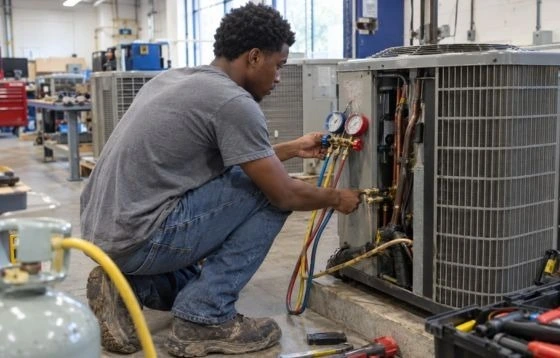
An HVAC technician is judged on the job by what their hands can do — diagnose a failed compressor, braze a joint, recover refrigerant, wire a control board. A program that is mostly lecture and textbook produces graduates who freeze on their first service call.
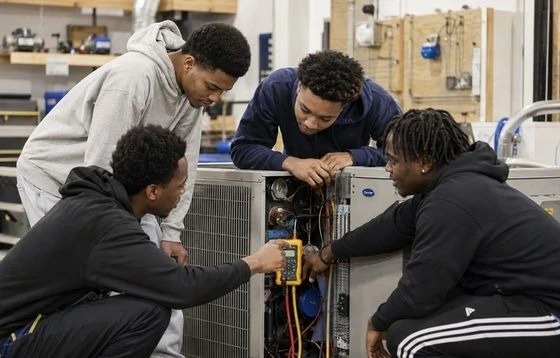
Ask for the ratio of lab time to classroom time and what equipment you’ll train on. Strong programs teach on the same systems you’ll see in the field: residential and commercial air conditioning units, furnaces, heat pumps, refrigeration equipment, electrical components, and diagnostic tools. If you can, watch a lab in session during your visit.
Red flag: vague answers about “hands-on components” with no lab tour offered.
One of HVAC’s biggest advantages is speed. A focused certification program can get you job-ready in roughly 8 months, compared with the two to four years an apprenticeship-only path can take. But faster isn’t automatically better — the program still needs enough lab hours to build real competence.
Just as important is scheduling. If you’re working, supporting a family, or transitioning careers, look for day and evening options so training fits around your obligations rather than forcing you to quit your job to attend. Ask whether start dates are frequent or whether you’ll wait months for the next cohort.
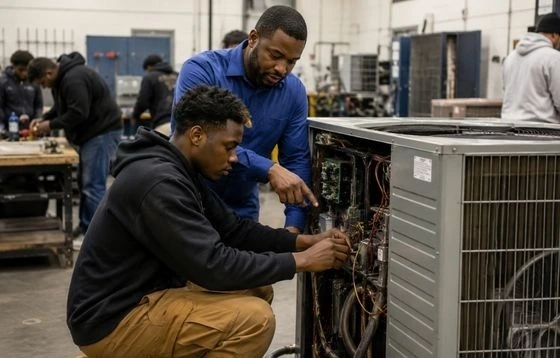
The best HVAC instructors have spent years in the field before they ever stood in front of a class. They teach the shortcuts, the diagnostic instincts, and the customer-facing habits that textbooks skip. During your tour, ask about instructors’ backgrounds and how many years they worked as technicians or contractors. Field-experienced instructors are also the people whose industry relationships often turn into your first job lead.
A certificate is not the goal — employment is. This is where many schools get vague, so press for specifics:
As a reference point, PTTI reports a placement rate near 92% and maintains employer relationships across the Philadelphia region, with Career Services guiding students from admission through job placement. Use figures like that as your comparison baseline, and be skeptical of any school that won’t share its numbers.
Compare total cost, not just the sticker figure. Factor in certification exam fees, tools, and any required materials. Then ask what financial aid is available: grants, federal and private loans, veterans’ benefits, and institutional payment plans can all lower the real out-of-pocket cost. A transparent school will walk you through financing options and help you understand eligibility before you enroll rather than after. Best HVAC trade school in Philadelphia promises financial aid as it sets the total against the payoff. If a program costs a fraction of a year’s college tuition and leads to a trade paying a median above $60,000, the return on investment is easy to calculate.
HVAC technology keeps evolving — smarter controls, new refrigerants driven by environmental regulation, high-efficiency heat pumps, and connected diagnostic tools. HVAC certification program Philadelphia specialises training on outdated equipment leaves you a step behind on day one. Ask what systems and tools the labs use and whether the curriculum reflects current refrigerant regulations and modern diagnostic methods.
Location does double duty. A campus you can reach reliably means you actually finish, and a school embedded in the Philadelphia job market means its employer network is where you want to work. PTTI’s campus serves students across Philadelphia and the surrounding region — from Spring Garden, North Philadelphia, West Philadelphia, South Philadelphia, and Southwest Philadelphia to nearby communities like Camden, Cherry Hill, Pennsauken, and Collingswood in New Jersey, and Darby, Yeadon, Drexel Hill, Lansdowne, and Ardmore in Pennsylvania. A Philadelphia-based diploma opens work across the metro area, which stretches into four states.
Finishing the program matters as much as starting it. Ask about admissions guidance, academic support, attendance flexibility, and how the school helps students who hit obstacles. The programs with the best outcomes tend to be the ones that treat completion and placement as their responsibility, not just yours.
| Checklist Item | Strong HVAC Program | Warning Signs |
| Certifications | EPA 608 + OSHA 30 included in tuition | Certifications sold separately or not mentioned |
| Hands-on training | Extensive lab time on real systems | Mostly lecture; no lab tour offered |
| Program length | ~8 months, clear schedule | Vague timeline or open-ended |
| Scheduling | Day and evening options | One rigid schedule only |
| Instructors | Years of field experience | Unclear instructor backgrounds |
| Job placement | Published rate + Career Services | No placement data shared |
| Cost transparency | Total cost + aid explained upfront | Hidden fees, unclear financing |
| Local relevance | Philadelphia employer network | No local hiring connections |
For many students, this is the real question behind choosing an HVAC school. The honest comparison:
A four-year degree takes longer, costs far more, and often ends in debt without a guaranteed job. HVAC training does the opposite: you can be certified and working in under a year, usually without student loans, in a trade with strong, weatherproof demand. HVAC training in Philadelphia: About 40,600 HVAC openings are projected each year, on average, over the decade, many of them created as experienced workers retire or move on. That replacement demand means steady hiring even when the broader economy slows. U.S. Bureau of Labor Statistics
College still makes sense for careers that require a degree. But for a student who wants a skilled, hands-on, well-paid career and a fast route into the workforce, HVAC is one of the strongest arguments for the trade-school path. If you’re weighing broader options, PTTI’s related programs — from welding technology to steam, sprinkler, and pipe fitting — offer the same fast-entry, hands-on model in adjacent mechanical trades.
No statewide HVAC license exists in Pennsylvania.HVAC certification program Philadelphia ensure that requirements are set federally and locally, and EPA Section 608 is the real federal requirement for anyone handling refrigerant. That said, Philadelphia has its own municipal mechanical licensing and permit requirements, administered through the city’s Department of Licenses & Inspections. A good local program like HVAC training in Philadelphiaunderstands these rules and prepares you for the credentials that Philadelphia-area employers and permit work actually require. best HVAC trade school in Philadelphia ensure that student is well versed with all the equipment and tools.This is another reason to favor a school rooted in the city rather than a generic online course. PTTILicenseMap
Beyond the essentials, NATE (North American Technician Excellence) certification is a nationally recognized, voluntary credential, and NATE-certified technicians can earn meaningfully more than non-certified peers as you advance. SkillCat
Bring this short list to every school visit:
A confident program answers all six without hesitation.
Here’s what graduates can reasonably expect as they build experience:
| Career Stage | Typical Annual Pay (Philadelphia region) |
| Entry / newly certified | ~$40,000 – $48,000 |
| Mid-career / median | ~$56,000 – $62,000 |
| Experienced / specialized | ~$70,000 – $95,000+ |
Ranges reflect BLS national and Pennsylvania data alongside Philadelphia metro estimates; individual pay varies by employer, specialization, and certifications.
Pay climbs fastest for technicians who specialize — commercial refrigeration, controls, and chiller work tend to command premiums over residential-only service. Certifications and experience stack on top of that. The trajectory is one of the trade’s biggest draws: your income grows as your skill does, without needing to return to school.
The best way to use this checklist is to score two or three best HVAC trade school in Philadelphiaagainst it, then tour your top pick in person. A program that includes EPA 608 and OSHA 30, puts you on real equipment, offers flexible scheduling, publishes its placement results, and sits inside the Philadelphia job market checks every box that actually predicts a successful career.
If PTTI is on your shortlist, the next step is simple. Explore the HVAC Certification Program philadelphia request information, or schedule a campus tour to see the labs and meet the instructors. To speak with a Career Services advisor about start dates, schedules, and financial aid, contact PTTI admissions at 215-381-9403 or info@ptt.edu. Bring the six tour questions above — the right school will answer every one.
Compare programs on certifications included (especially EPA 608), hands-on lab hours, instructor experience, job placement rates, total cost with financial aid, schedule flexibility, and local employer connections. Tour the campus and ask each question directly before enrolling.
A focused HVAC certification program can be completed in roughly 8 months — significantly faster than a two-to-four-year apprenticeship path or a four-year degree — while still delivering enough lab time to become job-ready.
A quality program includes EPA Section 608 preparation and the exam. Under the federal Clean Air Act, EPA 608 is mandatory for anyone who handles refrigerant, and it doesn’t expire. Always confirm it’s part of tuition, not a separate cost. PTTI
Pennsylvania has no statewide HVAC license, but EPA Section 608 is federally required for refrigerant work, and Philadelphia has its own municipal licensing and permit requirements. A locally rooted program prepares you for both. LicenseMap
The national median was $61,010 in May 2025, and Pennsylvania’s median runs around $62,400. Philadelphia-area technicians commonly earn from the high-$50Ks into the $70s and beyond with experience and specialization. U.S. Bureau of Labor StatisticsTradeCareerPath
Yes. Employment is projected to grow 11 percent from 2025 to 2035, much faster than average, with about 40,600 openings each year. The work is essential, weatherproof, and resistant to automation and offshoring. U.S. Bureau of Labor Statistics
Many strong programs offer both day and evening schedules so working adults, career changers, and parents can train without quitting their jobs. Ask about evening classes and start dates during your tour.
Is HVAC school worth the cost?
For most students, yes. Training costs a fraction of a four-year degree, usually avoids heavy debt, and leads to a trade with a median wage above $60,000 and clear paths to higher pay through certifications and specialization.
How to become an HVAC TECHNICAN AT 30