
An HVAC Training Program in Philadelphia can be a great career start for new aspirants. Especially if you’re considering an HVAC training program in Philadelphia. You deserve a full, honest picture before committing your time and money. Pay, job outlook, and training details all matter when deciding if this career fits you. But most guides cover only one piece of the puzzle. Below, we break down everything you need to know, from national salary averages to state-by-state pay, training length, and certifications included.
This blog article will give you a look at HVAC Technician career salary, jobs, and career growth, all explained in one go. Before diving into specifics, here’s a general national snapshot for HVAC technician pay:
| Metric | Approximate Range |
| Entry-Level Hourly | $18 – $23 |
| Mid-Career Hourly | $25 – $32 |
| Experienced Hourly | $34 – $44+ |
| National Annual Average | $50,000 – $70,000 |
The HVAC Career will always be in demand because developing infrastructure demands HVAC units. Especially in countries like Europe, the United States, and all over the world. According to the U.S. Bureau of Labor Statistics, employment for heating, air conditioning, and refrigeration mechanics is projected to grow steadily over the next decade, driven by construction activity and equipment replacement needs nationwide.
Before enrolling in any skilled trade or educational program, students often want to know the salary and pay. This makes sense, as it motivates such hard work. Pay for HVAC technicians varies significantly by location. Cost of living, construction demand, and union presence also play a role in these numbers.
High-Paying Tier
| State | Entry-Level | Intermediate | Senior |
| Illinois | $24/hour | $34/hour | $46/hour |
| New York | $23/hour | $33/hour | $44/hour |
| California | $22/hour | $32/hour | $43/hour |
Mid-Paying Tier
| State | Entry-Level | Intermediate | Senior |
| New Jersey | $20/hour | $28/hour | $38/hour |
| Washington | $19/hour | $27/hour | $37/hour |
| Massachusetts | $19/hour | $26/hour | $36/hour |
Solid-Growth Tier
| State | Entry-Level | Intermediate | Senior |
| Pennsylvania | $18/hour | $24/hour | $33/hour |
| Ohio | $17/hour | $23/hour | $31/hour |
Note:The figure predicted here are based on the information provided by BLS data may differ.
Moreover, Pennsylvania sits comfortably in a solid-growth tier, with Philadelphia’s mix of older housing stock and new construction keeping HVAC demand steady year-round.
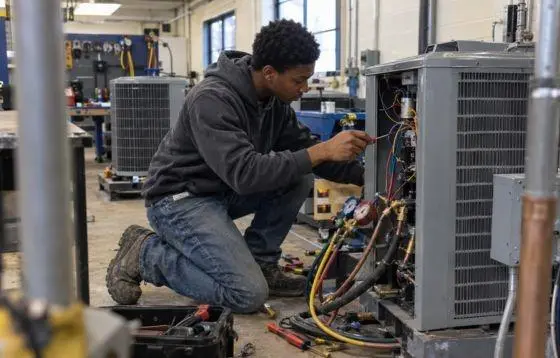
HVAC technician salary increases with experience. Few students do externships. This is like observing more and applying later . More experience will lead to better pay. Salary: Entry-level technicians earn around $20/hour, intermediate technicians around $28/hour, and senior technicians often earn more than $38/hour. That steady climb reflects how experience and certification translate directly into stronger pay over time.
| Experience Level | Hourly Range |
| Entry-Level | $18 – $23 |
| Intermediate/Journeyman | $25 – $32 |
| Senior/Master | $34 – $44+ |
Therefore, patience and continued certification pay off in real, measurable ways throughout an HVAC career.
HVAC technician salary varies by where you set up this trade. Here’s a quick comparison:
| Work Setting | Pay Level |
| Residential Repair | Lower to mid-range |
| New Construction Installation | Mid-range |
| Commercial Refrigeration | Mid to high range |
| Specialized/Energy Management | Highest range |
Additionally, technicians who specialize in commercial refrigeration or energy management systems tend to see the biggest pay jumps. They also specialize in basic refrigeration techniques for solving large warehouse configurations. The course also involves setting up digital thermostats. Understanding wiring systems.
Several factors push pay higher, regardless of location:
Geographic location matters a lot, as it is directly linked to pay. The HVAC job outlook is much better in these rich states. States with higher cost of living and stronger construction activity generally pay HVAC technicians more.
Technicians holding advanced licensing or certification, like EPA Section 608, typically earn more than uncertified workers. These certifications ensure that the student is well aware of the safety protocol . Later on, they help with placement with a client or business owner.
Students get to specialize in HVAC in various streams. Commercial refrigeration and energy management specialists often earn more than general residential technicians. The course includes laying aluminum, wiring, and understanding heating and cooling systems, which use red for heat and blue for cold, and connecting to the electrical circuit throughout the house.
Union-affiliated technicians often receive higher wages and benefits than non-union positions. There are also free independent technicians; they earn most of the money when they do the work independently. If you are paid by the hour, wages and salary are set differently, based on the current market rate. Therefore, stacking these factors- location, license, specialization, and union status- can significantly boost overall earning potential.
Here’s how HVAC technician pay compares to a few related skilled trades:
| Role | Entry-Level Pay | Experienced Pay |
| HVAC Technician | $18 – $23/hour | $34 – $44+/hour |
| Automotive Technician | $17 – $22/hour | $34 – $45+/hour |
| Steamfitter | $19 – $25/hour | $36 – $46+/hour |
| Sterile Processing Technician | $16 – $20/hour | $27 – $34+/hour |
Anyway, if you look at the table, HVAC technician wages are estimated at. It is in demand, also very close to electricity, and carries the setup, which is very crucial for any residential or commercial setup. Overall, HVAC technician pay compares favorably against several other in-demand skilled trades.
The job outlook for HVAC technicians is increasing significantly across the U.S. and Europe. HVAC training program in philadelphia offers a good placement rate for students. According to the U.S. Bureau of Labor Statistics, HVAC technician employment is projected to grow steadily over the next decade, supported by ongoing construction, equipment replacement, and an aging technician workforce.
| Trade | Job Growth Outlook |
| HVAC | Steady growth |
| Automotive | Steady growth |
| Steamfitting/Pipefitting | Steady growth |
Therefore, this career offers strong long-term stability, not just a short-term hiring boost.
Here’s a general roadmap of how HVAC technician pay tends to grow:
Finally, many technicians use this roadmap to plan certifications and career moves strategically.
A full HVAC training program moves through a clear course sequence: Introduction to HVAC, Refrigeration Fundamentals, Electricity in HVAC, Domestic Refrigerators and Freezers, Air Conditioning Systems, Indoor Air Fundamentals, Heating Systems, Energy Management and Conservation, and Commercial Refrigeration Systems 1 through 3.
The program also includes Job Application Skills coursework and a hands-on Externship, giving students real-world exposure before graduation.
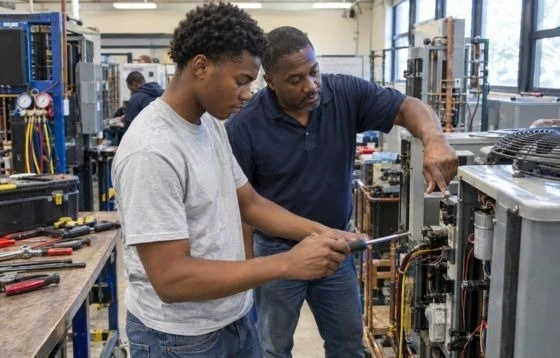
Strong HVAC training programs include certification built directly into the coursework, at no extra cost:
As a result, graduates leave training with credentials employers actively look for during hiring.
Philadelphia Technician Training Institute (PTTI) offers a comprehensive HVAC training program that includes the full course sequence, hands-on labs, and certifications. PTTI also offers day and evening schedules to fit different life situations.
Here’s how enrollment works in PTTI:
An HVAC training program in Philadelphia offers a clear, practical path toward steady pay and long-term job security. However, real success in this career depends on combining hands-on training with the right certifications and continued specialization. Between strong salary growth, solid job outlook, and included credentials, this trade checks a lot of boxes for people ready to start something new. Overall, HVAC training gives students the full picture and the real skills they need to build a lasting career.
The salary you can expect at a skilled trade program at Entry-level pay generally starts around $17–23/hour and grows significantly with experience and certification. That also depends on location and city, as well as experience.
Illinois, New York, and California currently offer the highest HVAC technician pay ranges.
Programs like PTTI’s include EPA Section 608 and OSHA 30 at no extra cost.
Yes. The U.S. Bureau of Labor Statistics projects steady growth for this trade over the next decade.
Yes. Of course, PTTI, the best trade skills institute in Philadelphia, is known for its Financial aid that accepts FAFSA applications under school code 042213.
Read More: