
Picking a trade school is a career decision worth thousands of dollars and months of your life, yet most guides make it harder, not easier. They rank schools by who paid for placement, hide the factors that actually predict whether you finish job-ready, and blur the line between marketing and results. This guide does the opposite. It lays out exactly how to choose a trade school in Philadelphia using six measurable criteria, a scoring method you can apply in an afternoon, a campus-tour checklist, and the red flags that should end your search immediately.
Whether you are a high school graduate, a career changer, a veteran, or an adult learner comparing trade schools near me across Philadelphia, the surrounding Pennsylvania suburbs, and South Jersey, the goal is to help you evaluate any program the way a workforce professional would, so the school you choose is the one that gets you hired.
The right program moves you from beginner to employed in months; the wrong one costs you a year and a tuition bill with little to show for it. Because skilled trades hire on demonstrated ability, the school you pick directly shapes whether employers see you as job-ready. Knowing how to choose a trade school in Philadelphia is therefore not a formality; it is the single decision that determines your return on time and money.
Weak programs are expensive in ways the invoice never shows. You lose months you cannot recover, graduate without the certifications employers screen for, and sometimes need to retrain from scratch. The students who struggle are rarely the ones who lacked ability; they are the ones who chose on polished advertising instead of measurable outcomes. Learning what to look for in a trade school upfront is the cheapest insurance you will ever buy.
Philadelphia sits in a strong regional labor market for the trades. Aging infrastructure, active shipbuilding and fabrication, healthcare and commercial construction, and a manufacturing base that still builds things daily all drive steady hiring. According to the U.S. Bureau of Labor Statistics, many skilled-trade occupations are sustained by consistent replacement demand as experienced workers retire, which keeps opportunities open across welding, pipefitting, automotive, manufacturing, construction, and sterile processing.
Demand is not limited to Center City. Graduates find work across a wide radius, which is why training centrally in Philadelphia pays off.
Because a trade credential is portable, where you train matters less than how well you train. If you are weighing your fit for the local market, PTTI’s overview of skilled trades training in Philadelphia is a useful starting point before you compare specific schools.

To choose the best trade school in Philadelphia, score each program on six criteria: hands-on training hours, certifications included, verified job placement, transparent all-in cost, schedule fit, and accreditation. Tour the campus, ask for real numbers, and walk away from any school that hides outcomes or pressures you to enroll.
That short answer is the entire framework in one paragraph. The rest of this guide shows you how to apply and score each criterion so you can tell a genuine career launchpad from a sales pitch. This is the part most competing pages skip, and it is exactly why decision-stage searchers stay confused.
Every school claims to be “hands-on,” “affordable,” and “employer-connected.” The fix is to convert vague claims into measurable factors you can rate.
| # | Criterion | What It Measures |
| 1 | Hands-on hours | Real skill built through practice |
| 2 | Certifications | Employer-recognized credentials |
| 3 | Verified placement | Actual hiring outcomes |
| 4 | Transparent cost | The true, all-in price |
| 5 | Schedule fit | Whether you can finish |
| 6 | Accreditation | Standards and accountability |
These six correlate directly with employability. Class size, campus aesthetics, and glossy marketing do not. When you focus your comparison on measurable outcomes rather than atmosphere, the strongest school usually becomes obvious. For a complementary read on matching a program to your own goals, see PTTI’s guide on how to choose the best trade school program for yourself.
The factors below are the ones hiring managers and workforce professionals watch, because each one maps onto whether a graduate can perform on day one. Rate every school you consider on all six.
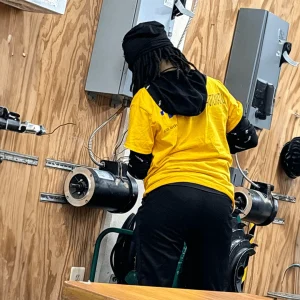
The strongest predictor of job readiness is how many hours you spend doing the work rather than watching or reading about it. Skilled trades are performance-based; employers hire people who can strike an arc, diagnose a fault, or set a form correctly, and that only comes from repetition on real equipment.
Separate classroom hours from shop or lab hours, then weigh the ratio. Applied training on industry-standard equipment is where hands-on trade training clearly beats online-only or self-taught paths.
PTTI’s model is built around applied practice across fields such as Welding Technology and Automotive Training and Repair, where real lab time is the core of the program rather than an add-on. In a city with active fabrication and repair work, that booth and shop time is what local employers expect to see.
A completion certificate from the school is not the same as an industry certification employers recognize. The best programs are structured so you graduate ready to sit for the credentials that actually open doors and raise pay.
Ask which recognized certifications the curriculum prepares you for, and whether exam preparation is built in.
| Program Area | Credentials to Ask About |
| Welding | AWS-aligned weld testing, safety credentials |
| Automotive | ASE-aligned certifications, EV/hybrid fundamentals |
| Manufacturing & Automation | OSHA safety, industrial/automation credentials |
| Steam, Sprinkler & Pipe Fitting | Safety and trade-specific certifications |
| Concreting, Masonry & Framing | OSHA safety, construction credentials |
| Central Processing & Sterile Services | CRCST-aligned certification prep |
Programs like Manufacturing & Automation and Central Processing & Sterile Services are designed with certification readiness in mind, which is exactly what you want to confirm before enrolling anywhere in Philadelphia.
High demand” is a market statistic, not a placement rate. A credible school can describe its actual career services and point to real employer relationships rather than industry-wide numbers that apply to everyone.
Ask specific questions and listen for specific answers:
PTTI’s approach to careers and job opportunities reflects this standard, and its look at how students build trade careers before graduation shows what employer-focused training looks like in practice. In the Philadelphia market, relationships with local fabrication shops, contractors, and healthcare facilities matter more than national averages.
The honest number is the all-in cost: tuition plus tools, fees, books, and required equipment, not the headline tuition alone. A school that cannot put that figure in writing is telling you something important.
Cost transparency is a trust test as much as a budget test.
Between grants and aid, real out-of-pocket cost is often far lower than the sticker price, but only a school that walks you through it honestly earns your trust. PTTI publishes clear financial aid information and dedicated veterans’ program guidance so you can see the real picture before committing.
The best program is the one you can realistically finish. If the schedule does not fit your life, completion rates fall, and an unfinished program helps no one. Consider start dates, class times, and total length, and scrutinize any speed claims.
A short timeline is a real advantage only if “job-ready” means you can pass a genuine skills test and meet employer expectations at the end of it.
If the answer to all three is yes, a fast track is a genuine head start; if not, “fast” just means “shallow.” A quality accelerated program compresses time without cutting the reps that make you employable, which is what students searching for job-ready trade programs in Philadelphia should insist on.
Accreditation is the baseline that tells you a school meets recognized standards and answers to an outside authority. It also affects financial aid eligibility and how employers view your training. Confirm it before anything else.
If a school is vague or evasive about accreditation, stop there. You can review PTTI’s accreditation and licenses directly, which is the kind of transparency you should expect from any accredited trade school you consider.
Once you know the six criteria, turn them into a simple scorecard: rate each school from 1 to 5 on every factor, then compare totals. This converts a confusing, emotional choice into a clear one and exposes schools that are strong on marketing but weak on substance.
| Criterion | A 5 Looks Like | A 1 Looks Like |
| Hands-on hours | Majority lab time, pro equipment | Mostly lectures, dated gear |
| Certifications | Built-in prep for real credentials | Only a completion certificate |
| Verified placement | Named employers, real services | Vague “in-demand” claims |
| Transparent cost | Written all-in cost + aid | Tuition only, extras later |
| Schedule fit | Start dates and times fit you | One rigid option |
| Accreditation | Clearly published, current | Missing or evasive |
A school scoring in the high 20s across these six is worth a campus tour. Anything scoring low on accreditation, cost transparency, or placement should give you serious pause, no matter how appealing the rest of the pitch. This scorecard is the practical heart of how to choose a trade school in Philadelphia without being swayed by hype, and it works equally well whether you are comparing two schools or five.
A campus tour is where claims meet reality. Brochures can say anything; labs cannot hide. When you visit the campus, treat it like an inspection, not a sales appointment, and bring a checklist.
Vague, defensive, or “sign today” answers are themselves the answer. If a school resists any reasonable request, that resistance tells you how it treats enrolled students. Before you tour, it can help to read PTTI’s guidance on how to know whether a Philly trade school program is actually employer-recognized.

Some warning signs should end your search immediately, regardless of how good the rest of the pitch sounds. Recognizing them answers the question every careful applicant is really asking: how do I know a trade school is legit?
For a deeper walkthrough, PTTI’s guide on how to choose a trade school in Philadelphia without getting scammed pairs well with this checklist. Applying these filters early saves Philadelphia students months of wasted time.
Choosing well also means understanding what you are choosing instead of. For the skilled trades, hands-on training is a fundamentally different product from a four-year degree, an online course, or self-teaching, and the differences map directly onto whether you get hired.
A degree takes years and often significant debt, with earning delayed until after graduation. Hands-on training compresses that timeline, focuses on the specific skills employers test for, and lets you start earning far sooner. For many students weighing a community college or university against a technician program, the trade route is not a fallback; it is the faster, more direct path. PTTI explores this tradeoff in depth in why people choose skilled trades training over traditional college.
Online courses teach theory but cannot give you booth time, shop time, or the muscle memory the trades require. Self-teaching can build curiosity but rarely builds certification readiness, safety discipline, or employer connections. The gap shows the moment you sit for a skills test.
| Factor | Hands-On Trade School | Online-Only / Self-Taught |
| Real equipment time | Core of the program | Little to none |
| Certification readiness | Built in | Rarely structured |
| Employer connections | Part of the model | On your own |
| Time to job-ready | Months | Unpredictable |
The common thread is that structured, applied programs deliver speed, career readiness, certification preparation, and real employer expectations in one package, which is what makes the difference on a Philadelphia job site.
When you apply the six criteria to PTTI, the reason to shortlist it becomes clear across every field it trains for. Each program is built around applied, hands-on learning on industry-standard equipment, with certification readiness and career support treated as core parts of the training rather than afterthoughts.
Because these programs serve students from across Philadelphia and nearby communities in Pennsylvania, New Jersey, and Delaware, they connect graduates to a broad regional job market rather than a single neighborhood. If you are not sure which field fits, the fastest way to narrow it down is to explore all programs, take the Program Matchmaker Quiz, or start a conversation with admissions.
Knowing how to choose a trade school in Philadelphia is the hard part; acting on it is the rewarding one. Use the six criteria, run the scorecard, tour the campuses, and trust what you see over what you are told. The best trade schools in Philadelphia will welcome that scrutiny rather than deflect it.
When you are ready to see how a hands-on, certification-focused program measures up in person, take the Program Matchmaker Quiz to find your best-fit field, review your financial aid options so you know your real cost, or contact admissions to schedule a campus tour. Choose the school that earns your trust.
Score each school on six criteria: hands-on hours, certifications included, verified placement, transparent cost, schedule fit, and accreditation. Tour the campus, ask for real numbers, and walk away from anything vague. PTTI is built around applied, certification-focused training that meets these standards.
Look for measurable hands-on training on real equipment, built-in certification preparation, honest all-in cost, verified placement support, a schedule that fits your life, and clear accreditation. These factors predict whether you graduate genuinely job-ready, which is what PTTI’s programs are designed to deliver.
Hands-on hours and accreditation are foundational because they set skill and credibility; certifications and verified placement drive employability; cost transparency and schedule fit determine whether you finish. Strong programs, like those at PTTI, perform well on all six rather than just one.
A legitimate school publishes its accreditation, gives you all-in cost in writing, lets you tour the labs, and discusses real outcomes without pressure. Evasiveness on any of these is a red flag. Transparency across accreditation, cost, and outcomes is central to how PTTI operates.
Many hands-on programs prepare you for entry-level work in well under a year, sometimes in months, depending on the trade. What matters is that “job-ready” means passing a real skills test and meeting employer expectations, which is the standard PTTI’s accelerated, applied training is built around.