
If you are moving into heating and cooling work, the certification landscape can feel confusing fast. There are federal rules, safety credentials, refrigerant tests, and industry exams, and it is not obvious where to begin. The short answer is that most HVAC certifications build on one foundation: the EPA 608 certification. Start there, then add credentials in a deliberate order as your skills and experience grow. A structured, hands-on HVAC training program is the clearest way to prepare for these exams rather than piecing it together alone.
This guide explains what EPA 608 is, how its four categories differ, and the smartest sequence for earning the rest of your HVAC certifications. It also covers whether Pennsylvania requires a license, what certified HVAC technicians earn in the Philadelphia area, and how local training connects to real job-site expectations. Whether you are a high school graduate, a career changer, a veteran, or an adult learner in Philadelphia, Pennsylvania, New Jersey, or Delaware, this roadmap will help you invest your time and money in the credentials that actually move your career forward.
HVAC certifications are credentials that prove a technician can safely and competently work on heating, ventilation, air conditioning, and refrigeration systems. Some are legally required, some are employer-preferred, and some are manufacturer-specific. Together they verify that you understand refrigerant handling, electrical safety, system diagnostics, and code compliance.
Certifications matter for three practical reasons. First, one of them is required by federal law before you can even touch refrigerant. Second, employers across the Philadelphia region use credentials to screen candidates, so the right ones open more doors. Third, as you stack HVAC certifications, you become qualified for more complex, better-paying work. In a field where equipment keeps getting more technical, verified skill is what separates a competitive candidate from the rest.
It helps to think of HVAC certifications not as a single checkbox but as a sequence. You start with the legal baseline, add safety and refrigerant credentials, and then pursue advanced exams that reflect real expertise. Getting that order right saves money and shortens your path to steady employment.
EPA 608 certification is a federally mandated credential under Section 608 of the Clean Air Act that any technician must hold to maintain, service, repair, or dispose of equipment that could release refrigerant. In plain terms, you cannot legally buy refrigerant or work on most air conditioning and refrigeration systems without it. The certification is issued per technician, not per company, and it does not currently expire.
Because EPA 608 is tied to protecting the ozone layer and limiting harmful emissions, the rules are strict and enforced. The exam always includes a Core section covering environmental regulations and safe refrigerant practices, plus one or more type-specific sections depending on the equipment you plan to service. This refrigerant certification is the true starting point of any HVAC career, which is why it belongs at the top of your list.
EPA 608 is divided into categories based on the kind of equipment you will handle. Here is how the four designations compare.
| EPA 608 Type | What It Covers | Common Examples |
| Type I | Small appliances with 5 lbs of refrigerant or less | Window AC units, refrigerators, freezers, vending machines, PTAC units |
| Type II | Medium-, high-, and very-high-pressure systems | Residential split-system AC, heat pumps, rooftop units, supermarket refrigeration |
| Type III | Low-pressure appliances | Centrifugal chillers |
| Universal | Core plus Type I, II, and III combined | Any regulated appliance |
Each section contains 25 questions, and you generally need 18 correct to pass. The Core section is required for every type. If you pass Core plus all three types, you earn Universal certification, which is the most flexible credential because it lets you work on virtually any system you encounter. For most people entering the field, Universal is the goal worth aiming for from the start.
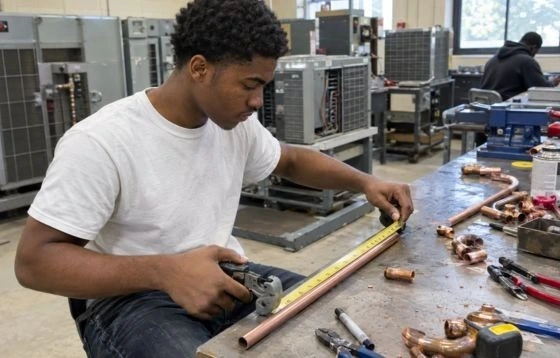
Get your EPA 608 certification first, ideally at the Universal level, because it is legally required to handle refrigerant. From there, add OSHA safety training and refrigerant-specific credentials, then pursue advanced exams like NATE once you have real experience. This order matches how employers actually hire and how skills realistically build.
Here is a practical sequence that works well for technicians starting out in the Philadelphia area.
Following this path matters because it mirrors a real HVAC career ladder, where each credential unlocks the next level of responsibility. Chasing advanced certifications before the basics wastes money; building in order compounds your value.
Safety credentials sit near the top of the list for a reason. OSHA 10 and similar training teach hazard awareness, electrical safety, ladder and fall protection, and proper handling of pressurized systems. Many Philadelphia-area employers and job sites, especially commercial and union environments, expect this training before you set foot on site. Pairing safety certification with your EPA 608 credential makes you a far more hireable entry-level technician.

Pennsylvania does not issue a single statewide HVAC license, but you still need the federal EPA 608 credential to handle refrigerant, and local requirements apply. The City of Philadelphia regulates contractors through registration and permitting, so requirements differ depending on whether you work as an employee technician or run your own business.
This section is for educational purposes and is not legal advice. Always verify current requirements with the City of Philadelphia and the Commonwealth of Pennsylvania before performing or contracting HVAC work.
In practice, this means your first priority is the federal refrigerant certification, followed by whatever local registration applies to your role. Because rules can vary across Pennsylvania, New Jersey, and Delaware, technicians who work across state lines benefit from understanding each jurisdiction’s expectations. A good training program helps you understand this landscape so you are not caught off guard after graduation.
HVAC technicians in Philadelphia earn a median of roughly $62,220 per year as of 2026, noticeably above the Pennsylvania median of about $53,550. Entry-level pay starts lower, often near $39,000 to $42,000, while experienced and licensed technicians can earn $80,000 or more, especially in union, commercial, and healthcare settings.
Certifications directly influence where you land in that range. The more HVAC certifications you hold, the more types of work you can legally and competently perform, which translates into higher earning potential over time. A technician with Universal EPA 608, safety training, and a NATE credential is simply qualified for more, and better-paid, work than someone with a single basic certification.
| Career Stage | Approximate Annual Pay (Philadelphia / PA, 2026) |
| Entry-level / apprentice | $39,000 – $42,000 |
| Experienced technician | $55,000 – $65,000 |
| Licensed / specialized (union, commercial) | $75,000 – $83,000+ |
A few factors push Philadelphia pay above the state average: a strong union presence, steady commercial and healthcare construction, and the region’s older building stock that constantly needs service. For a deeper look at how pay grows with experience, PTTI’s breakdown of HVAC technician salary and career path is a useful reference. Figures vary by employer, specialization, overtime, and location, and no training program can guarantee a specific salary.
The outlook is strong. The U.S. Bureau of Labor Statistics projects employment of HVAC mechanics and installers to grow about 9% over the decade, faster than the average for all occupations. Demand is driven by new construction, the replacement of aging systems, stricter energy-efficiency standards, and the ongoing retirement of experienced technicians.
That demand is especially durable in the Philadelphia region. Older homes and commercial buildings need continual service, hospitals and institutions run complex systems year-round, and newer efficiency rules push owners to upgrade equipment. Importantly, HVAC work is hard to automate: diagnosing and repairing systems in the field requires hands-on judgment that machines cannot replace. If you are weighing whether this is a stable path, PTTI’s honest assessment of whether HVAC is a good career in 2026 is worth reading. For someone entering the trade with the right certifications, the combination of steady demand and automation resistance makes HVAC a dependable choice.
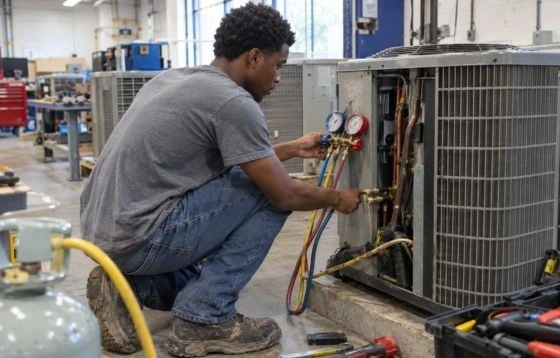
The fastest, most reliable way to earn your first HVAC certifications is through structured, hands-on instruction rather than self-study alone. A quality program teaches refrigeration fundamentals, electrical systems, airflow, system diagnostics, and safe refrigerant handling, which is exactly what the EPA 608 exam and later credentials test.
Good training also mirrors the job site. Working on real equipment in a lab setting builds the muscle memory employers expect on day one, and it directly supports passing certification exams. Programs that help students prepare for multiple industry certifications give graduates a meaningful head start, because stacking credentials is how technicians grow their careers and their pay. Philadelphia Technician Training Institute (PTTI) designs its complete HVAC training courses around these real-world competencies, from refrigeration basics to commercial systems.
For students across North Philadelphia, South Philadelphia, West Philadelphia, and nearby communities like Camden, Cherry Hill, Darby, Drexel Hill, and Lansdowne, local training removes a major barrier to entry. You learn the skills, prepare for the certifications that matter, and step into a regional job market that is actively hiring.
Earning HVAC certifications is far less confusing once you follow the right order. Start with the EPA 608 certification at the Universal level, because federal law requires it and it keeps every type of work open to you. Layer in safety and refrigerant credentials next, then pursue NATE certification as your experience deepens. That sequence builds your skills, your credibility, and your earning potential in the right order, in a Philadelphia job market that consistently needs skilled HVAC technicians.
If you are ready to begin, explore PTTI’s HVAC Certification Program to see how hands-on training can prepare you for the certifications that launch a stable, in-demand career.
Get your EPA 608 credential first, ideally at the Universal level. It is required by federal law to handle refrigerant, so no serious HVAC career can begin without it. After that, add OSHA safety training, refrigerant-specific credentials, and eventually NATE certification as you gain hands-on experience.
Yes. Under Section 608 of the Clean Air Act, any technician who maintains, services, repairs, or disposes of equipment that could release refrigerant must hold EPA 608 certification. It is issued per technician, and it does not currently expire, so it remains valid throughout your career.
Type I covers small appliances, Type II covers medium- to high-pressure systems like residential AC and heat pumps, and Type III covers low-pressure chillers. Universal combines all three, letting you work on virtually any regulated equipment. Most technicians aim for Universal certification for maximum flexibility.
Yes, once you have experience. NATE certification is widely recognized as the HVAC industry’s gold standard and validates advanced diagnostic and installation knowledge. It can strengthen your résumé and earning potential, but it is best pursued after you have mastered the fundamentals and earned your EPA 608 credential.
Focused HVAC training programs can prepare you for entry-level work and key certifications in well under a year, far faster than a traditional degree. Timelines vary by program and schedule, but hands-on training is built to get you job-ready and certification-ready efficiently.