
Skilled trades such as welding, HVAC, and automotive repair are built on something you cannot absorb from a screen alone: the feel of the work in your hands. That reality sits at the center of a question more prospective students ask every year — can you learn a skilled trade online, or do you still have to train in person? The honest answer is that an online trade school can teach a meaningful share of the theory, but on its own it cannot make you job-ready in a field where employers hire people who can perform, not just explain. This guide breaks down which parts of trade training translate well to online learning, which parts demand a physical lab and an instructor at your side, and how hands-on trade training in Philadelphia bridges the gap, before covering how long training takes and what to look for in a program. If you are weighing a faster, debt-light alternative to a four-year degree, understanding this online-versus-in-person distinction is the first real decision you need to get right.
You can learn part of a skilled trade online, but not all of it. Online learning works well for theory, safety rules, codes, and diagrams. It cannot replace the supervised, hands-on practice that trades like welding and HVAC require. To become genuinely job-ready, nearly every skilled trade demands in-person training on real equipment.
Think of any trade as two layers stacked together. The first layer is knowledge: how a system works, why a weld fails, what a wiring diagram means, which safety procedures protect you on a job site. That knowledge transfers reasonably well to a screen. The second layer is physical skill — the muscle memory, the judgment, and the precision that only develop when you repeat a task with your own hands under the eye of an instructor who can correct you in real time. An online trade school can deliver the first layer. It cannot deliver the second, and the second is what employers actually pay for.

A fair amount of the classroom side of skilled trades training fits online delivery. The problem is never the theory — it is everything that comes after the theory.
Online formats handle conceptual learning well. When you first explore what welding is, how an internal combustion engine operates, or how sterilization standards protect patients, that foundational knowledge can be taught through video, reading, and interactive modules. The theory side of a trade school program often includes material such as:
For many students researching whether a trade is right for them, this is the part that feels approachable. You can study it on your own schedule, and a quality program may front-load some of it before you ever step into a lab. If you want a sense of how a structured curriculum sequences this knowledge, PTTI’s welding technology training is a useful example of how theory and practice are layered together rather than taught in isolation.
Here is where online-only training runs out of road. You cannot strike a consistent arc, braze a joint, diagnose a misfire by feel, or pass a weld test by watching a video. These are psychomotor skills, and they only improve through supervised repetition. A trade requires in-person training for everything that involves:
No reputable employer will hire a welder who has never welded or an automotive technician who has never turned a wrench. That is why the most credible path still runs through a physical campus.
Hands-on training is non-negotiable because skilled trades are performance-based. Employers do not ask for a transcript; they ask you to perform a task and then inspect the result. A clean weld, a correct diagnosis, or a properly installed system is the proof, and that proof can only be built through in-person practice.
Consider how hiring actually works in these fields. A welder often has to pass a weld test in front of an inspector. An automotive technician has to demonstrate diagnostic ability on an actual vehicle. A sterile processing technician has to handle instruments and follow decontamination steps precisely, because a mistake has real consequences for patients. None of these moments can be faked with an online certificate. This is also why asking “is welding hard” misses the point — it is not that the work is impossibly difficult, it is that it has to be practiced physically to be learned at all. That hands-on requirement is exactly what makes a program like automotive training and repair effective: students work on genuine systems instead of simulations.
An online trade school can be worth it for the knowledge portion of a trade, or for related roles that are more administrative. For hands-on skilled trades, however, an online-only program rarely delivers job-ready graduates on its own. The best value usually comes from programs that combine online or classroom theory with real, supervised lab work.
It helps to separate two very different things people mean by “online trade school.” Some mean fully online programs that promise to make you a tradesperson from your laptop. Those deserve healthy skepticism in hands-on fields, because they skip the part employers care about most. Others mean programs that use online tools for the theory while still requiring you to show up for labs. That blended approach can genuinely add value, and it reflects how modern skilled trades education is increasingly delivered.
If cost is driving your interest in online options, it is worth looking at total value rather than format alone. Many people ask how much trade school costs and assume online is automatically cheaper, but the better question is which path actually leads to employment. A program that gets you hired is more affordable than a cheaper one that does not, which is why reviewing real financial aid options matters more than chasing the lowest sticker price.
The clearest way to see the trade-off is to compare the two formats across the factors that actually determine whether you get hired.
| Factor | Online-Only Training | In-Person / Hands-On Training |
| Theory & safety knowledge | Strong | Strong |
| Equipment and tool practice | Not possible | Core of the program |
| Instructor feedback on technique | Limited or delayed | Immediate and physical |
| Certification or weld-test readiness | Inadequate alone | Prepared directly |
| Employer credibility | Often questioned | Widely recognized |
| Overall job readiness | Partial | Full |
The pattern is consistent. Online formats match in-person learning on knowledge and fall short everywhere that physical skill is involved. For a hands-on trade, those are precisely the categories that decide your employability, and they are exactly what quality hands-on trade training is built to develop.
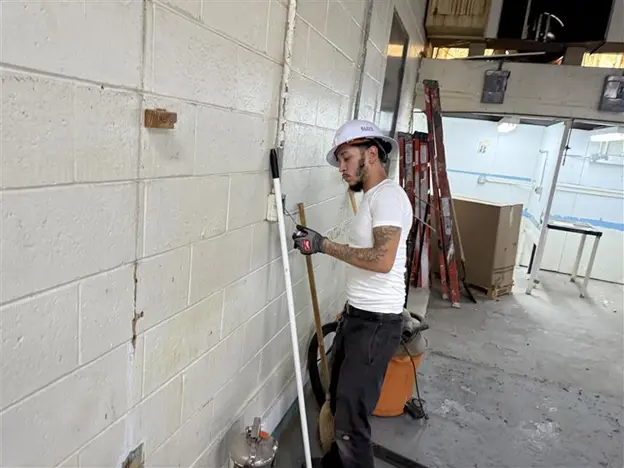
Hybrid programs are where online learning and in-person training stop competing and start complementing each other. In a hybrid model, students absorb theory through flexible formats and then apply it in a supervised lab, which respects both busy schedules and the hard requirement for physical practice.
This structure solves the biggest objection to pure online learning without discarding its advantages. You still get the convenience of studying concepts on your own time, but you also get the lab hours that make you hireable. For fields with strict procedural standards, this matters even more. A sterile processing technician program is a strong example: students need to understand decontamination theory and then prove they can execute it on real instruments, because healthcare employers and patients depend on that precision. The theory alone is not enough, and the practice alone would lack the underlying knowledge — so the two have to be taught together. In practice, that blend is what effective hands-on trade training looks like today, and it is the model most reputable programs now follow.
Most skilled trades programs take from a few months to under a year, which is far shorter than a traditional four-year degree. The exact length depends on the trade, the schedule, and how much lab time the field requires. Because training is focused on employable skills, graduates can often enter the workforce quickly.
This speed is a major reason people choose the trades over college in the first place. When someone asks how long is trade school, they are usually comparing it to the time and debt of a degree, and the contrast is stark. A focused, hands-on program concentrates on what employers test for rather than general-education requirements, so your time goes directly toward becoming job-ready. That is also why short, focused trade school options — and a hands-on trade school in Philadelphia in particular — continue to attract high school graduates, career changers, veterans, and adult learners who want to start earning sooner. For those exploring a route into the workforce without a bachelor’s degree, PTTI outlines how students become skilled technicians without traditional college through concentrated, practical instruction.
Because the hands-on layer of a trade can only be built on-site, the location of your training genuinely matters. For students across the region, a trade school in Philadelphia offers something an online trade school cannot: physical labs, industry-standard equipment, and instructors who correct your technique in person. This is the deciding factor for anyone serious about a hands-on field.
A trade school in Philadelphia also puts you close to the regional job market that will eventually hire you, from the city’s neighborhoods to the surrounding Pennsylvania and South Jersey communities. Welding is one of the clearest examples, since welding training has to happen at a booth with real metal and real heat, not on a screen. This is also where hands-on trade training proves its worth, because the skills you build on local equipment are the ones regional employers recognize.
Pipe and mechanical systems follow the same logic. Learning steam, sprinkler, and pipe fitting means physically cutting, threading, and joining pipe under supervision, which is why PTTI’s steam, sprinkler, and pipe fitting program is lab-based rather than lecture-only.
Manufacturing is evolving fast toward automation, yet it still rewards people who can operate and troubleshoot equipment in the real world. Students interested in becoming a manufacturing automation technician train directly on the systems they will later run, developing skills that pure online study cannot replicate.
The construction trades round out the picture. Concrete, masonry, and framing are inherently physical, and the same is true for drywall and finishing, where technique is learned by doing. Across all of these fields, the common thread is that in-person training is what converts knowledge into a marketable skill.
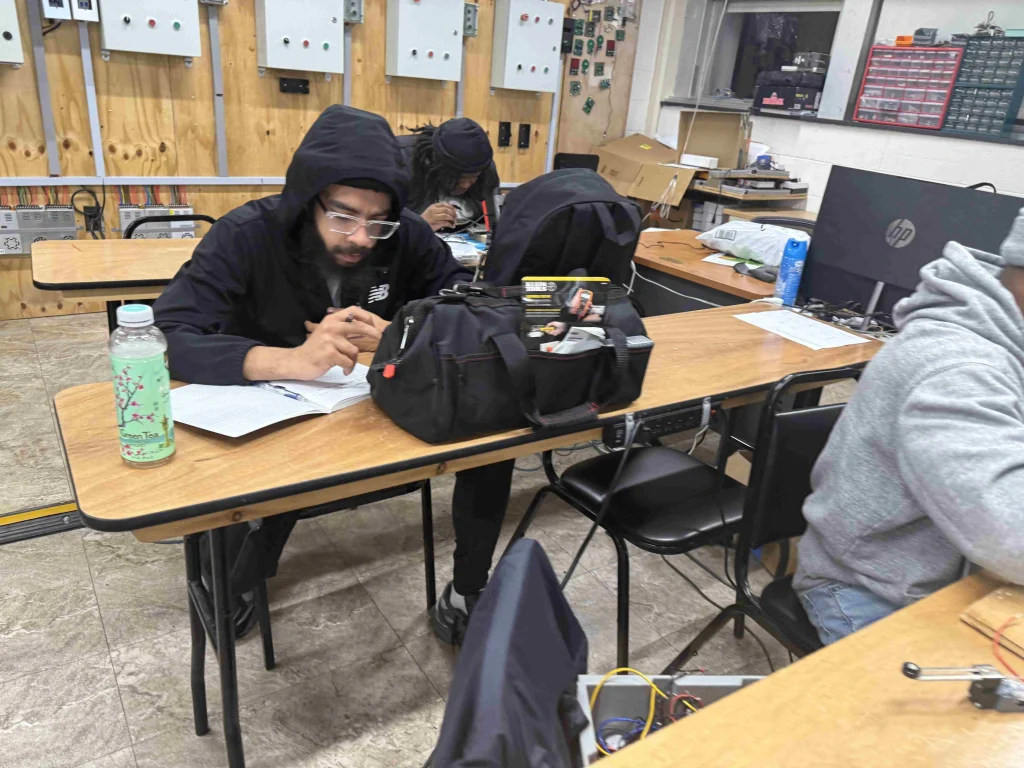
Once you accept that hands-on trade training must happen in person, choosing a program becomes clearer. When you compare any trade school in Philadelphia against another, focus on a few practical questions that reveal whether a program will actually make you employable.
That last point is why so many prospective students start by talking to a school directly. Reviewing a program’s structure and career and job support tells you far more about outcomes than a marketing claim ever will.
So, can you learn a skilled trade online, or do you have to train in person? The realistic answer is both: an online trade school can give you the knowledge foundation, but the hands-on skill that makes you employable has to be built in person, on real equipment, with an instructor who can correct you as you work. For hands-on fields, in-person training is not a formality — it is the entire point. Hybrid programs that pair flexible theory with supervised labs offer the best of both worlds, and a local trade school in Philadelphia puts that practice within reach while keeping you close to the employers who will hire you. If you are ready to turn interest into real, marketable skill, explore PTTI’s hands-on programs and connect with admissions to find the path that fits your goals.
No. You can learn the theory, safety, and concepts of a trade online, but you cannot fully learn a skilled trade online because hands-on skills require supervised, in-person practice on real equipment. Nearly every trade demands physical training to reach the level employers expect.
Not entirely. You can study welding or HVAC theory online, but you cannot become job-ready without in-person labs. Welding requires physical practice at a booth, and HVAC work requires hands-on experience with real systems, both of which an online-only trade school cannot provide.
Some are legitimate for theory or for administrative and support roles, but online-only programs are rarely sufficient for hands-on skilled trades. The most credible option is a program that combines online or classroom theory with required in-person training, so you graduate with demonstrable skill.
Most skilled trades programs take from a few months to under a year, depending on the trade and schedule. That is why many students choose the trades as a fast, focused alternative to a four-year degree when they want to start working sooner.
Yes. Knowing the theory is valuable, but skilled trades are performance-based, so employers hire based on what you can physically do. Hands-on training is what turns your knowledge into an inspectable, marketable skill that passes a weld test, a diagnostic, or a procedural check.