
Few skilled trades offer a climb as clear as heating and cooling. You can start with little or no experience, train on real equipment, earn a paycheck within months, and keep advancing for decades. The HVAC career path runs from apprentice installer to service technician to specialized lead — and for many people, all the way to owning a company. Across Philadelphia and the surrounding region, contractors are short on trained people, which means nearly every rung of that ladder is hiring.
This guide maps the full HVAC career path step by step: what you do at each level, the training and certifications you need, how long each stage takes, and what you can realistically expect to earn in the Philadelphia market in 2026. It is written for high school graduates, career changers, veterans, and adult learners who want a stable trade with real room to grow. Whether your goal is a steady service job or your own business one day, understanding the ladder first — starting with the right hands-on trade training in Philadelphia — helps you plan each move with intention.
The HVAC career ladder is the step-by-step progression from entry-level installer to independent contractor. Most people begin as an HVAC apprentice or installer, advance to service technician after earning EPA 608 certification, then specialize or move into lead, supervisory, and eventually ownership roles as their skills and experience grow.
What makes this trade appealing is how stackable it is. Each rung builds directly on the last, so the ductwork and equipment knowledge you gain as an installer feeds your diagnostic work as a technician, and the field experience you gain as a technician prepares you to estimate jobs, lead crews, and run a business. Unlike careers that require years of schooling before you earn anything, an HVAC career path lets you get paid while you climb.
| Rung | Role | What you focus on |
| 1 | Apprentice / Installer | Assembling ductwork, setting equipment, learning tools and safety |
| 2 | Service Technician | Diagnosing and repairing systems; refrigerant handling |
| 3 | Lead / Specialist | Commercial systems, refrigeration, heat pumps, controls |
| 4 | Service Manager / Estimator | Scheduling, estimating, leading crews, customer accounts |
| 5 | Business Owner / Contractor | Running a company, bidding work, hiring technicians |
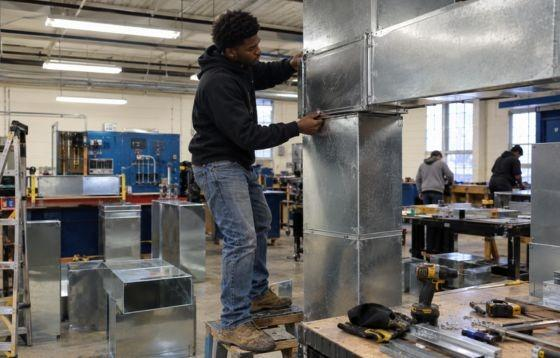
The first rung is where nearly everyone begins. As an HVAC apprentice or entry-level installer, you support experienced technicians: carrying and staging equipment, assembling and hanging ductwork, setting condensers and air handlers, running basic electrical whips, and learning to use hand and power tools safely. It is physical, hands-on work, and it is where the fundamentals become second nature.
Entry requirements are modest. Most employers and training programs look for candidates who are at least 18 with a high school diploma or GED, though a strong work ethic and reliability often matter just as much. This is also the stage where structured HVAC training pays off, because arriving on a job site already knowing how a system works lets you contribute — and earn — faster.
Demand at this level is rising as older heating systems are replaced with high-efficiency equipment. Learning modern skills such as heat pump installation early gives new installers an edge, since electrification is one of the fastest-growing segments of residential and light-commercial work.
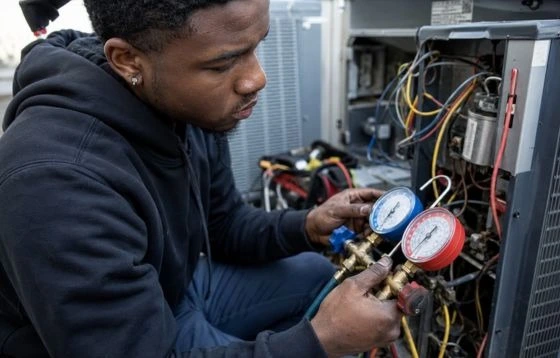
The jump from installer to HVAC service technician is the most important step on the ladder. A service technician does not just build systems — they diagnose why a system failed and fix it. That means reading gauges, testing electrical components, checking refrigerant charge, interpreting error codes, and explaining the problem to a customer. This is the rung where pay climbs meaningfully and where your value to an employer multiplies.
Yes. EPA 608 certification is a federal requirement under Section 608 of the Clean Air Act for anyone who maintains, services, repairs, or disposes of equipment containing refrigerant. Without it, you cannot legally open a refrigerant circuit or even purchase refrigerant, which makes it the single most important credential for an HVAC service technician.
The credential comes in four types — Type I for small appliances, Type II for high-pressure systems, Type III for low-pressure systems, and Universal, which covers all three. Most technicians aim for Universal because it opens the widest range of work, and the credential does not expire once you earn it. Preparing for the exam is a core part of quality EPA 608 certification training, which is why many technicians study through a structured program rather than on their own.
Beyond that federal requirement, employers value credentials that prove hands-on competence. NATE (North American Technician Excellence) certification is widely recognized for service and installation, and OSHA safety training signals you can work responsibly on a job site. Practical skills — electrical troubleshooting, brazing, airflow measurement, and clear customer communication — often separate the technicians who get promoted from those who stall, and well-rounded HVAC training builds all of these together.
Once you are a confident HVAC service technician, specialization is how you raise your ceiling. Residential service is steady work, but commercial and industrial systems — rooftop units, chillers, commercial refrigeration, and building-automation controls — pay more and are harder to automate away. Each specialty deepens your expertise and makes you more valuable to employers who struggle to find people able to handle complex equipment.
Some of these specialties overlap with adjacent trades. Large mechanical systems involve piping, steam, and hydronics, so training in steam, sprinkler, and pipe fitting can broaden the kind of work you take on and the customers you can serve.
Modern systems are also increasingly electronic. Heat pumps, variable-speed equipment, and smart controls reward technicians who understand wiring, sensors, and automation, so building those skills through electrical and automation training positions you for the highest-paying technical roles in the field.
Not every step up means staying in the field full-time. Experienced technicians often move into lead technician, estimator, or service manager roles. A lead runs crews and mentors HVAC apprentices, an estimator prices jobs and bids projects, and a service manager oversees scheduling, quality, and customer accounts. These positions trade some tool time for higher, steadier pay and form a natural bridge toward running your own business.
This is also where soft skills matter most. Communication, teamwork, and the ability to explain technical problems in plain language become as important as diagnostic ability. Employers promote technicians who can be trusted with customers and crews, which is why strong training programs build professionalism alongside technical skill.
The top rung for many is ownership. After years of field and management experience, plenty of technicians launch their own companies — starting with service calls and installations, then hiring their own crews. Ownership rewards the accumulated knowledge of the entire HVAC career path: you already understand the work, the equipment, the pricing, and the customers.
Pennsylvania does not issue a statewide license for technicians or contractors, so there is no single state exam to pass. Running a business, however, is different from doing the work: owners typically need to register the business, carry insurance, meet local permitting rules, and — in Philadelphia and some municipalities — hold a local contractor or trade license. EPA 608 certification still applies to any refrigerant work performed.
Because the rules are set locally rather than statewide, it pays to understand exactly what HVAC licensing in Pennsylvania involves before you hang a shingle. Treat this as an educational overview rather than legal advice, and confirm current requirements with your municipality.
The business side also brings a learning curve of its own — estimating, marketing, hiring, and cash flow. A practical guide to starting your own trade business can help technicians make that transition without costly early mistakes.
Entry-level HVAC training typically takes 6 to 12 months, after which you can start earning as an apprentice or installer. From there, most technicians reach full HVAC service technician status within one to three years, specialize over the next few years, and — if they choose — move into management or ownership after several years of field experience. The pace depends on you, since certifications, specialties, and reliability all speed the climb.
| Stage | Typical timeframe | Milestone |
| Training | 6–12 months | Core skills and EPA 608 preparation |
| Apprentice / Installer | Year 1 | Earning while learning on the job |
| Service Technician | Years 1–3 | Diagnosing and repairing independently |
| Lead / Specialist | Years 3–7 | Commercial, refrigeration, or controls expertise |
| Manager / Owner | Years 5+ | Running crews or your own company |
Technicians in the Philadelphia area generally earn between about $58,000 and $71,000 per year, with entry-level roles starting lower and senior, supervisory, or specialized positions reaching $80,000 or more. Pay rises at each rung of the ladder, and credentials plus overtime can push earnings well above the base.
For reference, the U.S. Bureau of Labor Statistics reported a national median wage of $59,810 for heating, air conditioning, and refrigeration mechanics and installers in May 2024, and Pennsylvania’s median runs slightly higher at roughly $62,400. In a market like Philadelphia, EPA 608 Universal certification is the baseline, while NATE certification and commercial refrigeration expertise command noticeable premiums, and seasonal overtime frequently adds several thousand dollars a year.
| Career stage | Approximate annual range (Philadelphia area) |
| Apprentice / Installer | $42,000 – $52,000 |
| Service Technician | $55,000 – $68,000 |
| Lead / Specialist | $70,000 – $85,000 |
| Service Manager | $80,000 – $95,000+ |
| Business Owner | Varies widely with business success |
Yes — by the numbers, HVAC is one of the more secure skilled trades. The U.S. Bureau of Labor Statistics projects employment of these technicians to grow 8 percent from 2024 to 2034, much faster than the average for all occupations, with about 40,100 openings each year over the decade. Much of that demand comes from replacing retiring workers and from the steady need to install and service climate-control systems.
The Philadelphia region reinforces that demand. A large healthcare and life-sciences sector needs precise environmental controls, an aging building stock requires constant retrofits and repairs, and the shift toward electrification and heat pumps is creating new work every year. For a closer look at the numbers, the HVAC technician employment outlook shows why the trade remains dependable across the tri-state area.
Ties the salary and outlook discussion to the aspirational ownership rung.
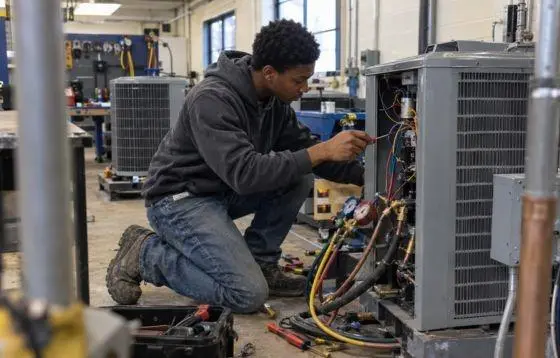
An HVAC career path is not tied to one neighborhood or employer. Graduates find work throughout Philadelphia — from South and North Philadelphia to West Philadelphia, Mantua, Powelton Village, and the Spring Garden corridor — as well as across the surrounding suburbs and South Jersey.
Opportunities extend into nearby Pennsylvania communities such as Yeadon, Lansdowne, Darby, Drexel Hill, and Ardmore, and across the river into Camden, Pennsauken, Collingswood, Cherry Hill, Maple Shade, and Cinnaminson. Because that certification is federal and portable, a technician trained in Philadelphia can carry that credential wherever the best work is.
The HVAC career path is one of the clearest ladders in the skilled trades: start as an apprentice, become an HVAC service technician, specialize, lead, and — if you choose — own a business. Each rung builds on the last, you earn while you learn, and demand across the Philadelphia region is strong heading into 2026. With the right training and certifications, the climb from beginner to independent professional is well within reach.
If you are ready to take the first step, explore PTTI’s hands-on programs to see how training can prepare you for the field, or contact admissions to ask questions and plan your start.
Begin with hands-on HVAC training, then enter the field as an HVAC apprentice or installer. You do not need prior experience — most people start by learning core skills and EPA 608 preparation in a short program, then build from there. Reliability and a willingness to learn matter as much as any prior background.
Pennsylvania has no statewide HVAC license, but EPA 608 certification is a federal requirement for anyone handling refrigerant. Some municipalities, including Philadelphia, require local contractor or trade licensing for business owners. Always verify current local rules before taking on work independently.
Technicians in Philadelphia typically earn about $58,000 to $71,000 per year, with specialized and supervisory roles reaching $80,000 or more. Certifications, overtime, and commercial expertise raise earnings. Figures vary by employer and experience and are not guaranteed.
Most entry-level HVAC training programs take 6 to 12 months. After that, you can start earning as an HVAC apprentice while continuing to build skills. Reaching full HVAC service technician status usually takes one to three years of field experience on top of your initial training.
Yes. Many technicians move from service work into lead, estimating, or management roles, then start their own companies. Ownership builds on the skills earned across the HVAC career path, though it also requires business knowledge, licensing where required, and insurance.