
For many people in the Philadelphia area, trade school pays off faster than college in 2026. A focused trade program costs a fraction of a four-year degree, takes months instead of years, and lets graduates start earning while their college peers are still paying tuition. College can still win over a full lifetime in certain fields, but on speed-to-income and early return, the trades have the clear edge.
That single comparison drives one of the most important decisions a young person, career changer, or veteran in Philadelphia will make. The fear behind it is real and reasonable: spending four years and tens of thousands of dollars on a degree, then graduating into a job market that doesn’t guarantee work in your field. This guide breaks down the trade school vs college Philadelphia question the way a workforce professional actually evaluates it, using current 2026 cost, debt, salary, and demand data, with Philadelphia and the surrounding region in focus throughout. If you have ever asked whether trade school is worth it compared to a degree, the answer is best reached through numbers, not assumptions.
Cost gap is wide: A four-year public degree now runs roughly $108,000+ in total cost of attendance, while trade programs typically cost a small fraction of that.
If you want the quickest route to a stable income with the least debt, a trade school in Philadelphia usually pays off faster than a four-year college. That is the short answer to the trade school vs college Philadelphia question: you finish sooner, spend far less, and enter a workforce that is actively short on skilled labor. College tends to pay off over a longer horizon, and only in fields where the degree is genuinely required.
This is not a case against higher education. Doctors, engineers, and attorneys need degrees, and some graduates do very well. The point is to look at the actual numbers and timelines instead of inherited assumptions, because the math has shifted meaningfully in the last decade.
“Paying off faster” is really three questions rolled into one:
When all three line up in your favor, you reach financial independence years earlier. That early head start, invested or saved, compounds over a working life.
The stakes are higher now because college costs keep climbing while skilled-trade wages keep rising. Total U.S. student loan debt has passed $1.8 trillion, and the “a degree guarantees a good job” promise has weakened, with a large share of graduates working in roles that never required a degree. That shift is exactly why so many families now ask whether trade school is worth it instead of assuming a four-year degree is the default. At the same time, Pennsylvania and the wider Philadelphia region face persistent skilled-labor shortages that keep trade jobs in demand, which is part of why enrolling in a trade school in Pennsylvania has become a credible route to high paying jobs without a degree. For anyone weighing trade school vs traditional college, the risk profile of each path has changed.

The cost difference is the most concrete part of the trade school vs college Philadelphia comparison. A four-year degree carries tuition, fees, housing, and years of living expenses; a trade program is shorter, narrower, and far cheaper to complete. Understanding the real trade school cost Philadelphia students face, set against four-year tuition, is where this decision usually becomes clear. The lower the trade school cost, Philadelphia applicants find, the faster the path to well-paid skilled trades careers Philadelphia keeps creating.
The total cost of attendance at an in-state public university now averages around $27,000 per year once tuition, fees, room, and board are included, which works out to roughly $108,000 over four years. Private nonprofit colleges average far more, with sticker tuition alone near $45,000 a year. Most students do not pay full sticker price after aid, but the gap between trade and degree costs remains large.
The published price is only part of the story. Only about 40% of bachelor’s students finish in four years, and closer to 60% take six. Every extra semester adds tuition and pushes back the first full-time paycheck. That delay, often overlooked, is one of the biggest hidden costs of the college path.
Trade and technician programs generally cost a fraction of a degree, with national figures commonly ranging from a few thousand dollars up to the low tens of thousands depending on the field and equipment involved. The trade school cost Philadelphia residents actually pay depends on the program and available aid, but it stays far below four-year tuition in nearly every case. Because programs are short, total spending stays low and break-even comes quickly. To pin down your own trade school cost, Philadelphia applicants can use PTTI’s financial aid team and net price calculator for a clear, personalized number rather than a guess.
Trade school is not automatically out of pocket. Many programs qualify for federal financial aid, and veterans may be able to use education benefits through veterans programs. Because trades often lead into apprenticeships and quick employment, many students begin earning soon after, sometimes alongside training. Aid is one more reason the trade school cost Philadelphia families budget for is so much easier to absorb than four years of degree expenses, and a big part of why so many decide trade school is worth it.
| Cost Factor | Four-Year College | Trade / Technician Program |
| Typical total cost | ~$108,000+ (public, in-state) | A fraction of a degree |
| Time to complete | 4–6 years | Months to ~2 years |
| Typical debt at finish | ~$29,000–$38,000 average | Often low or none |
| Years before earning | 4+ | Under 1 (many programs) |
| Financial aid available | Yes | Yes |
Speed is where the trades separate from college most clearly. The trade school vs college salary debate often ignores the simplest advantage of all: trade graduates start collecting paychecks years earlier.
While a college student is in year one, a trade graduate can already be working and building experience. By the time the degree is finished, the tradesperson may have several years of income, on-the-job skill, and zero or minimal debt. That head start is the engine behind faster payoff.
Opportunity cost is the income you give up while studying. Four years out of the full-time workforce can mean well over $100,000 in earnings a college student never made, on top of tuition spent. Add those two figures together and the early-career gap between the paths can be substantial, which is exactly the dynamic explored in PTTI’s look at how trade school helps you start earning faster than a four-year degree.
Most trade and technician programs can be completed in months to roughly two years, far shorter than a bachelor’s degree. Because the training is performance-based and focused, you spend your time building employable skills, not satisfying general-education requirements. Several PTTI programs are structured for fast, job-focused completion.
Not necessarily. The idea that every college graduate out-earns every tradesperson is one of the most persistent myths in this debate. When you look closely at the trade school vs college salary picture, many skilled trades in the Philadelphia region pay competitively, and certified specialists frequently match or beat common degree-track starting salaries.
Skilled trades nationally cluster in the $55,000–$75,000 median range, with a mean across trade occupations near $68,000. In the Philadelphia market, union density, infrastructure work, and manufacturing push many roles toward the upper end. Welders, pipefitters, automotive technicians, and manufacturing-automation technicians all offer solid, growing pay, and the specialized end of each field climbs higher with experience and certification. These are genuinely high-paying jobs without a degree, and they make the trade school vs college salary gap far smaller than most people assume. You can explore the range of skilled trades careers Philadelphia offers in PTTI’s overview of Philadelphia trade jobs that pay high salaries without a degree.
Lifetime earnings averages for degree-holders are pulled up by high-paying majors like engineering and computer science. Many common majors produce starting salaries in the $45,000–$55,000 range, and roughly 40% of graduates work in jobs that don’t require a degree at all. When you subtract debt payments and four years of lost income, the early-career trade school ROI often beats a degree, which is why a skilled trades career increasingly competes with white-collar paths. The strongest trade school ROI shows up in skilled trades careers Philadelphia employers struggle to fill, where demand outpaces supply. PTTI breaks down the full comparison in its analysis of trade school ROI versus a bachelor’s degree, and the takeaway is consistent: high paying jobs without a degree are real, local, and growing.
| Path | Typical Early-Career Salary | Debt Burden | Years to Break Even |
| Skilled trade (Philadelphia region) | $50,000–$75,000 | Low / none | Short |
| Common degree major | $45,000–$55,000 | ~$29,000–$38,000 | Longer |
| High-demand specialized trade | $70,000+ | Low / none | Shortest |
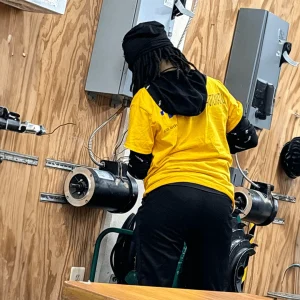
Pay only matters if the jobs are there, and in the Philadelphia area they are. Skilled trades face structural demand: experienced workers are retiring, infrastructure needs constant maintenance, and much of the work simply cannot be sent overseas or handed to software.
Hands-on trades resist automation because they require physical presence, manual judgment, and on-site problem solving. A leaking pipe, a misaligned weld, or a vehicle diagnostic cannot be fixed by an app. This is a major reason skilled trades remain a smart career choice in 2026 even as AI reshapes office work.
The Philadelphia region supports a broad mix of employers across fabrication, shipbuilding and ship repair, commercial and healthcare construction, manufacturing, and mechanical contracting. Demand stretches well beyond the city into nearby Pennsylvania communities like Yeadon, Lansdowne, Darby, Drexel Hill, and Ardmore, and across the river into South Jersey towns including Camden, Pennsauken, Collingswood, Cherry Hill, and Maple Shade. This regional reach is why choosing a trade school in Pennsylvania, specifically one based in Philadelphia, opens doors well past the city limits. Because trade credentials are portable, training centrally in Philadelphia positions graduates to take work in whichever direction the strongest opportunity appears, including Delaware. The breadth of skilled trades careers Philadelphia and its suburbs generate is exactly what makes the region a strong place to train, and PTTI’s career and job opportunities resources connect students to that market.
The deeper difference between the paths is not just cost or time; it is how you learn. Trade training is built around doing the work, which is exactly what employers hire for.
A traditional college experience leans on lectures, readings, and exams. A trade program puts you in a lab with the tools, materials, and equipment of the job. This is the core of hands-on trade training Philadelphia employers expect, and it is what separates the best trade schools in Philadelphia from generic classroom programs. At PTTI, students train in applied environments on industry-standard gear across welding, automotive repair, manufacturing and automation, and steam, sprinkler, and pipe fitting. Doing the work is the curriculum.
Employers care about verified skills. Trade programs prepare you for the certifications and weld tests, safety credentials, and licensing pathways that prove competency on day one. Beyond technical ability, strong programs build the job-site behaviors hiring managers consistently ask for: safety discipline, blueprint and diagram reading, measurement accuracy, troubleshooting, communication, and reliability.
Online courses and self-teaching can introduce concepts, but they cannot replicate supervised hours on real equipment. You cannot learn to lay a sound weld, diagnose a vehicle, or fit pipe from video alone. In-person, hands-on trade training Philadelphia students get from experienced instructors is what converts knowledge into the muscle memory and confidence employers expect, and it is the gap that generic or online-only programs leave open. For anyone still asking whether trade school is worth it over a cheaper online course, this is the deciding factor: verified, supervised skill is what gets hired.
| Learning Path | Hands-On Practice | Employer Recognition | Speed to Job-Ready |
| Hands-on trade school | High | Strong | Fast |
| Traditional college | Low (most majors) | Varies by field | Slow |
| Online-only training | Minimal | Weak for trades | Incomplete |
| Self-taught | Unstructured | Hard to verify | Unpredictable |
There is no universal winner; there is a right fit for your goals. The honest answer to “is trade school worth it” depends on what you want your next few years to look like. For hands-on, high-demand work, is trade school worth it usually comes down to one thing: whether you would rather be earning than studying.
A four-year degree is the right call when your target career legally or practically requires it, such as medicine, law, engineering, or academic research. If you want a broad academic foundation, plan to pursue an advanced degree, or are drawn to a field where the credential is the entry ticket, college is worth the time and cost.
Trade school is often the smarter financial bet if you want to start earning quickly, prefer building things over sitting in lectures, want to minimize or avoid debt, and value skills that lead directly to employment in high-demand fields. For many high school graduates, career changers, veterans, and adult learners across Philadelphia, that description fits, which is why so many are choosing skilled trades over college debt.
Use this quick checklist. If most of these sound like you, a trade program likely pays off faster:

For students who land on the trade side of the trade school vs college Philadelphia question, the next step is choosing the right program. Philadelphia Technician Training Institute delivers hands-on trade training Philadelphia students can use to reach high paying jobs without a degree, with programs across welding technology, manufacturing and automation, automotive repair, steam, sprinkler and pipe fitting, concreting, masonry and framing, drywall framing and finishing, and central processing and sterile services.
What ties them together is the model: real labs, industry-standard equipment, certification preparation, and job placement support aimed squarely at the regional workforce. That combination is what families look for when they compare the best trade schools in Philadelphia, because hands-on quality and employer alignment matter more than any brochure claim. If you are not sure which trade fits your goals, the Program Matchmaker Quiz is the fastest way to narrow it down, and you can always schedule a campus tour to see the training environment in person before deciding.
In the 2026 trade school vs college Philadelphia comparison, the trades win on the metrics that matter most early in a career: lower cost, less debt, and a far faster path to a paycheck. College still has its place for degree-required professions, but for hands-on, high-demand work, a focused trade program is usually the quicker financial payoff, especially in a region with steady skilled-labor demand. If you have weighed trade school vs college Philadelphia options and still wonder whether trade school is worth it, the data points the same way: faster earning, less debt, and durable demand.
The most useful move is not picking a side in the debate; it is matching your goals to a specific path. Among the best trade schools in Philadelphia, PTTI is built to turn the trade school vs college Philadelphia decision into a clear next step toward high paying jobs without a degree. If the trades sound right, take the Program Matchmaker Quiz to find your best-fit program, explore PTTI’s programs, or contact admissions to map out your timeline and start earning sooner.
For most people, trade school pays off faster. You finish in months instead of years, spend far less, and start earning sooner, often with little or no debt. College can pay off over a longer horizon, mainly in fields where the degree is required.
Trade and technician programs typically cost a fraction of a four-year degree. A public in-state degree averages around $108,000 in total cost of attendance over four years, while trade programs are far cheaper and much shorter, keeping total spending and debt low.
Yes, for hands-on, high-demand careers. Skilled trades resist automation, face ongoing labor shortages, and pay competitively in the Philadelphia region. With lower cost and faster entry, the early-career return on investment often beats common degree paths.
Not necessarily. Many trades pay $50,000–$75,000 in the Philadelphia area, and specialized, certified workers earn more. College earnings averages are inflated by a few high-paying majors, while many degrees produce starting pay in the $45,000–$55,000 range.
Trade programs generally take months to about two years, while a bachelor’s degree takes four years and often longer. Only about 40% of college students finish in four years, which adds cost and delays earning.
No. Most skilled trades require a high school diploma or GED plus hands-on training and certification, not a degree. Employers hire on demonstrated skill and verified credentials, which a focused trade program is built to provide.
Yes. Many programs qualify for federal financial aid, and veterans may use education benefits. PTTI’s financial aid team and net price calculator can give you a clear, personalized cost before you enroll, so the trade school cost Philadelphia students plan for has no surprises. For a trade school in Pennsylvania, aid options like these keep the path affordable.
Compare hands-on lab time, industry-standard equipment, certification preparation, and job placement support. The best trade schools in Philadelphia align training to real employer needs, so look for applied learning over lecture-heavy formats and ask about graduate outcomes.
For most students, yes. A trade school in Pennsylvania, especially one based in Philadelphia, trains you for the local market, builds relationships with regional employers, and keeps costs lower. Portable certifications still let you work across PA, NJ, and DE.
Often, yes. Is trade school worth it for someone with some college credit? If you want to stop accumulating debt and start earning sooner, switching to hands-on training can pay off quickly. Many career changers and former college students decide trade school is worth it for exactly that reason.
The trade school ROI is usually stronger early in a career because you spend less and earn sooner. Lower cost plus a faster start means the trade school ROI often beats a degree for the first decade, particularly in high-demand fields.
The trade school vs college salary gap is smaller than most expect. Many trades pay $50,000–$75,000 locally, rivaling common degree majors. Once you factor in debt and lost income, the trade school vs college salary comparison often favors the trades early on.
PTTI provides hands-on trade training Philadelphia students can use to enter the workforce quickly, with real labs and industry-standard equipment. This kind of hands-on trade training Philadelphia employers value is what turns instruction into hireable skill. These are real high paying jobs without a degree.
Read More