
Heating and cooling never stops being essential, which is why HVAC remains one of the most stable skilled trades you can enter without a four-year degree. But once you decide to work in heating, ventilation, and air conditioning, a bigger question appears: should you focus on homes or on large buildings? Understanding residential vs commercial HVAC early helps you aim your training, your first job search, and your long-term earning plan in the right direction. For anyone exploring a skilled trades career in 2026, this is one of the most practical decisions to get right from the start. In the Philadelphia region, both paths are hiring, both pay competitively, and both reward hands-on skill over classroom theory. This guide breaks down what each path involves, how the systems and work environments differ, what the pay looks like, which certifications you need in Pennsylvania, and how to decide which HVAC career fits your goals. By the end, you will know exactly how to take the next step.
The core difference is scale and complexity. Residential HVAC work involves heating and cooling systems in homes, which are smaller and more standardized. Commercial HVAC work involves large systems in offices, schools, hospitals, and retail buildings, which are bigger, more complex, and often rooftop-mounted. The trade is the same; the equipment, schedule, and pay differ.
Both paths share the same foundation. You still diagnose problems, read gauges, handle refrigerant, repair electrical components, and keep systems running efficiently. What changes is the environment and the depth of technical knowledge required. A residential HVAC technician spends the day moving between homes, interacting directly with homeowners, and solving familiar problems on split systems and furnaces. A commercial HVAC technician works on larger equipment, frequently as part of a crew, and often needs a deeper understanding of controls and building automation.
The table below summarizes the main contrasts in the residential vs commercial HVAC decision.
| Factor | Residential HVAC | Commercial HVAC |
| Where you work | Houses, apartments, condos | Offices, factories, hospitals, schools, retail |
| Typical systems | Split systems, furnaces, heat pumps | Rooftop units, chillers, boilers, VRF, cooling towers |
| System complexity | Lower, more standardized | Higher, more specialized |
| Customer interaction | High, direct with homeowners | Lower, often with facility managers |
| Schedule | Seasonal peaks, frequent on-call | Steadier, more Monday–Friday with on-call rotation |
| Work conditions | Indoors, attics, basements | Rooftops, heights, exposure to weather |
| Pay | Competitive | Typically higher |
| Path to ownership | Clearer, faster | Possible but capital-intensive |
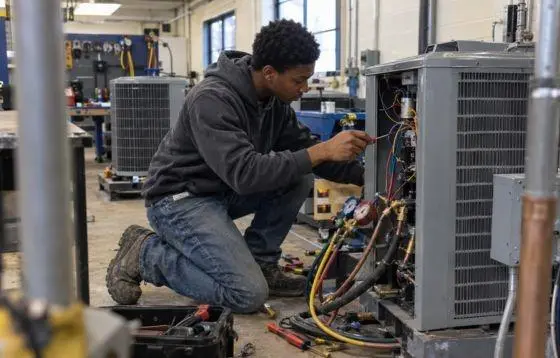
A residential HVAC technician installs, maintains, and repairs heating and cooling systems in homes. Typical work includes servicing central air conditioners, furnaces, and heat pumps, replacing worn parts, charging refrigerant, and explaining repairs to homeowners. The role blends technical skill with strong customer service.
Most residential systems are split systems: an outdoor condenser paired with an indoor furnace or air handler. Because these systems are relatively standardized, a residential HVAC technician can build speed and confidence quickly. The growth of electric heating has also made heat pumps a major part of the job, and technicians who understand them are increasingly valuable. If that area interests you, PTTI’s overview of heat pump installation training explains why these skills are in rising demand.
The residential side rewards people who enjoy variety and direct interaction. You meet new customers daily, solve a wide range of problems, and often see a job through from diagnosis to completion the same day. The trade-off is seasonality. Summer heat and winter cold create demand spikes, which can mean long hours and on-call shifts during peak months. For many technicians, that intensity also means strong overtime pay.
Residential work also offers one clear long-term advantage: it tends to provide the most direct path to owning your own business. Many independent HVAC contractors started on the residential side, built a customer base, and eventually launched their own companies.
A commercial HVAC technician installs, services, and troubleshoots large heating and cooling systems in non-residential buildings. The work covers rooftop units, chillers, boilers, cooling towers, and variable refrigerant flow (VRF) systems, along with the building automation controls that manage them. These systems serve hundreds of people at once, so precision matters.
Commercial equipment is physically larger and technically deeper than residential equipment. A commercial HVAC technician often needs to understand higher-voltage electrical systems, complex refrigeration, and digital control platforms. Because of that complexity, commercial technicians frequently work in teams and specialize over time in areas like controls, refrigeration, or chiller systems. This mechanical and systems knowledge overlaps with other building trades, which is why some workers cross-train in areas covered by PTTI’s Steam, Sprinkler & Pipe Fitting program to broaden their options.
The schedule is one of the biggest draws of commercial work. While emergencies still happen, much commercial HVAC work is contract-driven and planned, which often means a more consistent Monday-to-Friday daytime schedule with an on-call rotation for urgent calls. That steadiness appeals to technicians who want predictable hours.
The main trade-offs are physical. Commercial units are usually installed on rooftops, so you will work at heights and in the elements. The work can be more demanding on the body, but it also builds the specialized expertise that commands higher pay over a long HVAC career.
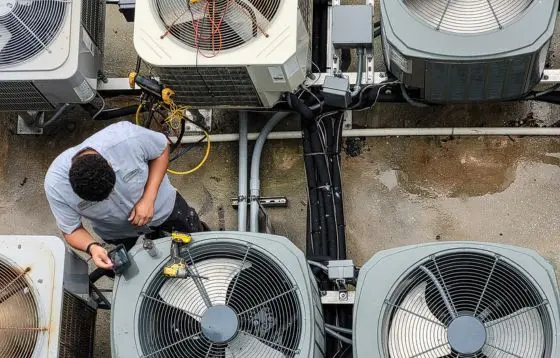
Commercial HVAC usually pays more. When you compare HVAC technician salary across both paths, a commercial HVAC technician commonly earns $10,000 to $20,000 more per year than a residential counterpart, largely because commercial systems are larger, more complex, and require specialized knowledge. That said, top residential technicians who master sales or own their businesses can close much of the gap.
To put real numbers to it, the U.S. Bureau of Labor Statistics reports a national median wage of about $61,010 per year for heating, air conditioning, and refrigeration mechanics and installers as of May 2025. Pennsylvania sits above that figure, with a statewide median near $62,400. In the Philadelphia market, HVAC technician salary commonly ranges from roughly $55,000 to $75,000, with experienced, commercial, and union technicians reaching higher. You can see a fuller local breakdown in PTTI’s HVAC salary guide for the Philadelphia area.
Here is how earnings typically progress in the region. These are estimates that vary by employer, experience, specialization, certifications, and overtime, and they are not guarantees.
| Stage | Residential HVAC (approx.) | Commercial HVAC (approx.) |
| Entry level | $45,000 – $52,000 | $48,000 – $58,000 |
| Experienced | $55,000 – $68,000 | $62,000 – $80,000 |
| Senior / specialist | $68,000 – $85,000 | $80,000 – $95,000+ |
Several factors push an HVAC technician salary higher on either path: specialized certifications, refrigeration and controls expertise, union membership, overtime, and a willingness to take on-call work. For commercial specialists, union technicians, and business owners, six figures is achievable over time. The key point in the residential vs commercial HVAC pay comparison is that commercial offers a higher ceiling for complex technical work, while residential offers faster entry and a clearer route to self-employment. In both cases, the biggest lever on your HVAC technician salary is skill: the more systems you can confidently diagnose and repair, the more you earn.
HVAC demand is strong and durable. According to the U.S. Bureau of Labor Statistics, employment of heating, air conditioning, and refrigeration mechanics and installers is projected to grow much faster than the average for all occupations, with roughly 40,000 openings nationwide each year over the decade. Many of those openings exist to replace a large wave of retiring technicians.
That retirement gap is central to why this is a smart moment to start an HVAC career. A significant share of the current workforce is nearing retirement, which creates steady, structural demand for trained replacements. Both residential and commercial employers feel this shortage, so skilled new technicians have real leverage in the job market. For a wider view of local momentum, PTTI’s look at HVAC technician employment and outlook adds helpful context.
The Philadelphia region reinforces the national trend. The area’s mix of older housing stock, dense commercial real estate, hospitals, universities, and ongoing construction keeps both a residential HVAC technician and a commercial HVAC technician busy year-round. Demand extends well beyond the city into surrounding Pennsylvania communities and across the river into South Jersey, from Camden and Cherry Hill to Drexel Hill, Lansdowne, and Darby. Because skills transfer across the region, training centrally in Philadelphia positions you for work in whichever direction the best opportunity appears.
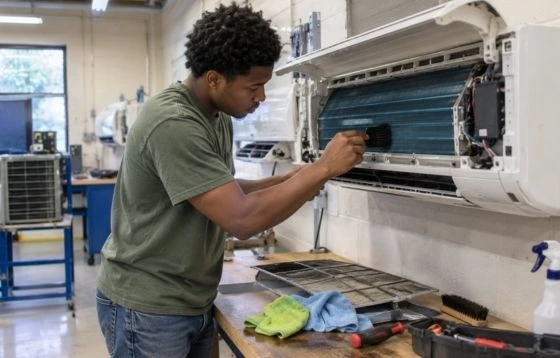
The single most important credential is EPA Section 608 certification. Under the federal Clean Air Act, anyone who maintains, services, or repairs equipment that could release refrigerant must hold it. This applies equally to residential and commercial HVAC work, and once earned, the certification does not expire.
Pennsylvania does not issue a statewide HVAC license, which surprises many people. Instead, requirements are set federally through EPA Section 608 and locally by municipalities. In Philadelphia, the Department of Licenses and Inspections (L&I) governs permits and certain trade registrations, such as sheet metal registration, for specific types of work. For an employed technician, the practical requirement is EPA 608 plus any city registration tied to the job. This overview is educational and not legal advice, so verify current rules with the EPA and the City of Philadelphia before you begin working. PTTI’s explainer on HVAC licensing in Philadelphia walks through these details.
Because no state license gates the field, employers hire on demonstrated skill and recognized certifications. Beyond EPA 608, these credentials strengthen your résumé and pay:
A strong training program prepares you to earn these credentials, which is exactly what employers look for. Programs that help students pass multiple industry certifications and build a safety-first mindset give graduates a real hiring edge on both the residential and commercial sides.
Choose residential HVAC if you value variety, enjoy working directly with people, and want the clearest path toward eventually owning a business. Choose commercial HVAC if you prefer complex systems, team-based work, steadier scheduling, and a higher long-term pay ceiling. Neither choice locks you in permanently.
To make the decision concrete, weigh these questions:
Here is the reassuring part: you are not choosing forever. Many technicians begin on the residential side to build fundamentals, then cross-train into commercial systems to raise their income. The reverse happens too. Because the core skills transfer, your first job is a starting point, not a life sentence. What matters most in the residential vs commercial HVAC decision is getting solid, hands-on HVAC training and your EPA 608 certification so you can step onto either path with confidence. Good HVAC training builds the versatile skill set that lets you move freely between both sides of the trade.
The fastest route is hands-on HVAC training followed by EPA Section 608 certification. Because Pennsylvania has no statewide license, you do not need years of schooling to begin. A focused HVAC training program can prepare you for entry-level residential or commercial work in well under a year, which makes the trade a realistic option for adults retraining for a new career.
Here is the typical path from beginner to hired:
For learners weighing their options, PTTI’s guide on how to start trade jobs in Philadelphia with no experience is a useful starting point. HVAC also stands out among the high-paying jobs you can reach without a four-year degree, which is a major reason so many career changers and recent graduates choose it. The goal is simple: build real skill, earn the certifications employers require, and launch an HVAC career you can grow for decades.
Residential HVAC technicians install, maintain, and repair heating and cooling systems in homes and apartments. Commercial HVAC technicians work on larger systems in offices, hospitals, schools, factories, and other commercial buildings.
Commercial HVAC technicians often earn more because they work with complex systems and specialized equipment. However, salaries depend on experience, certifications, location, and employer.
Residential HVAC can be a good starting point for beginners because it helps them develop fundamental troubleshooting, installation, and customer service skills. Commercial HVAC is also an option for beginners who receive proper technical training and mentorship.
Commercial HVAC can involve more complex systems, advanced controls, larger equipment, and specialized troubleshooting. Residential HVAC focuses more on household heating and cooling systems. Both paths require technical knowledge, safety awareness, and practical problem-solving skills.
Aspiring HVAC technicians typically complete a technical training program or apprenticeship to learn installation, maintenance, electrical fundamentals, refrigeration, and troubleshooting. In the United States, technicians who handle regulated refrigerants generally need EPA Section 608 certification.
Yes. Residential technicians can transition into commercial HVAC by gaining experience with larger systems, building automation, commercial refrigeration, and advanced electrical controls. Additional training and relevant certifications can help make the transition easier.
Both career paths offer opportunities for advancement. Residential technicians can become senior technicians, service managers, or business owners. Commercial technicians can specialize in building automation, industrial HVAC, system commissioning, or facilities management.
Choose residential HVAC if you prefer working in homes, solving everyday heating and cooling problems, and interacting directly with homeowners. Consider commercial HVAC if you enjoy complex equipment, larger projects, advanced controls, and troubleshooting building-wide systems. Hands-on HVAC training can help you explore both options before choosing a specialty.
HVAC Training form basic to advanced level
HVAC Technician at 30
Honest Pros and cons of becoming HVAC Technician